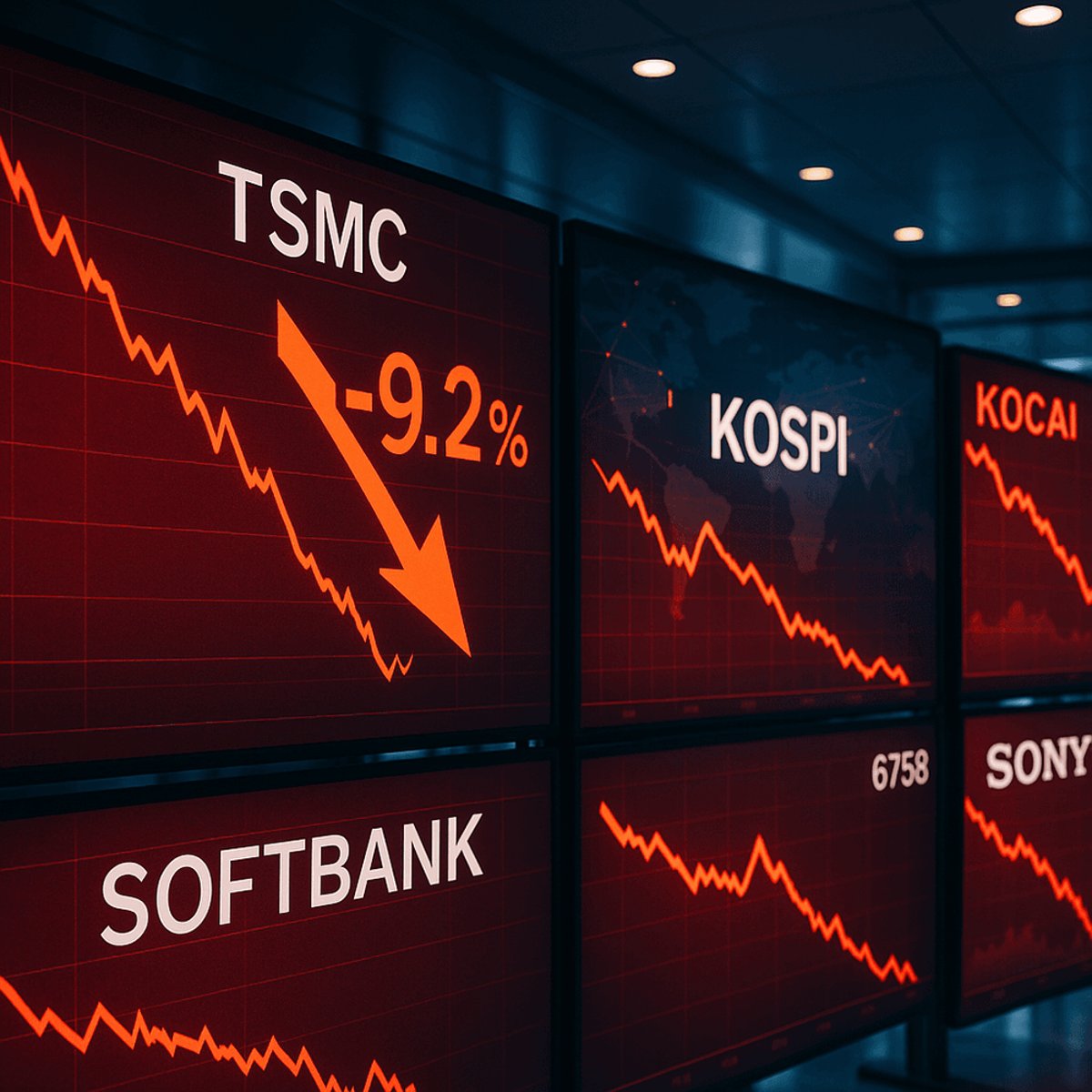
SoftBank Group shares crashed 9.2% Wednesday morning, leading a brutal selloff across Asian tech markets as investors fled semiconductor and AI stocks following overnight losses in US peers. The rout signals growing concerns about government intervention in the chip sector and AI valuations.
The tech investment giant that helped birth the modern startup ecosystem is getting pummeled by the very forces it helped unleash. SoftBank Group shares opened down 9.2% in Tokyo Wednesday, extending Tuesday's decline despite CEO Masayoshi Son's surprise announcement of a $2 billion investment in Intel. The move, designed to signal confidence in the struggling chipmaker, instead highlighted how even SoftBank's massive war chest can't stem the tide when global sentiment turns.
The selloff ricocheted across Asia's tech corridors like a digital wildfire. Japanese semiconductor stalwart Advantest tumbled 6.27%, while Renesas Electronics and Tokyo Electron shed 2.46% and 0.75% respectively. The synchronized decline underscores how deeply integrated the global chip supply chain has become – and how vulnerable it remains to policy shocks.
The catalyst came from an unexpected source: Commerce Secretary Howard Lutnick's consideration of taking federal equity stakes in companies receiving CHIPS Act funding, according to Reuters sources. The proposal sent shockwaves through an industry already grappling with export controls, tariff threats, and the growing weaponization of semiconductor technology. For investors who've poured billions into the AI boom, the specter of government ownership represents a fundamental shift in how the sector operates.
Taiwan Semiconductor Manufacturing Company, the world's most advanced chipmaker and Nvidia's key manufacturing partner, fell 1.69% as investors weighed the implications. The company's Phoenix fabs, funded partly through CHIPS Act money, could potentially face government oversight under Lutnick's proposal. Meanwhile, Foxconn, which has pivoted aggressively into AI manufacturing through its Nvidia partnership, dropped 2.16%.
South Korea's tech giants felt the heat differently. Memory leader SK Hynix, riding high on AI chip demand, tumbled 3.33% as investors questioned whether the AI infrastructure buildout can sustain current valuations. Samsung Electronics, however, managed a 0.75% gain, benefiting from its more diversified portfolio beyond pure-play AI exposure.
The contagion spread to Hong Kong's tech heartland, where the Hang Seng Tech Index shed 0.87% in early trading. Short video platform Kuaishou Technology led declines with a 4.8% drop, while JD Health International and Horizon Robotics fell 3.31% and 2.29% respectively. Even established giants like Alibaba Group and Xiaomi Corp couldn't escape, declining 1.44% and 1.34%.
The breadth of the selloff reveals deeper anxieties about the sustainability of the AI boom that's driven tech valuations to stratospheric levels. SoftBank, which famously bet big on WeWork and other unicorns that later imploded, now finds itself caught between its traditional growth investing playbook and a market increasingly skeptical of sky-high valuations. Son's Intel investment, while strategically sound given the company's manufacturing capabilities, comes as investors question whether throwing more capital at the chip sector makes sense amid regulatory uncertainty.
What makes this selloff particularly concerning is its speed and scope. Unlike previous tech corrections that started in one region and gradually spread, this downturn hit simultaneously across time zones, suggesting algorithmic trading and automated strategies amplified the initial moves. The fact that even companies with strong fundamentals like TSMC and Samsung couldn't escape the selling pressure indicates this is more than just a sector rotation – it's a fundamental reassessment of tech risk.
The Asian tech rout exposes the fragility of the AI investment thesis that's powered markets for months. As governments worldwide grapple with the strategic importance of semiconductors, the days of pure market-driven growth in the sector may be ending. For SoftBank and other tech investors, the challenge now is navigating a landscape where geopolitics increasingly trumps fundamentals. The next few sessions will reveal whether this is a temporary correction or the beginning of a broader recalibration of tech valuations across the Pacific Rim.