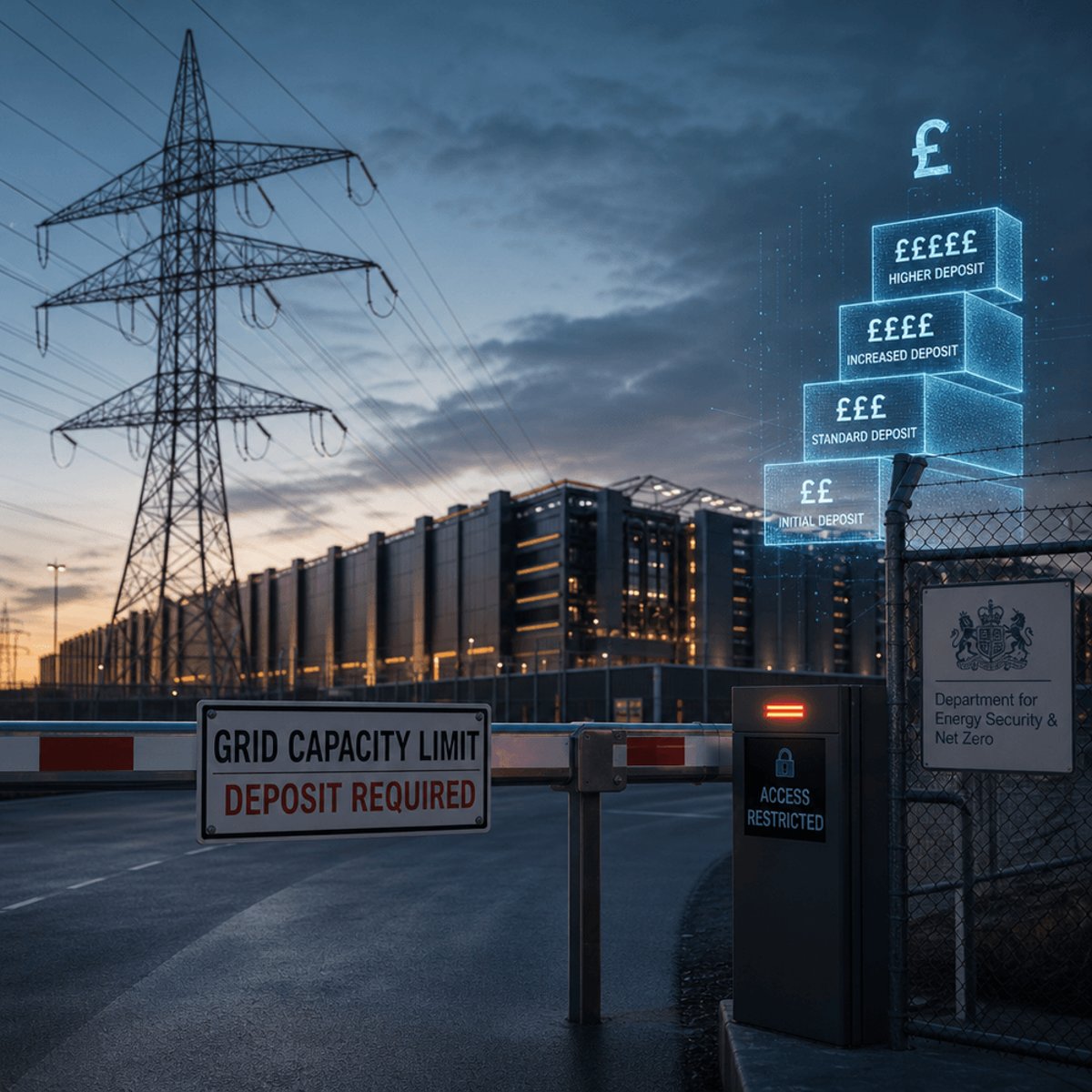
UK energy regulators just dropped a bombshell on the data center industry. New proposals would force facilities to pay deposits between £237,500 and £712,500 per megawatt for power connections—a move that could saddle hyperscale AI projects with upfront costs reaching hundreds of millions of pounds. The policy marks one of the first major regulatory responses to the infrastructure strain created by AI's explosive energy appetite, and it's sending ripples through an industry already grappling with power constraints.
The UK's energy regulator is making data center operators put their money where their megawatts are. Under new proposals, facilities seeking grid connections will need to fork over deposits ranging from £237,500 to £712,500 per megawatt—potentially the steepest power connection fees anywhere in the developed world.
The math gets uncomfortable fast for hyperscalers. A modest 100-megawatt facility, standard for modern AI training clusters, would face deposits between £24 million and £71 million before a single server rack gets installed. Scale that to the 300-500MW campuses that Microsoft, Google, and Amazon are reportedly planning across Europe, and you're looking at deposits that could exceed £200 million per project.
This isn't happening in a vacuum. The UK's grid operators have been sounding alarms for months about data center demand outpacing infrastructure capacity. National Grid reportedly has a connection queue stretching years into the future, with AI facilities representing an outsized share of applications. The deposit requirement appears designed to separate serious projects from speculative land grabs—forcing companies to prove financial commitment before claiming scarce grid capacity.
The timing couldn't be more pointed. OpenAI, Meta, and other AI leaders have been in a land rush across Europe, snapping up sites with power access before training their next-generation models. Industry insiders say available power capacity has become more valuable than real estate itself, with some parcels trading at premiums based purely on megawatt allocations.
What makes these deposits particularly aggressive is their structure. Unlike traditional connection fees that cover infrastructure upgrades, these appear designed as financial filters—refundable if projects proceed, but substantial enough to deter speculative reservations. One energy consultant who works with hyperscalers told colleagues the fees represent "six to twelve months of typical data center operating costs paid upfront, before you've built anything."
The ripple effects extend beyond balance sheets. Higher upfront costs could push AI infrastructure toward countries with friendlier power policies, potentially undermining the UK's pitch as a European tech hub. Ireland, the Netherlands, and Nordic countries have already attracted massive data center investments with comparatively streamlined grid access, though several are now implementing their own restrictions as local opposition grows.
For the AI industry, this is another cost variable in an already expensive infrastructure equation. Training GPT-scale models requires not just computing power but consistent, massive electrical supply. Nvidia's latest H200 GPU clusters can pull 10-15 megawatts per rack, and a full-scale training facility might house dozens of such clusters. When you're burning through megawatts like that, seven-figure deposits per megawatt start looking like a material line item.
The policy also exposes a growing tension between national AI ambitions and physical infrastructure reality. UK officials have championed becoming an "AI superpower," but the grid wasn't built for the kind of concentrated power loads that modern AI demands. These deposits are essentially regulators admitting the infrastructure can't keep pace with the technology—and making the tech industry pay for the privilege of waiting in line.
What's particularly interesting is how this might reshape data center economics. If deposits become standard across Europe, we could see a shift toward smaller, distributed facilities rather than massive single-campus deployments. Or it might accelerate corporate investment in on-site power generation—solar arrays, batteries, even small modular reactors—to reduce grid dependence entirely.
Other regulators are watching closely. Similar capacity crunches are emerging in US markets like Northern Virginia and around major European cities. If the UK's deposit model proves effective at managing queue discipline without killing projects outright, expect copycats. If it drives investment elsewhere, expect a different approach.
The UK's proposed deposit scheme represents the first serious regulatory friction against AI infrastructure expansion in a major developed market. Whether it's a prudent grid management tool or a competitive own-goal depends on execution and whether other countries follow suit. For hyperscalers already juggling AI capex concerns, it's another reminder that the hardest part of the AI boom might not be the algorithms—it's getting enough power to run them. As these policies proliferate, the companies that secure power access early, or figure out how to operate without grid dependency, will have a significant advantage in the next phase of AI buildout.