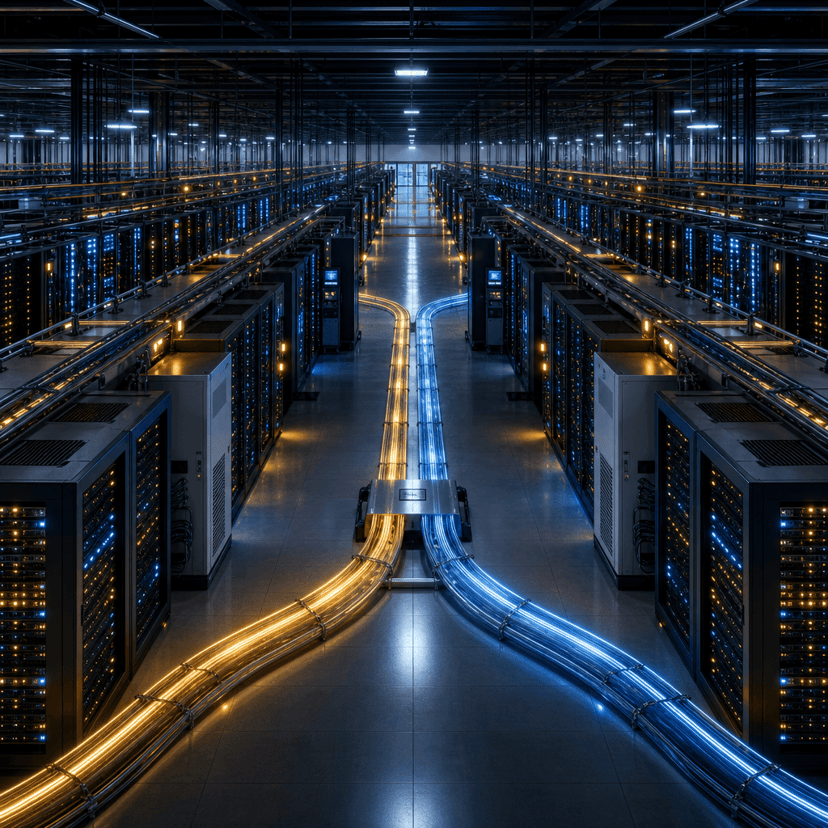
Meta just pulled off one of the biggest infrastructure deals in tech history. The company announced a $14 billion partnership with BlackRock to develop a 1-gigawatt data center campus in El Paso, Texas - a massive bet on AI infrastructure that signals how quickly the race to build "superintelligence" is reshaping corporate finance. The deal, which closes in days, pairs Meta's 15 years of data center expertise with BlackRock's capital firepower, creating a new model for funding the compute-hungry future of AI.
Meta is rewriting the playbook on how Big Tech finances its AI ambitions. The company announced today it's teaming up with investment giant BlackRock on a $14 billion data center venture in El Paso, Texas - one of the largest infrastructure deals in the industry's history and a clear signal that the race to build AI capacity has entered a new phase.
The partnership pairs Meta's infrastructure know-how with BlackRock's capital muscle in a deal structure that's drawing attention across Silicon Valley. BlackRock will own 80% of the venture through its managed funds, while Meta retains 20%. The El Paso campus will pack 1 gigawatt of compute capacity, enough to power Meta's push toward what CEO Mark Zuckerberg calls "superintelligence."
"Building the infrastructure for superintelligence is key to making sure the benefits of this technology are distributed to everyone," Zuckerberg told reporters in a statement. "Our partnership with Larry and the team at BlackRock allows us to move faster and at greater scale."
The deal's financial engineering reveals how desperate tech companies are to secure compute capacity without tanking their balance sheets. Meta will contribute land and construction-in-progress assets valued at $2.3 billion, while BlackRock pumps in $4.9 billion in cash at closing. Meta gets a one-time distribution of about $1 billion to balance the 80/20 ownership split, then immediately leases the entire campus back for an initial four-year term with options extending to 20 years.
BlackRock CEO Larry Fink framed the move as part of a broader shift in how companies fund critical infrastructure. "Companies around the world are looking for long-term strategic partners to help develop their most important projects, and BlackRock is built to meet that need," Fink said in the announcement. A chunk of BlackRock's investment comes from $12.5 billion in debt financing, spreading risk across capital markets.
The timing couldn't be more critical. Meta and rivals like Microsoft, Google, and Amazon are locked in an arms race to build the massive data centers needed to train and run increasingly powerful AI models. These facilities don't come cheap - the El Paso campus alone represents over $10 billion in Meta investment and will create 4,000 construction jobs at peak, with 2,300 workers already onsite.
Meta's new "Meta Compute" strategy is designed to diversify how it finances this buildout. Rather than funding everything through traditional capital expenditures, the company selected BlackRock after what it describes as a "highly competitive process." The deal gives Meta flexibility while freeing up capital for other investments, including AI research and product development.
The campus is expected to begin bringing capacity online in 2028, a timeline that reflects both the scale of construction and the lead times needed to secure power and cooling infrastructure. Meta will handle construction management, property management, and administrative services, then occupy the entire facility as the initial tenant.
But the deal comes with strings attached. Meta is providing residual value guarantees with an aggregate threshold of about $13 billion that decreases over time. If certain conditions are met within the first 16 years of the lease, Meta would cover any shortfall between fair value and the guaranteed threshold - essentially insurance for BlackRock's investors.
Wall Street is watching closely. The transaction marks one of the first times a major tech company has brought in outside capital at this scale for data center development, potentially setting a template for future deals across the industry. Morgan Stanley and JPMorgan served as Meta's financial advisors, while Kirkland & Ellis advised BlackRock.
Beyond the financial mechanics, the El Paso project carries significant local economic impact. Meta is connecting the site to its America's Workforce Academy, a free skilled trades training program that guarantees graduates jobs at company data center sites. The company also provided $500,000 to El Paso public schools for STEM and trades education.
BlackRock is adding its own workforce push through Future Builders, a $30 million initiative expected to train over 12,000 electricians across Texas over three years - a recognition that the state's booming energy and infrastructure demands are straining available labor.
The partnership brings together BlackRock's Global Infrastructure Partners and HPS Investment Partners, both now part of the BlackRock empire, showcasing how the firm's recent acquisitions are creating new capabilities in infrastructure investing. For BlackRock, the deal offers clients exposure to AI infrastructure and energy assets at a moment when both are seeing explosive demand.
Meta's willingness to cede majority ownership while maintaining operational control represents a fundamental shift in how tech giants think about infrastructure. Rather than owning every brick and server, companies are increasingly acting as anchor tenants in facilities backed by institutional capital - a model common in commercial real estate but relatively new to tech.
The move also raises questions about how rivals will respond. Microsoft has been aggressive in securing data center capacity for its OpenAI partnership, while Google and Amazon are racing to expand their cloud infrastructure. If Meta's financing model proves successful, expect similar partnerships to follow.
For now, the El Paso campus stands as a concrete example of how the AI boom is reshaping not just software and algorithms, but the physical infrastructure underpinning the entire industry. With capacity measured in gigawatts and price tags in the tens of billions, building the future of AI increasingly looks like building the factories and power plants of the industrial revolution - just with more venture debt and residual value guarantees.
Meta's $14 billion BlackRock partnership marks a turning point in how tech companies fund AI infrastructure. By bringing in institutional capital while maintaining operational control, Meta is creating a blueprint that could reshape the industry's approach to the massive buildouts required for next-generation AI. The deal's success or failure will be closely watched by rivals facing similar capacity constraints, and the financing structure - complete with lease-backs and residual value guarantees - may become the new normal as the AI infrastructure arms race accelerates. For El Paso, it means thousands of jobs and a place at the center of the AI revolution. For the tech industry, it's a reminder that the future of artificial intelligence will be built as much by financial engineers as by software developers.