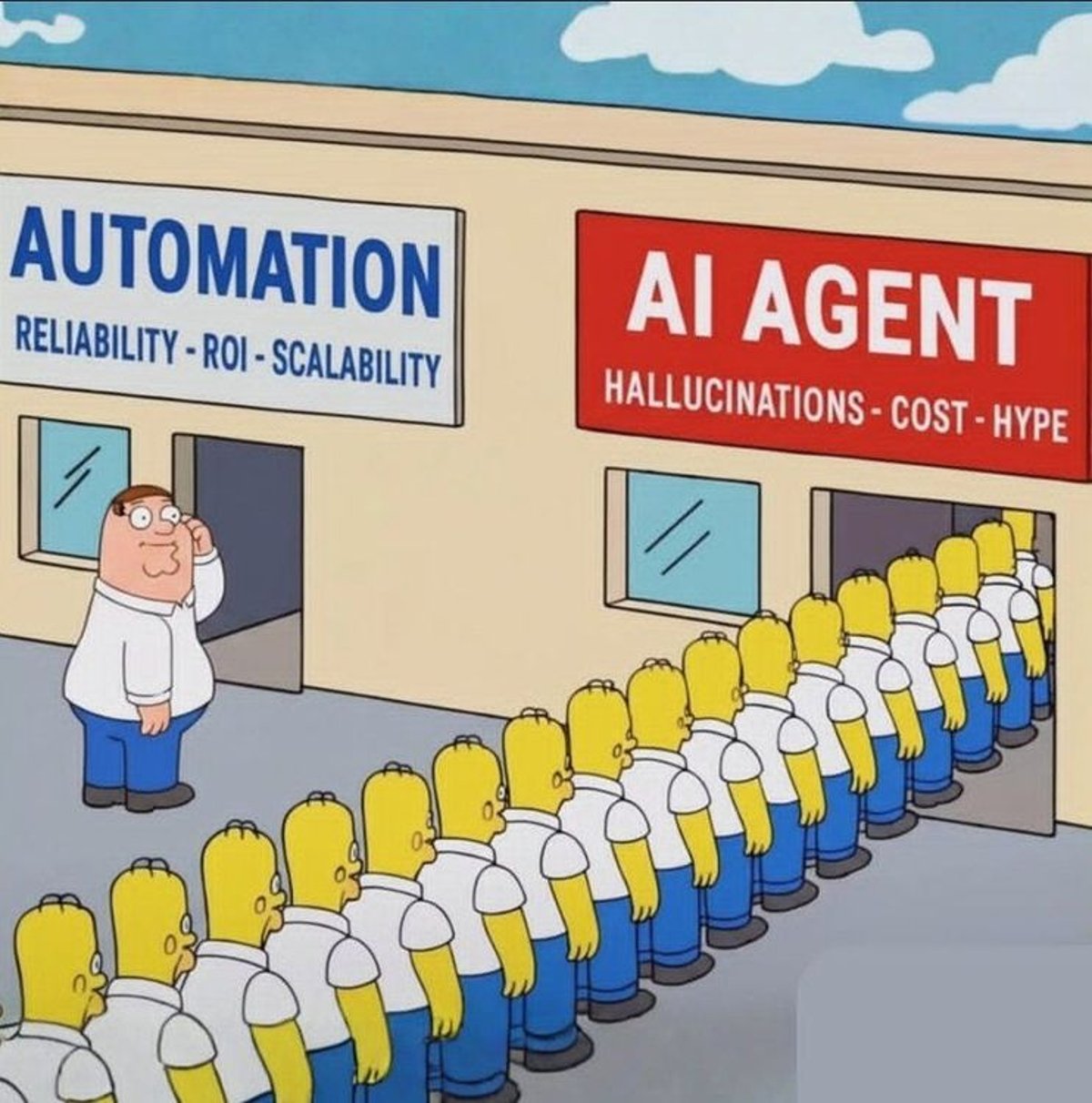
The meme captures a real moment in technology culture. One door is labeled Automation: Reliability, ROI, Scalability and stands empty. The other reads AI Agents: Hallucinations, Cost, Hype, and the line stretches down the hallway. The joke lands immediately. Underneath it sits a genuine engineering question: when should you build deterministic automation, and when does it actually make sense to deploy AI agents?
Automation
What the meme contrasts are not simply two tools but two philosophies of building systems. Traditional automation encodes rules. Engineers map out a workflow, define inputs and outputs, and the system executes those instructions the same way every time. Robotic process automation, scripts, and workflow engines all belong here. Once the logic is written and tested, the machine runs cheaply and consistently. This is the quiet machinery behind countless business operations: copying data between systems, processing invoices, onboarding employees, reconciling records. When the work is repetitive and predictable, automation delivers exactly what the meme promises: reliability, scalability, and fast return on investment.
The downside is that rule-based automation assumes the world stays stable. If the process changes frequently or inputs arrive in unpredictable forms, the system becomes fragile. A redesigned user interface, a new document format, or an edge case that the designer never anticipated can break the workflow. Maintenance becomes the hidden cost. Automation still works best when the task has clear structure and relatively little variation.
AI Agents
AI agents emerged as a response to the places where that structure breaks down. Systems built on large language models can read unstructured text, interpret messy documents, classify emails, summarize conversations, and make conditional decisions without every possibility being hard-coded in advance. These capabilities make them attractive for tasks that previously required human judgment: customer support triage, contract review, research summarization, operational monitoring. In those environments the promise is flexibility rather than precision. The system can adapt to new formats and ambiguous inputs without needing a new rule for every scenario.
Yet the meme’s warnings about hallucinations, cost, and hype are not exaggerated. Language models can generate confident errors. When those outputs feed into automated workflows, small mistakes can cascade into larger operational problems. Multi-step agent systems often require several model calls, retries, and tool interactions, which introduces latency and operational expense. Building guardrails, monitoring behavior, and defining safe fallback paths adds another layer of engineering complexity. The result is a powerful but unstable technology stack that demands careful design before it can operate safely in production.
Following the Crowd
The reason the crowd gathers at the AI-agent door has less to do with practical efficiency and more to do with incentives. Intelligent agents promise higher upside in complex environments where humans currently spend large amounts of time interpreting information. They also carry enormous narrative power. Saying a company is building AI agents signals innovation in a way that “we automated some workflows” rarely does. Founders, investors, and engineers are naturally drawn toward the frontier that feels intellectually ambitious, even when a simpler system would solve the immediate problem.
In reality the two approaches serve different kinds of work. When a process follows consistent rules, receives structured inputs, and rarely changes, deterministic automation remains the superior solution. Scripts, integrations, and workflow engines handle these tasks with speed and precision while producing predictable outcomes. Many back-office operations fall into this category, and organizations that automate them often see immediate improvements in efficiency and accuracy.
AI agents become useful when the inputs are ambiguous, the rules cannot be fully enumerated, or the system must interpret language and context before acting. Reading customer emails, analyzing documents, or correlating operational signals across logs and messages all require a level of interpretation that rigid automation struggles to provide. In those environments an agent can reduce the cognitive load on human workers by filtering, summarizing, and suggesting actions.
Building Effective Systems
The most effective systems increasingly combine both approaches. AI handles perception and interpretation. It reads the messy input, extracts structure, and proposes decisions. Deterministic automation then executes the resulting actions within controlled workflows. This architecture keeps the flexible intelligence where it is needed while reserving execution for components that behave predictably. Instead of replacing automation, AI often becomes the layer that feeds it.
Seen through that lens, the meme reflects a broader human pattern. Engineers and organizations gravitate toward tools that feel sophisticated and transformative, even when many problems reward the quieter discipline of encoding rules and building stable systems. Automation offers steady, compounding gains for well-defined tasks. AI agents extend automation into messy territory where judgment and interpretation matter. The challenge is not choosing one door permanently but recognizing which door actually fits the problem in front of you.