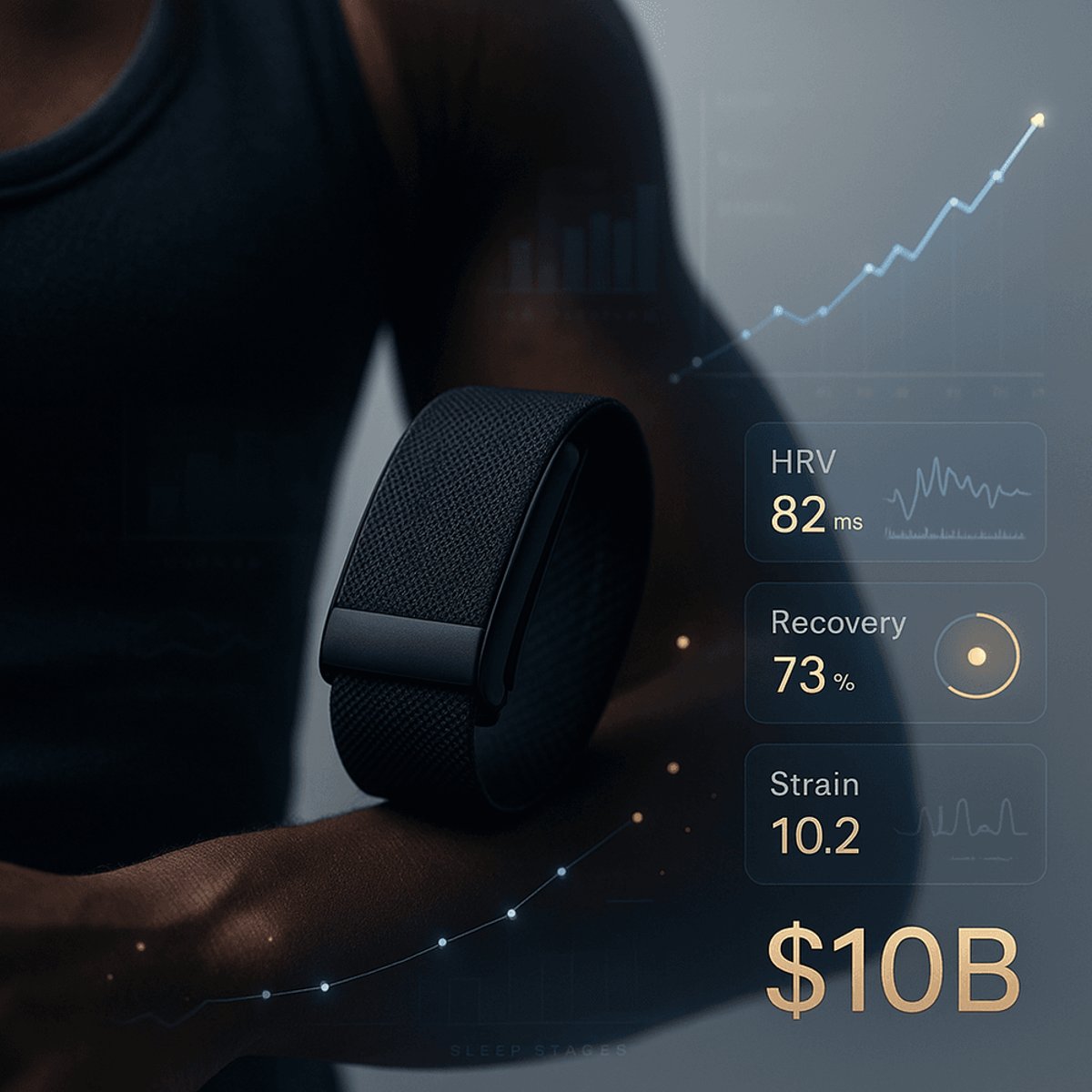
Whoop, the fitness tracking startup favored by elite athletes, just closed a massive $575 million Series G that triples its valuation to $10 billion. The round drew backing from sports icons Cristiano Ronaldo and LeBron James, signaling the wearables market's resilience even as other consumer hardware companies struggle. With this kind of late-stage firepower, the question on every VC's mind is simple: when's the IPO?
Whoop just pulled off one of the biggest late-stage raises in fitness tech history, and it's got everyone wondering if the Boston-based startup is gearing up for a public debut.
The company confirmed today it closed a $575 million Series G at a $10 billion valuation - nearly triple the $3.6 billion price tag it carried after its 2021 Series F, according to TechCrunch. That's a remarkable achievement in a market where consumer hardware startups have largely fallen out of favor with investors.
What makes this round particularly eye-catching isn't just the size. Soccer superstar Cristiano Ronaldo and basketball icon LeBron James both participated as investors, lending their star power to a brand that's already become ubiquitous among professional athletes. The celebrity involvement isn't just for show - both athletes have been vocal Whoop users for years, regularly posting about their recovery scores and strain metrics on social media.
The timing tells its own story. Series G rounds of this magnitude typically signal one of two things: either a company is stockpiling cash for a major expansion push, or it's building a war chest ahead of going public. Given Whoop's maturity and market position, industry watchers are betting on the latter.
Whoop has carved out a unique position in the crowded wearables market by focusing obsessively on performance optimization rather than general fitness tracking. The company's subscription model - users pay monthly fees rather than buying hardware outright - has created predictable recurring revenue that public market investors typically reward with premium valuations.
That business model stands in sharp contrast to competitors like Fitbit, which Google acquired in 2021, and Apple, which dominates the smartwatch category but relies on hardware sales. Whoop's approach has resonated particularly strongly with serious athletes and fitness enthusiasts willing to pay $30 per month for deeper insights into their training and recovery.
The valuation jump reflects more than just celebrity endorsements and a clever business model. The broader health tech sector has seen renewed investor interest as consumers increasingly prioritize wellness and preventive health monitoring. Wearables that can track metrics like heart rate variability, sleep stages, and respiratory rate have moved from nice-to-have gadgets to essential tools for anyone serious about optimizing their health.
But Whoop faces real competition. Apple continues to add health features to the Apple Watch, while startups like Oura have gained traction with their own subscription-based recovery tracking. The market has also seen consolidation, with larger tech companies snapping up promising startups before they can reach scale.
The celebrity investor angle shouldn't be dismissed as mere marketing theater. Athletes like Ronaldo and James bring more than money - they provide social proof and distribution at a scale traditional venture capital can't match. When Ronaldo posts his Whoop strain score to his 500 million Instagram followers, that's marketing budget money simply can't buy.
For Whoop founder and CEO Will Ahmed, this round represents validation of a vision he's been pursuing since starting the company in 2012. Ahmed, a former Harvard varsity squash captain, built Whoop around the insight that elite athletes needed better data to optimize their training. That thesis has proven remarkably durable, even as the wearables market has cycled through multiple hype waves.
The funding environment for late-stage startups has been brutal over the past two years, making Whoop's success all the more notable. While many venture-backed companies have been forced to raise down rounds or accept flat valuations, Whoop managed to triple its price in less than five years. That suggests genuine business momentum, not just investor exuberance.
Industry sources suggest the company has been profitable or near-profitable on an adjusted basis, though Whoop hasn't disclosed detailed financials. The subscription model provides visibility into future revenue that hardware sales can't match, giving the company leverage in valuation negotiations.
The obvious next question is timing. Companies don't typically raise Series G rounds unless they're either preparing to go public or making a major acquisition. Given the current IPO market conditions and Whoop's trajectory, analysts expect the company could file for an initial public offering sometime in late 2026 or early 2027, assuming market conditions remain favorable.
Whoop's massive Series G raise at a $10 billion valuation marks a defining moment for the fitness wearables category. While the celebrity backing generates headlines, the real story is a subscription-based hardware company achieving venture-scale returns in a notoriously difficult market. If Whoop can translate this momentum into a successful IPO, it could pave the way for other hardware startups to break through the venture capital ceiling. For now, investors and competitors alike are watching closely to see whether Ahmed and team can stick the landing on what could be one of 2026's most anticipated tech debuts.