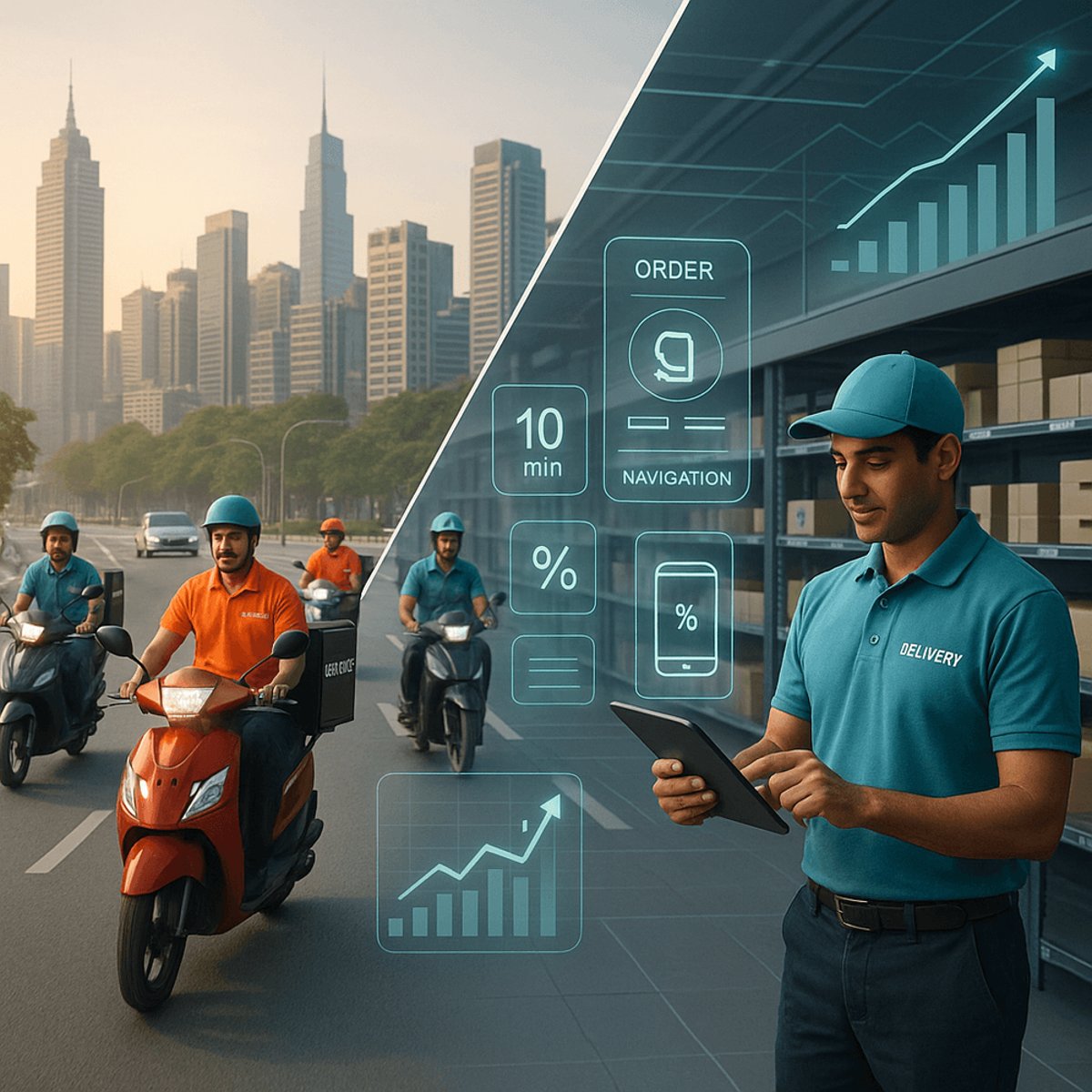
India's quick commerce battle just got another major cash injection. Zepto landed a massive $450 million funding round at a $7 billion valuation, with California's pension giant CalPERS leading the charge. The deal signals serious institutional money is betting big on India's 10-minute delivery revolution, especially as the market races toward an estimated $42-100 billion opportunity by 2030.
Zepto just threw down another major challenge in India's heated quick commerce battleground. The Mumbai-based grocery delivery startup announced it's raised $450 million at a $7 billion valuation, with California Public Employees' Retirement System (CalPERS) leading what marks a rare direct investment from the massive pension fund.
The timing couldn't be more strategic. Since Zepto's last funding round in November 2024, the competitive landscape has shifted dramatically. Swiggy made its public debut on India's stock exchange, while Blinkit overtook Zomato in gross order value for Q1 2025 - a clear sign that quick commerce is cannibalizing traditional food delivery.
"The key metric for this round of funding was our ability to turn dark stores profitable while acquiring over 10 million new monthly transacting users," CEO Aadit Palicha told TechCrunch. The numbers back up his confidence - Zepto scaled from 500,000 daily orders five quarters ago to 1.7 million today.
But the real story here isn't just Zepto's growth trajectory. It's how institutional money is finally waking up to India's quick commerce gold rush. CalPERS typically invests through intermediary funds rather than leading direct startup investments. The pension fund has been aggressively expanding its venture exposure since 2022, scaling from around $800 million to a targeted $5 billion after what officials called a "lost decade" of underperformance.
This shift comes as Morgan Stanley predicts India's quick commerce market could reach $42 billion by 2030, while Bernstein sees it hitting $100 billion within a decade. The analyst firm noted that in target markets, quick commerce has become the primary way people buy groceries.
Zepto's path to that IPO next year won't be easy. The company faces intensifying competition from multiple fronts. Legacy e-commerce giants Amazon and Flipkart have both launched quick delivery services, while established players like Blinkit, Swiggy Instamart, and Tata-owned BigBasket continue expanding their dark store networks.
The market fragmentation is getting wild. Startups are carving out specialized niches - Accel-backed Swish focuses on food delivery, Lightspeed-backed Snabbit books home services in 10 minutes, and fashion players like Myntra and Nykaa promise one-hour apparel delivery. Zepto tried launching Zepto Cafe in 44 cities but had to pause due to staffing challenges.
Geographically, the battle lines are drawn. According to J.P. Morgan, Blinkit operates in over 204 cities compared to Swiggy Instamart's 104 and Zepto's 80. But Zepto's concentration strategy might be paying off - the company runs over 1,000 stores and plans to add hundreds more over the next 12 months. Interestingly, 20% of its order volume now comes from smaller cities, suggesting room for geographic expansion.
What makes this funding round particularly significant is the investor mix. Beyond CalPERS, existing backers Lightspeed, Avenir, Avra, Glade Brook, The Stepstone Group, and Nexus Venture Partners all participated. CalPERS is also an investor in funds managed by several of these firms, creating an interesting web of institutional backing.
The round structure - a mix of primary and secondary investment - suggests some early investors are taking partial exits while the company raises growth capital. This dynamic often signals a maturing startup preparing for public markets, aligning with Zepto's IPO timeline.
For India's broader startup ecosystem, Zepto's success validates the quick commerce thesis that seemed almost too ambitious just a few years ago. The idea that consumers would pay premiums for 10-minute grocery delivery has evolved from experiment to essential service, particularly in India's dense urban markets where traffic and convenience intersect.
Zepto's $450 million raise at a $7 billion valuation represents more than just another funding milestone - it's institutional validation of India's quick commerce revolution. With CalPERS leading the charge and Morgan Stanley projecting a $42-100 billion market by 2030, the 10-minute delivery wars are attracting serious money. As Zepto prepares for its 2026 IPO, the real test will be maintaining unit economics while fending off Amazon, Flipkart, and a dozen specialized competitors all racing for the same consumer wallet.