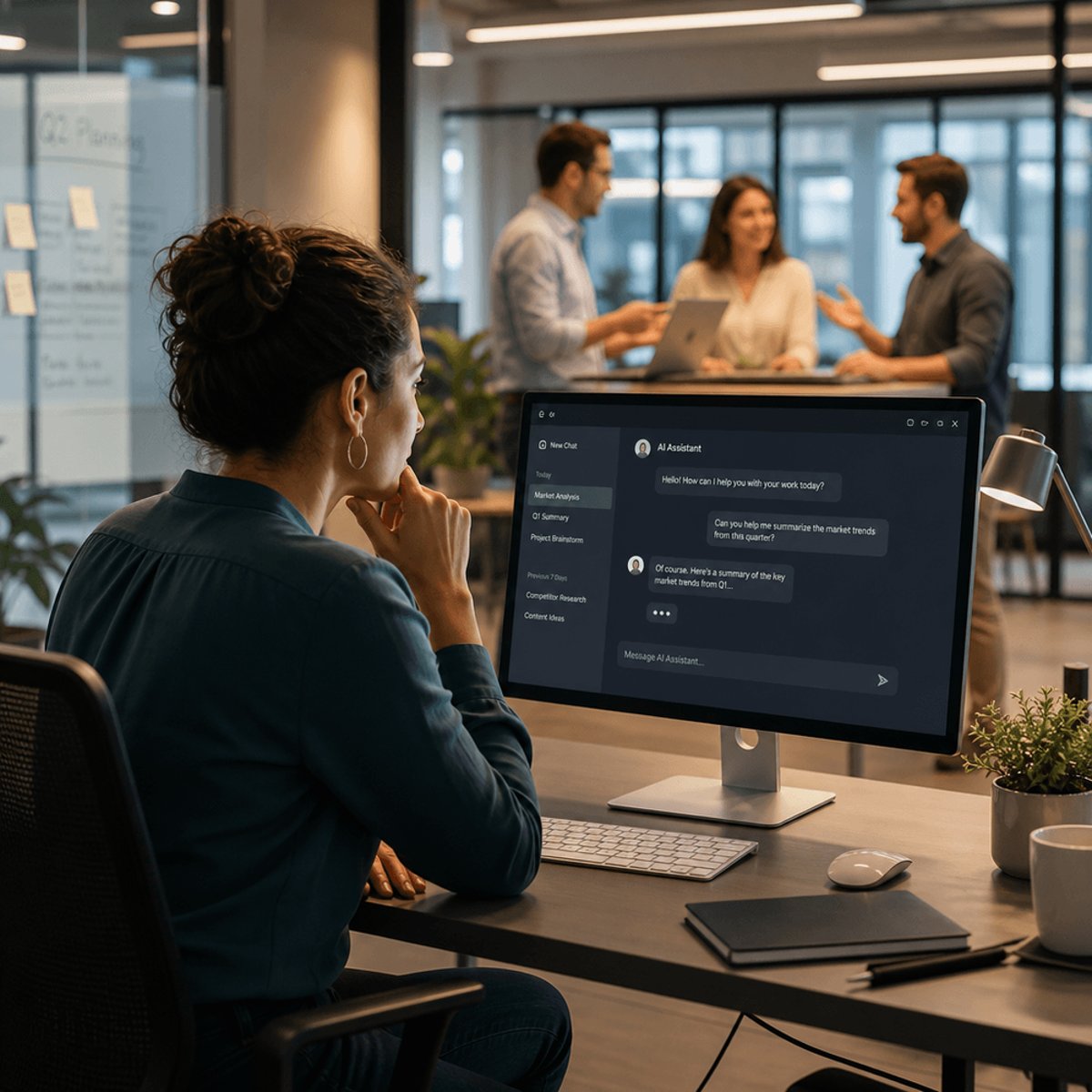
The office water cooler is losing ground to chatbots. New research shows three-quarters of employees now turn to AI tools for workplace questions instead of asking their colleagues, marking a fundamental shift in how knowledge flows through organizations. The trend promises efficiency gains but threatens the informal networks that have long been the backbone of corporate problem-solving and culture.
The workplace is experiencing a quiet revolution that's reshaping how employees solve problems. A series of recent studies reveals that 75% of workers now pose their questions to AI assistants rather than tapping a colleague on the shoulder or sending a Slack message, according to research highlighted by ZDNet.
The numbers tell a striking story about how quickly AI has infiltrated daily work routines. What started as occasional queries to ChatGPT or enterprise AI tools has evolved into employees' default problem-solving behavior. The appeal is obvious - instant answers without interrupting someone's workflow or waiting for a response.
But the trend carries hidden costs that organizations are only beginning to recognize. Those casual desk-side conversations and quick Slack exchanges weren't just about getting answers. They were how junior employees learned company norms, how teams built trust, and how institutional knowledge spread organically through organizations.
"We're seeing a fundamental change in workplace dynamics," notes workplace behavior research. When an employee asks AI instead of a coworker, they get information but miss the context, the war stories, and the relationship-building that comes with human interaction. They don't learn that Sarah in accounting has deep expertise in a particular area, or that the official process everyone follows is actually outdated.
The efficiency gains are real and measurable. Employees report faster problem-solving and less time spent waiting for responses. AI doesn't take lunch breaks or schedule meetings. It answers immediately, consistently, and without judgment about whether a question seems too basic.
Yet organizations are discovering the downsides. Knowledge that lives only in AI systems creates new vulnerabilities. Team cohesion weakens when colleagues stop interacting regularly. New hires struggle to build networks and understand unwritten rules. The informal mentorship that happened through daily questions evaporates.
Companies face a delicate balancing act. Banning AI tools isn't realistic or desirable - the productivity benefits are too significant. But letting the trend continue unchecked risks fragmenting organizational culture and creating isolated employees who interact more with algorithms than humans.
Some organizations are responding by redesigning workflows to preserve human connection while embracing AI efficiency. They're creating structured mentorship programs to replace informal learning, scheduling regular team interactions that AI can't replace, and training employees on when human insight matters more than quick answers.
The shift also raises questions about what happens to institutional knowledge. When employees stop asking each other questions, they stop sharing context about why decisions were made, what's been tried before, and what really matters versus what's just process. That knowledge risks getting lost as AI becomes the primary information source.
There's also a skills dimension. Younger workers entering the workforce may never develop the habit of building internal networks and knowing who to ask for what. They might become efficient at extracting information from AI but struggle with the relationship-building and political navigation that still defines career success.
The research suggests organizations need to think strategically about which types of questions should flow through AI versus human channels. Factual queries about policies or procedures? AI excels there. Questions requiring judgment, context, or insight into company culture and politics? Those still need human expertise.
Managers are finding they need to actively create opportunities for the informal knowledge sharing that used to happen naturally. That means being more intentional about team interactions, creating spaces for questions and discussion, and modeling the behavior of asking colleagues for input even when AI could provide a quick answer.
The technology isn't going away, and employees won't voluntarily choose slower methods when faster ones exist. But companies that figure out how to harness AI's efficiency while preserving the human connections that drive culture and institutional knowledge will have a significant advantage over those that let algorithms completely replace coworker interactions.
What's emerging is a hybrid model where AI handles routine information retrieval while organizations work harder to facilitate the meaningful human interactions that build teams, transfer tacit knowledge, and create the social fabric that makes workplaces function beyond just task completion.
The 75% figure isn't just a statistic - it's a signal that workplace culture is being rewritten in real-time. Organizations that treat this as purely a technology adoption story will miss the larger challenge of preserving what makes teams effective while embracing what makes individuals efficient. The companies that thrive will be those that figure out how to get the best of both worlds: AI's instant answers combined with the irreplaceable value of human connection, context, and culture. The question isn't whether employees will keep using AI, but whether organizations can adapt fast enough to maintain the human elements that technology can't replicate.