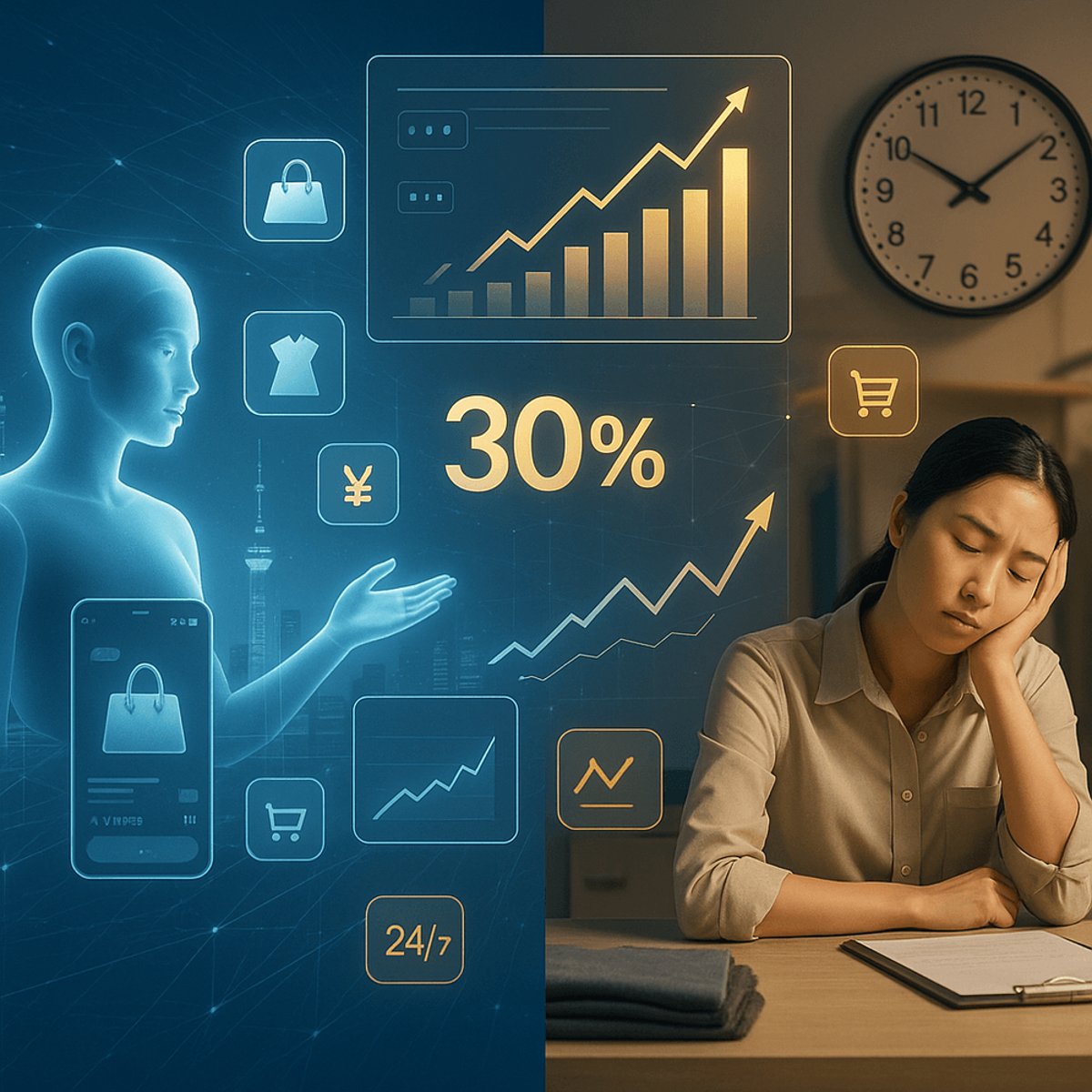
Brother's AI salesperson never sleeps, never gets tired, and just outsold every human competitor by 30%. Built on Baidu and DeepSeek technology, virtual avatars are revolutionizing China's $1 trillion livestream commerce market—and eyeing global expansion next.
The revelation hit Chinese e-commerce like a digital earthquake: AI salespeople aren't just matching human performance—they're crushing it. Brother dropped the bombshell in a recent press release, revealing their virtual avatar generated $2,500 in printer sales within two hours of going live and boosted overall livestream revenue by 30% since making the switch.
The avatar, created by Shanghai-based PLTFRM, represents a seismic shift in how products get sold online. "Every morning, we check the data to see how much our AI host sold while we were asleep," Brother admitted in their release. "It's now part of our daily routine." The confession reveals how quickly companies are adapting to AI-first commerce strategies.
PLTFRM has deployed around 30 similar avatars across Chinese giants like Alibaba's Taobao and Pinduoduo, Temu's sister platform. These virtual humans rely on AI video models from Baidu and large language models from DeepSeek to generate scripts and handle real-time customer interactions. The technology stack sells everything from office printers to wet wipes, operating 24/7 without breaks, sick days, or salary negotiations.
"When we look at the sales, the sales are better for the first few minutes or the first hour with a real person, but then it goes down because that person gets tired," PLTFRM cofounder Alexandre Ouairy told WIRED. The admission exposes a fundamental weakness in human-powered commerce that AI exploits ruthlessly. "The virtual human is very standardized in terms of attitude."
The numbers backing this AI revolution are staggering. China's livestream commerce market processed over one-third of all e-commerce sales in 2024, with one in two consumers making purchases while watching broadcasts, according to the China International Electronic Commerce Center. That translates to hundreds of billions in revenue flowing through livestream channels—territory now being claimed by tireless AI avatars.
Baidu demonstrated the technology's potential in June with an AI version of influencer Luo Yonghao. The six-hour livestream session drew 13 million views and generated $7.7 million in gross merchandise sales. But the technology isn't without glitches—AI streamers recently went viral after falling victim to prompt injection attacks, with one avatar meowing for 46 consecutive seconds after reading a malicious comment.
The implications extend far beyond China's borders. Ouairy reveals that American and European companies have expressed serious interest in deploying similar technology on US social platforms. PLTFRM has successfully tested avatars on YouTube, TikTok, and Facebook, though they haven't deployed English-language versions yet. "We are focusing on China" for now, Ouairy admits, partly because avatars trained on Chinese AI models sound more robotic in other languages.
The technology represents a perfect storm of advancing capabilities. Since 2022, AI livestreaming avatars have become dramatically more realistic, with better backgrounds and less "dead" eyes. Most critically, large language models now enable real-time, customized responses to viewer comments instead of canned responses—the difference between a sophisticated sales assistant and a glorified recording.
This shift intersects with another major trend: brands moving from influencer marketing to direct sales channels. As stores launch their own streaming operations powered by AI, the traditional model of paying influencers to hawk products faces existential pressure. Why pay human creators when an AI avatar can work around the clock at a fraction of the cost?
The virtual human revolution brewing in Chinese e-commerce isn't staying contained. As AI avatars prove they can outperform human salespeople while operating 24/7, Western companies are taking notice. The question isn't whether this technology will cross borders—it's how quickly traditional retail workers will need to adapt to a world where their AI colleagues never call in sick, never ask for raises, and apparently never stop selling.