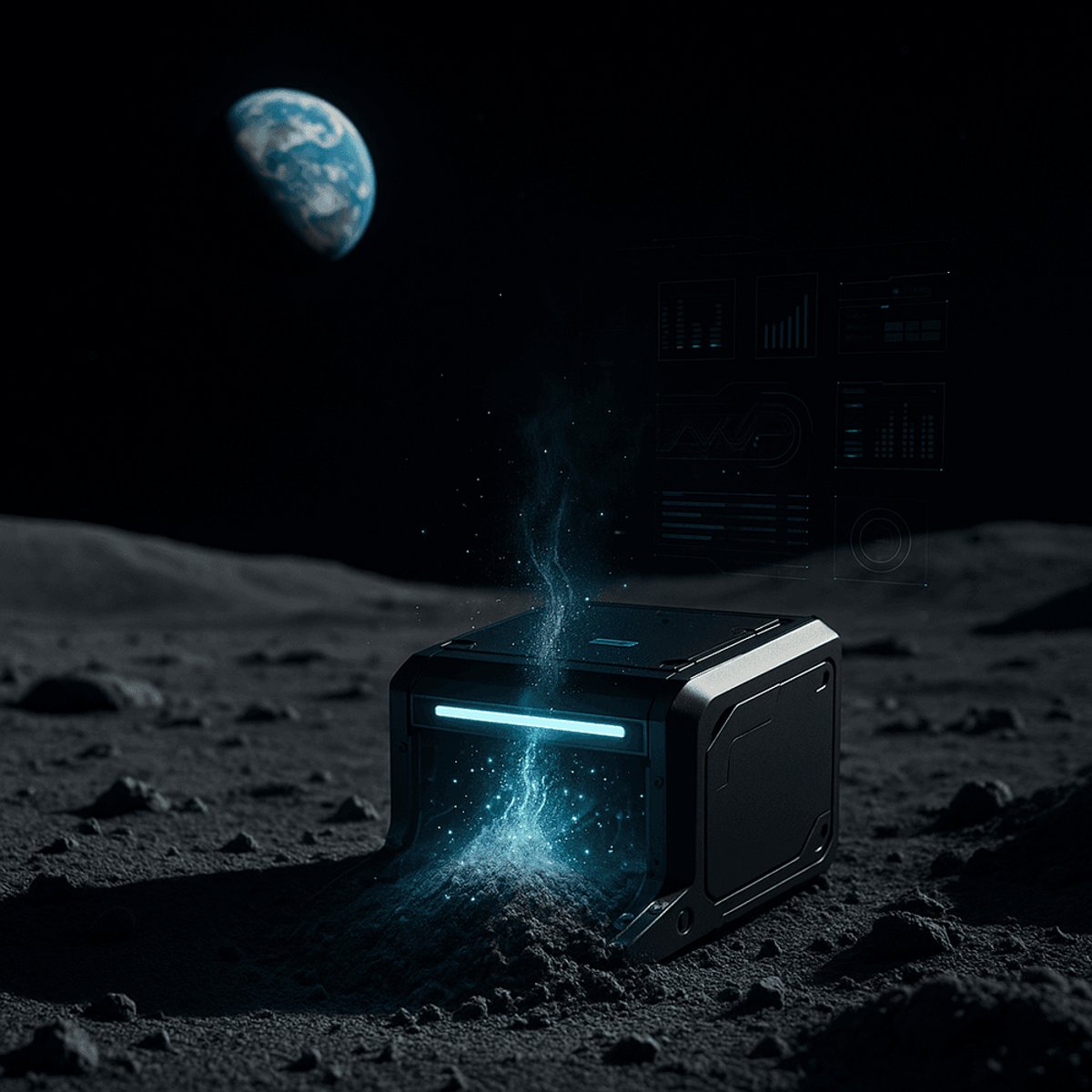
Blue Origin just unveiled a game-changing moon vacuum that turns lunar dust into electricity, solving one of space exploration's biggest power challenges. The AI-designed battery from little-known startup Istari Digital could revolutionize how spacecraft survive the brutal two-week lunar nights that have plagued missions for decades.
Blue Origin just dropped a bombshell at Amazon's re:Invent conference that could reshape lunar exploration forever. The Jeff Bezos-backed space company unveiled a revolutionary moon vacuum that literally turns dust into electricity - and the entire thing was designed by artificial intelligence.
The breakthrough comes from Istari Digital, a startup most people have never heard of but one that's quietly revolutionizing how we design critical hardware. "So what it does is sucks up moon dust and it extracts the heat from it so it can be used as an energy source, like turning moon dust into a battery," CEO Will Roper told CNBC.
This isn't just clever engineering - it's solving one of space exploration's most persistent problems. Every 28 days, the moon plunges into a brutal two-week darkness where temperatures drop so dramatically that most hardware simply dies. Spacecraft have been constrained by these lunar nights since the Apollo era, forced to either go dormant or rely on increasingly heavy battery packs that eat into precious payload capacity.
"Kind of like vacuuming at home, but creating your own electricity while you do it," Roper explained with the kind of casual tone that belies the technical complexity involved.
But here's where it gets really interesting - the battery was completely designed by AI, not human engineers. Roper, who transformed military acquisition processes as assistant secretary of the Air Force under Trump's first administration and helped launch Space Force, says Istari has cracked the code on AI hallucinations that plague other design systems.
The company's platform creates what Roper calls "guardrails" or a "fence around the playground" that prevents AI from wandering into impossible or dangerous territory. "Within that playground, AI can generate to its heart's content," he said. The system doesn't just tell you a design looks good - it verifies that every requirement and safety standard has been met before anything goes operational.
This controlled creativity approach is already paying dividends beyond Blue Origin. Istari Digital works as a prime contractor with Lockheed Martin on the experimental X-56A unmanned aircraft, and the startup has backing from former Google CEO Eric Schmidt, who's been quietly investing in next-generation defense and space technologies.
The timing couldn't be better. NASA is pushing hard to return astronauts to the moon through the Artemis program, while private companies like SpaceX and Blue Origin race to establish permanent lunar presence. Power generation on the moon's surface has remained one of the biggest technical hurdles, with most missions requiring massive solar arrays or nuclear reactors that add complexity and cost.
What makes Istari's approach so clever is using the moon's own resources. Lunar regolith - the fine dust that covers the moon's surface - is everywhere and has been considered more of a problem than a solution. The dust gets into everything, damages equipment, and poses health risks to astronauts. Now it's becoming a power source.
The broader implications stretch far beyond lunar missions. If AI can reliably design complex hardware systems while maintaining strict safety standards, it could accelerate development timelines across aerospace, defense, and other critical industries where one mistake can be catastrophic.
Roper's background gives him unique credibility here. During his Pentagon tenure, he pushed through acquisition reforms that reduced development times from decades to years, earning him recognition as one of the military's most innovative leaders. Now he's applying that same rapid-iteration philosophy to AI-driven design.
The moon vacuum represents something bigger than just another space gadget. It's proof that AI can handle real-world engineering challenges when properly constrained and validated. For an industry that's been notoriously slow to adopt new technologies due to safety concerns, seeing AI successfully design mission-critical hardware could open floodgates.
The moon vacuum isn't just about solving power problems on lunar missions - it's a glimpse into how AI might reshape engineering across industries where precision and safety are paramount. As companies race to establish permanent lunar presence, innovations like Istari's AI-designed systems could determine who gets there first and stays longest. The real test will be whether this technology performs as promised in the harsh reality of space, but early validation suggests we're witnessing the beginning of AI-native hardware design.