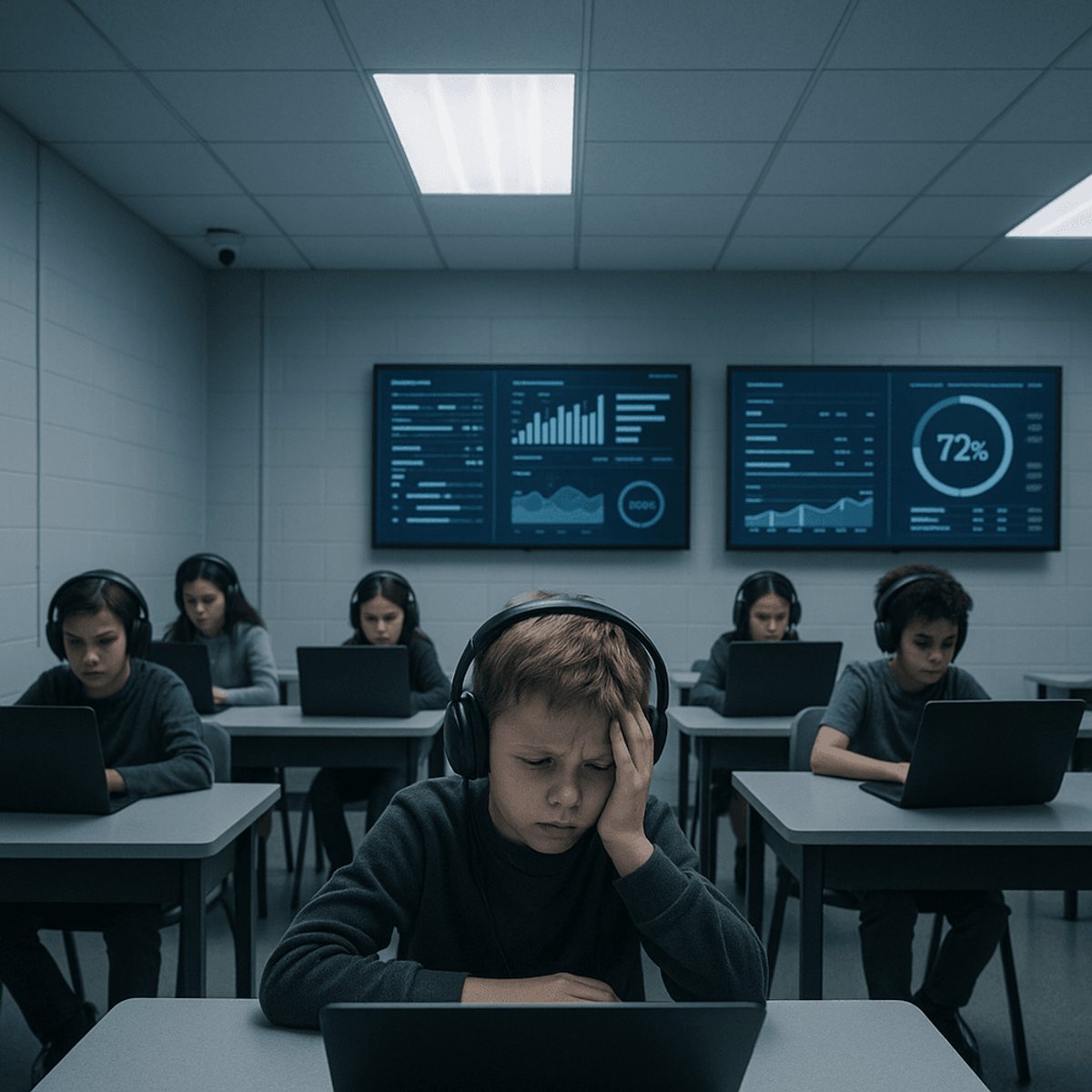
Alpha School promised the future of education - kids learning from AI software instead of human teachers in sleek, data-driven classrooms. But parents in Brownsville, Texas are pulling their children out after discovering a darker reality: 9-year-olds denied snacks until they hit learning metrics, children sobbing through endless multiplication drills, and surveillance systems tracking students even at home. The tech education experiment that attracted national attention is unraveling as families realize Silicon Valley's startup mentality doesn't translate to childhood development.
The future of education looked bright when Christine Barrios enrolled her daughter at Alpha School in Brownsville, Texas. No more outdated classrooms or overworked teachers - just cutting-edge software guiding kids through personalized learning at their own pace. But what started as an educational revolution quickly became a nightmare that would leave her 9-year-old sobbing that she'd "rather die" than continue.
Barrios' daughter got trapped in a multiplication lesson on IXL, the personalized learning platform that served as her math teacher. The software demanded she complete the exercise dozens of times without a single mistake before advancing. When the child asked her "guide" - Alpha's term for the non-teacher staff who supervise students - if she could move on, she was told to keep grinding through the problem.
Over an entire weekend, Barrios and her husband sat with their daughter for hours each day, with mom secretly double-checking answers on a calculator before the child entered them. Even after completing the tortuous lesson, the girl discovered she'd fallen further behind her algorithmic learning targets. Soon, Alpha School reported that the child wasn't eating lunch - she was spending meal breaks trying to catch up on IXL.
When Barrios sent snacks to school, they came back untouched. Her daughter explained that staff said she "didn't earn" her snacks and wouldn't get them until she met her learning metrics. Barrios pulled both her children out that November.
This isn't an isolated incident at Alpha School, according to WIRED's investigation by contributor Todd Feather. The tech-forward private school chain has built a national reputation by replacing traditional teachers with AI software and data-driven learning targets. Students sit in sterile rooms filled with large TVs displaying completion rates and performance metrics, plugged into laptops with headphones on for hours at a time.
The model caught fire among parents seeking alternatives to traditional education, especially in areas with limited schooling options. Alpha promised "limitless possibilities" through software-first learning, condensing education into two-hour intensive sessions and focusing on metrics over human interaction.
But former employees describe the environment as "experimenting on children." The school deliberately sets goals designed to be "impossibly difficult" to demonstrate students' supposed unlimited potential. Rather than hiring experienced educators, Alpha targets entrepreneurship-minded staff without teaching backgrounds - because apparently nothing screams early childhood education like startup culture.
The surveillance extends beyond school hours. One student received a notification at home that she'd been flagged for an "anti-pattern" by Alpha's monitoring system. The AI had captured video through her laptop's webcam showing her talking to her younger sister while in pajamas - at her own house.
Eye-tracking software monitors students' attention during lessons. Performance data flows continuously to massive wall displays comparing children's progress. The entire system treats 9-year-olds like junior software engineers grinding through code sprints rather than developing human beings.
Parents initially bought into the promise of personalized, future-focused education. The life skills classes, self-paced learning, and tech-forward approach seemed revolutionary compared to traditional schools struggling with teacher shortages and outdated curricula.
But as one parent noted, "numbers and data came first and the kids came second." The school's obsession with quantifying every aspect of learning leaves little room for art, creativity, social development, or the basic human interactions that define childhood education.
Alpha School disputes these characterizations, stating that "allegations that Alpha has mistreated, punished, or caused harm to any students are categorically and demonstrably false." The company maintains it prioritizes "a safe and productive environment to accelerate academic mastery."
Despite the growing criticism, Alpha School's expansion continues at breakneck speed. The company is opening roughly a dozen new campuses across Arizona, California, Florida, New York, North Carolina, and Virginia, in addition to five existing Texas locations. Trump administration officials, including Education Secretary Linda McMahon, have endorsed Alpha School and similar AI-education initiatives.
The timing couldn't be better for Alpha's business model. A nationwide teacher shortage has left parents desperate for alternatives, while political support for privatized, tech-driven education grows stronger. The company has successfully positioned itself as the solution to America's educational crisis.
But the Brownsville parents who've pulled their children out tell a different story. They discovered that childhood development can't be optimized like a startup's conversion funnel. Nine-year-olds aren't junior executives who thrive under relentless performance pressure. And learning to be human requires more than hitting algorithmic targets on a screen.
The question now is whether Alpha School's rapid expansion will continue despite these warning signs, or if more parents will realize that not everything needs to be disrupted by Silicon Valley's move-fast-and-break-things mentality - especially when what's breaking is their children's relationship with learning.
Alpha School's collapse in Brownsville reveals the dangerous intersection of Silicon Valley's optimization obsession with childhood education. While AI and personalized learning hold genuine promise, applying startup metrics to 9-year-olds creates a dystopian environment that prioritizes data over development. As the company expands nationwide with political backing, parents must weigh whether the promise of educational innovation is worth the risk of treating their children like beta test subjects. The real test isn't whether kids can hit algorithmic targets, but whether they'll still love learning when the experiment is over.