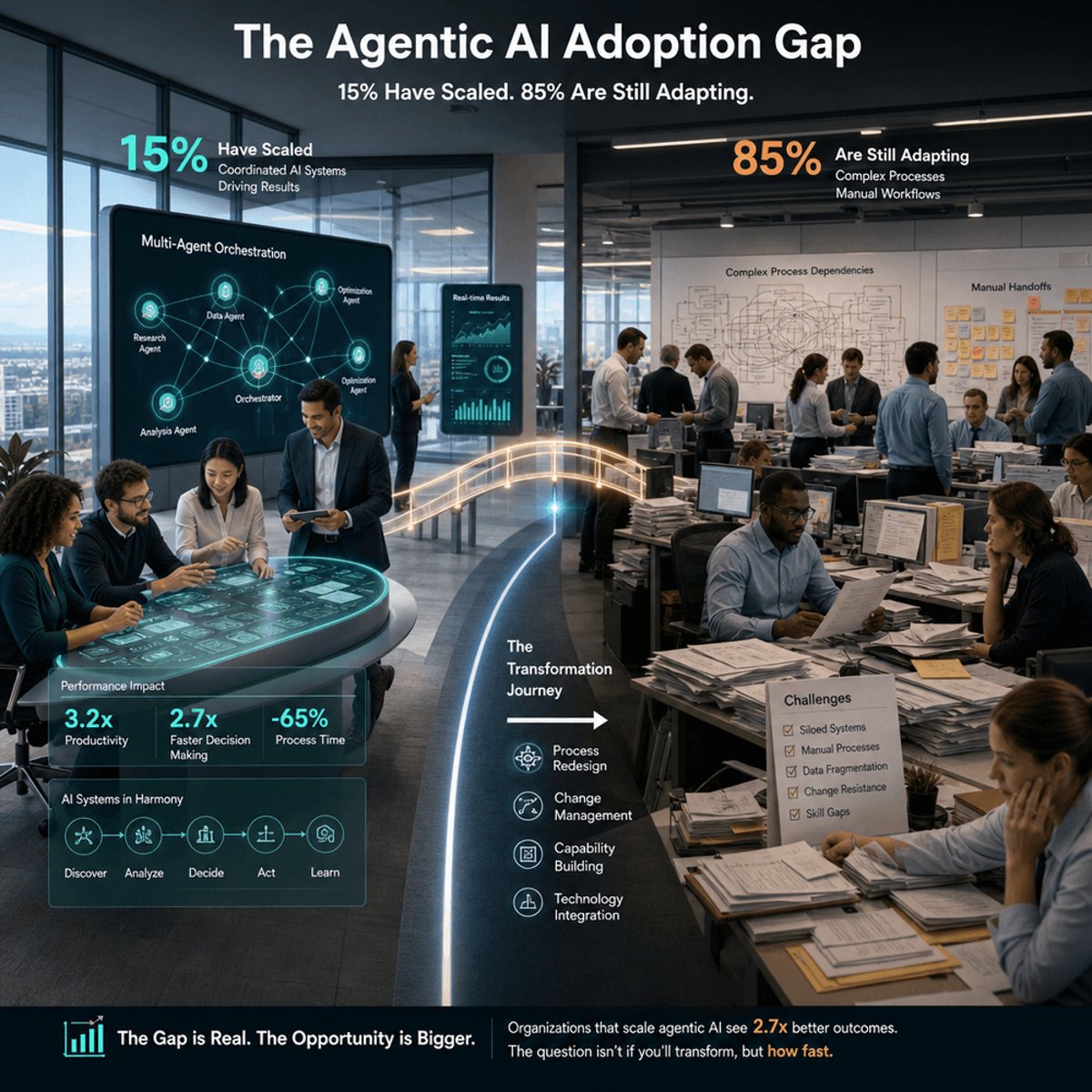
The agentic AI revolution everyone's been talking about? It's barely happening. Fresh research from Deloitte drops a sobering stat: just 15% of US organizations have successfully scaled orchestrated, multi-agent AI systems. The finding exposes a yawning gap between the hype around autonomous AI agents and the messy reality of actually deploying them at scale. While tech giants race to build more powerful AI models, most enterprises are still stuck figuring out how to reinvent their workflows and retrain their people to work alongside these systems.
Deloitte's latest research lands like cold water on the agentic AI hype cycle. While the industry buzzes about autonomous agents that can reason, plan, and execute complex tasks, the consultancy's data shows that 85% of US businesses haven't figured out how to actually deploy these systems at scale.
The 15% figure specifically tracks organizations that have reached "scaled, orchestrated, multi-agent adoption" - meaning they're not just running pilot projects or isolated AI experiments, but have successfully integrated multiple AI agents that work together across their operations. It's the difference between having a chatbot answer customer service questions and having a coordinated fleet of AI agents managing procurement, inventory, logistics, and customer interactions simultaneously.
What's tripping up the other 85%? It's not the technology. The real bottleneck is organizational. Companies are discovering that you can't just bolt agentic AI onto existing business processes like you would a new software tool. According to the Deloitte findings, enterprises need to fundamentally redesign how work flows through their organizations.
This means rethinking job roles, decision-making authority, and even basic operational workflows. An AI agent that can autonomously negotiate with suppliers doesn't fit neatly into a procurement department built around human managers signing off on every purchase order. A multi-agent system that optimizes manufacturing schedules in real-time clashes with planning cycles designed for quarterly reviews.
The workforce dimension adds another layer of complexity. Scaling agentic AI requires employees who can effectively supervise, collaborate with, and override autonomous systems when needed. That's a fundamentally different skill set than traditional software training. Workers need to understand not just how to use AI tools, but how to validate AI decisions, recognize when agents are operating outside acceptable parameters, and step in to course-correct.
The 15% who've cracked this code didn't get there by buying better AI models. They got there by treating AI adoption as a total organizational transformation - restructuring teams, redefining roles, rebuilding processes from scratch, and investing heavily in workforce development. It's expensive, time-consuming, and disruptive.
This research arrives as enterprises face mounting pressure to show returns on their AI investments. Companies poured billions into generative AI tools over the past two years, but many are still hunting for measurable business impact. Agentic AI promised to be the answer - systems that could actually execute tasks and drive outcomes, not just generate text. But Deloitte's findings suggest the path from pilot to production remains treacherous.
The gap also highlights a disconnect between AI vendors and enterprise buyers. Tech companies are racing to build more capable agents and better orchestration platforms. But the limiting factor for most organizations isn't model capability - it's change management, process redesign, and workforce readiness. The bottleneck is human and organizational, not computational.
For the 85% still struggling to scale, the research offers a reality check. Successful agentic AI deployment isn't an IT project. It's a fundamental business transformation that touches every department, requires executive commitment, and demands patience. Quick wins and isolated use cases won't cut it. Organizations need to be willing to reinvent how they operate.
The findings also raise questions about the timeline for widespread agentic AI adoption. If only 15% of organizations have reached scale now - years into the AI boom - how long before this technology becomes standard practice? The data suggests we're still in the early innings, despite all the breathless coverage of AI agents revolutionizing work.
What separates the 15% from everyone else comes down to commitment. The organizations that have successfully scaled agentic AI treated it as a multi-year transformation program, not a technology upgrade. They invested in change management, accepted short-term disruption for long-term gains, and built organizational muscle for continuous adaptation as AI capabilities evolve.
The 15% adoption rate isn't just a disappointing statistic - it's a blueprint for what comes next. Organizations still sitting on the sidelines now have a clear mandate: scaling agentic AI requires reinventing your business, not just implementing new software. The companies that figured this out early are already capturing competitive advantages through autonomous operations and AI-augmented workforces. For everyone else, the gap is widening. The question isn't whether to pursue this transformation, but whether you can afford to be in the 85% much longer. The technology is ready. The real work is building organizations capable of using it.