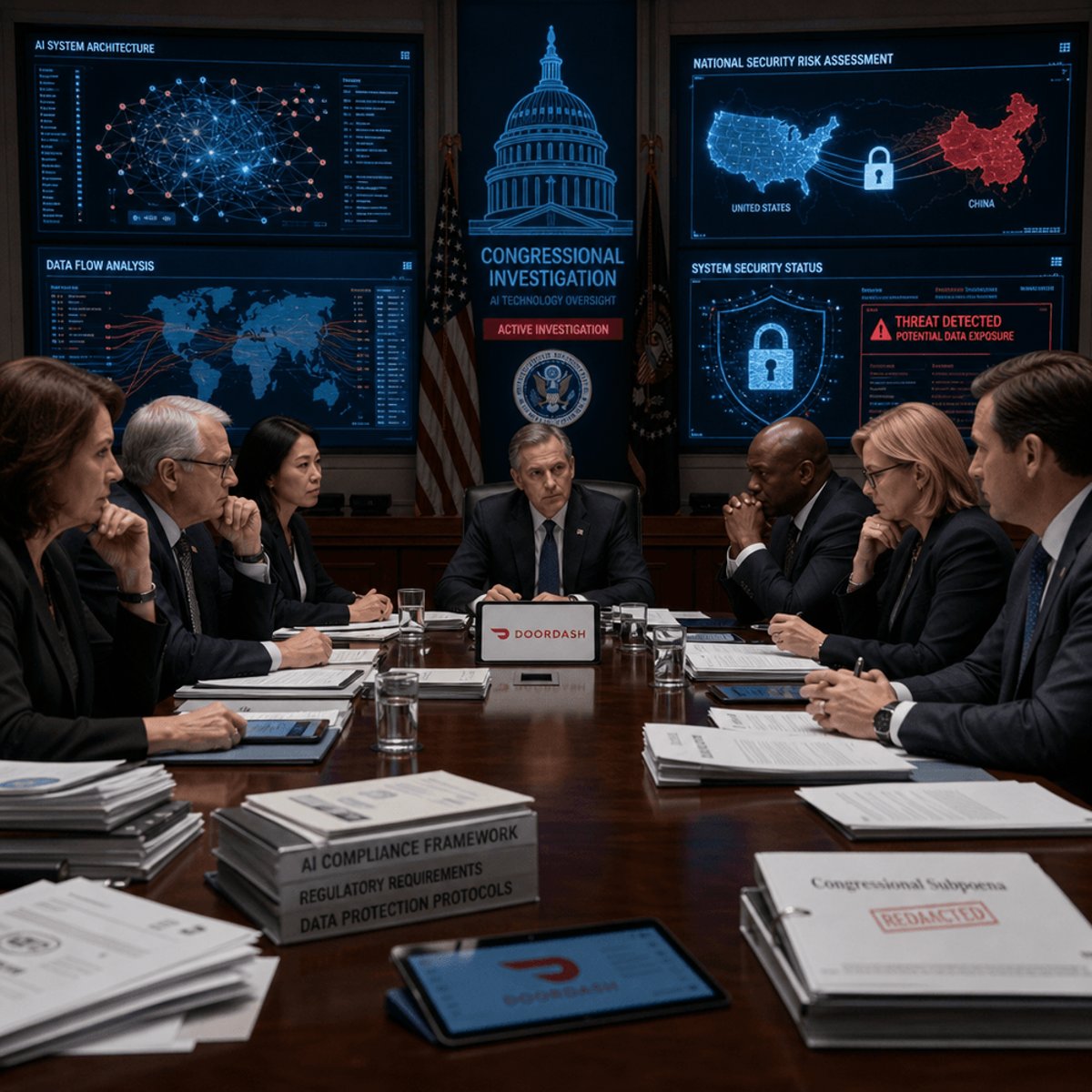
DoorDash is now in the crosshairs of a Congressional investigation examining the food delivery giant's use of Chinese-developed artificial intelligence models. The House Committee's joint inquiry, which targets multiple U.S. companies, reflects growing bipartisan concerns about potential national security risks tied to AI technology originating from China. The probe comes as Washington intensifies scrutiny of how American companies integrate foreign AI systems into their operations.
DoorDash just became the latest American tech company to face congressional heat over its use of Chinese artificial intelligence technology. The food delivery platform received a formal information request from a House Committee joint investigation probing how U.S. companies are deploying AI models developed by Chinese firms.
The inquiry marks a significant escalation in Washington's scrutiny of AI supply chains. While previous investigations focused primarily on hardware dependencies and data security, this probe digs into the software layer - specifically, which AI models power critical business operations and where those models originated. For DoorDash, which handles millions of daily transactions and vast amounts of consumer data, the questions carry particular weight.
The investigation comes at a moment when Chinese AI companies have made substantial technical strides. Firms like DeepSeek, Alibaba's DAIR Lab, and Baidu have released competitive large language models and computer vision systems that rival Western alternatives. Some of these models offer compelling economics - they're often cheaper to license and can be customized for specific use cases. But lawmakers worry about hidden vulnerabilities, data exfiltration risks, and potential backdoors that could compromise American infrastructure.
DoorDash hasn't publicly disclosed which AI systems power its platform, but the company relies heavily on machine learning for core functions. Route optimization algorithms determine how dashers navigate cities. Predictive models forecast demand surges and adjust pricing dynamically. Natural language processing handles customer service inquiries. Computer vision verifies food orders through photo recognition. Any of these systems could theoretically incorporate Chinese-developed components.
The House Committee's probe isn't targeting DoorDash alone. According to the brief disclosure, the food delivery company is "the latest" to receive an information request, suggesting a systematic sweep across industries. Previous congressional investigations have examined everything from telecommunications equipment to cloud infrastructure, but this marks one of the first focused specifically on AI model provenance.
What makes this investigation particularly thorny is the global nature of AI development. Unlike hardware supply chains where components can be traced to specific factories, AI models often incorporate techniques, training data, and architectural innovations from researchers worldwide. A model might be "developed" by a U.S. company but trained on datasets curated in China, or use transformer architectures pioneered by multiple international teams. Drawing bright lines about national origin gets messy fast.
The timing also matters. This probe lands as the U.S. races to maintain AI leadership against aggressive Chinese competition. Beijing has poured billions into AI research and development, explicitly aiming to become the global AI superpower by 2030. American policymakers increasingly view AI through a national security lens - not just as a commercial technology but as strategic infrastructure that could determine everything from military capabilities to economic competitiveness.
For DoorDash, the investigation creates an uncomfortable dilemma. If the company does use Chinese AI components, disclosure could trigger regulatory restrictions, public backlash, or requirements to rip out and replace systems at enormous cost. If it doesn't, the company still faces the burden of proving a negative - documenting every AI model in use, tracing its development lineage, and satisfying lawmakers that no problematic dependencies exist.
The broader tech industry is watching nervously. If Congress establishes new disclosure requirements or restrictions around foreign AI use, the compliance costs could be staggering. Many companies have built complex AI stacks that combine commercial models, open-source tools, and custom development. Untangling which pieces originated where - and certifying their security - represents a massive undertaking.
There's also the question of retaliation. China could respond to U.S. restrictions by limiting American companies' access to its AI ecosystem or imposing similar scrutiny on U.S. AI exports. Given that China represents a crucial market for many American tech firms, tit-for-tat restrictions could fragment the global AI industry into competing spheres.
What happens next depends partly on what DoorDash's response reveals. The company will need to provide detailed technical documentation about its AI infrastructure, vendor relationships, and data handling practices. Lawmakers will likely focus on whether any Chinese AI systems have access to sensitive consumer information, how data flows between systems, and what safeguards exist against potential exploitation.
This investigation signals that AI supply chain security is moving from theoretical concern to active policy priority. Companies across sectors should expect increased scrutiny about where their AI comes from, how it works, and what risks it might pose.
The DoorDash investigation represents more than just another Congressional inquiry - it's a sign that AI governance is entering a new phase where software provenance matters as much as hardware supply chains. As AI systems become embedded in critical infrastructure from food delivery to finance, expect lawmakers to demand unprecedented transparency about where these models come from and what risks they carry. For tech companies, the message is clear: document your AI supply chain now, because Washington is coming with questions.