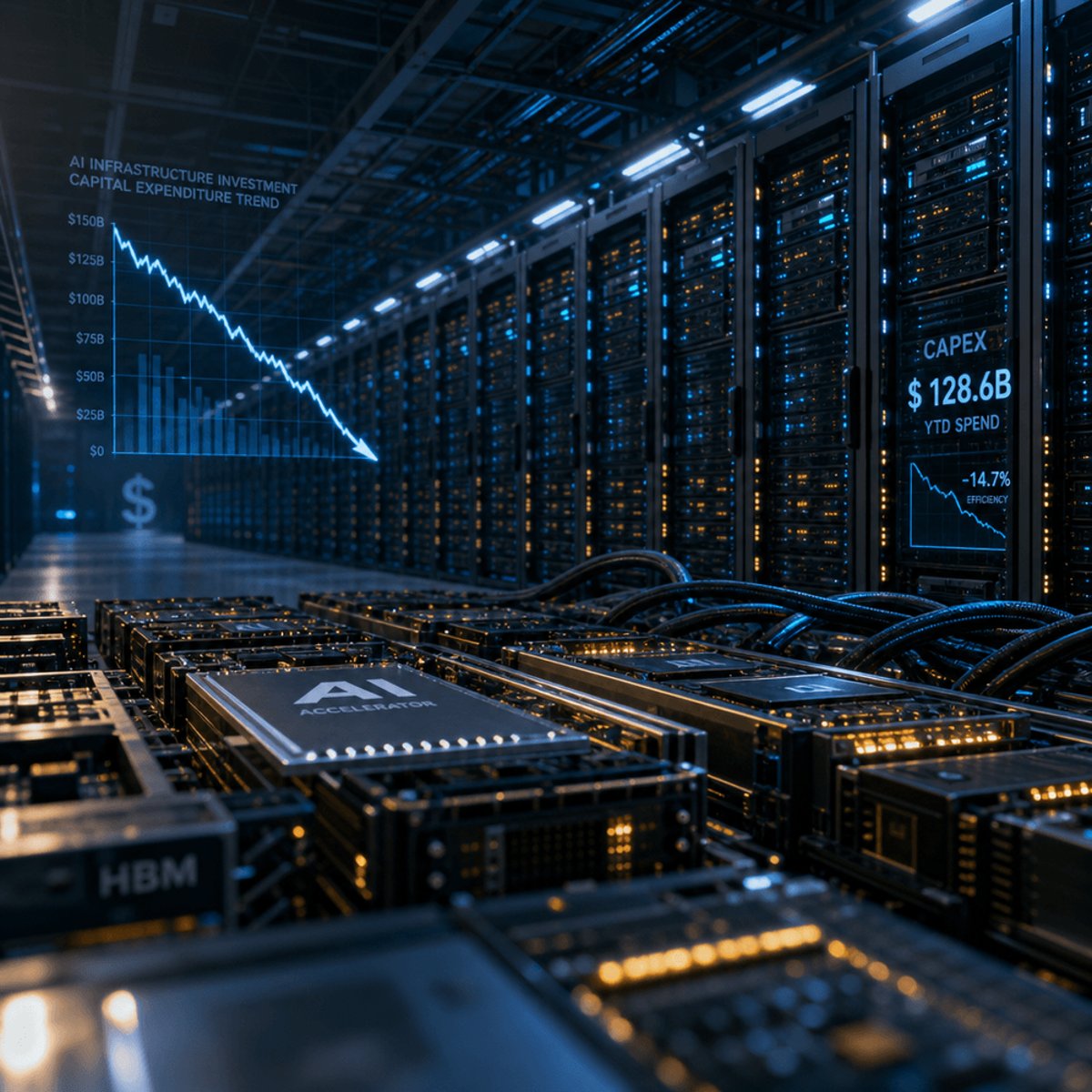
The AI infrastructure race just got a brutal reality check. Amazon, Alphabet, and Tesla all reported negative free cash flow in their latest quarterly earnings, while Meta saw its cash generation collapse by 91% compared to last year. The stunning reversal marks the first time this many tech giants have simultaneously burned through cash since the dot-com era, driven almost entirely by massive spending on AI chips, data centers, and memory infrastructure.
The numbers tell a stark story about how quickly AI ambitions are reshaping Big Tech's financial picture. Amazon, Alphabet, and Tesla each reported negative free cash flow for the quarter ending June 2026, according to earnings filings reported by CNBC. Meanwhile, Meta technically stayed cash-flow positive but saw its generation crater by 91% compared to the same period last year.
The culprit? An unprecedented arms race in AI infrastructure that's forcing these companies to spend tens of billions on Nvidia GPUs, high-bandwidth memory, and sprawling data center campuses. What started as strategic investments in 2023 has morphed into a spending tsunami that's now overwhelming even the tech sector's legendary cash-generating abilities.
Amazon's AWS division has been particularly aggressive, reportedly committing to over $75 billion in capital expenditures for 2026 alone to build out AI training capacity and inference infrastructure. That's nearly double what the company spent just two years ago. The shift comes as AWS races to maintain its cloud leadership against Microsoft Azure and Google Cloud, both of which have made AI capabilities central to their enterprise pitches.
Alphabet faces its own pressure points. The company's AI initiatives span everything from integrating large language models into Search to powering its Gemini family of foundation models. But the cost of training and running these systems has ballooned far beyond initial projections, with memory costs alone up an estimated 300% since early 2025 as demand for high-bandwidth memory chips from SK Hynix and Samsung has outstripped supply.
Meta's 91% cash generation drop is particularly eye-opening given CEO Mark Zuckerberg's track record of balancing growth investments with profitability. The company has been candid about its AI spending ramp, previously signaling capital expenditures could hit $40 billion in 2026. But the speed at which that spending is consuming cash flow appears to have caught even optimistic analysts off guard.
Tesla's negative cash flow adds another dimension to the story. While primarily known for electric vehicles, the company has been aggressively building its Dojo supercomputer and investing heavily in AI for autonomous driving. CEO Elon Musk has repeatedly emphasized that Tesla is fundamentally an AI and robotics company, but that vision is now coming with a steep price tag that's straining the balance sheet.
The memory shortage has emerged as a particularly painful bottleneck. High-bandwidth memory, or HBM, is essential for AI accelerators but remains in critically short supply. Chipmakers like SK Hynix and Micron have sold out their HBM3 production capacity through much of 2027, forcing tech companies to pay premium prices and lock in long-term commitments that strain cash reserves.
Wall Street's reaction has been mixed. Some analysts view the spending as a necessary investment to capture the next wave of computing, while others question whether the returns will materialize fast enough. The fact that multiple tech giants are simultaneously burning cash represents a rare moment of financial vulnerability for an industry that's spent the past decade printing money.
The competitive dynamics make it nearly impossible for any single company to pull back. If Amazon slows its AI infrastructure buildout, Microsoft gains ground in cloud. If Google eases spending, OpenAI and Anthropic could capture more enterprise AI deals. It's a classic prisoner's dilemma playing out with billions of dollars.
Historically, Big Tech's free cash flow has been one of its defining characteristics - the financial cushion that allowed these companies to weather downturns, fund moonshots, and return capital to shareholders through buybacks and dividends. Seeing that cushion evaporate simultaneously across multiple giants is unprecedented in the modern tech era.
The question now is whether this represents a temporary trough before AI revenues ramp, or the beginning of a longer period of margin compression and cash burn. Industry observers point to the 2000-2002 telecom infrastructure buildout as a cautionary tale, when companies spent hundreds of billions laying fiber that took years to generate returns.
But there are key differences. Today's AI infrastructure is already generating revenue through cloud services, enterprise software licenses, and consumer subscriptions. The technology is being deployed in production, not just built speculatively. Companies can point to actual use cases and customer demand, not just future projections.
Still, the financial stress is real and mounting. Credit rating agencies are starting to take notice, and some companies may need to tap debt markets or slow other initiatives to fund their AI ambitions. The era of Big Tech having unlimited resources to pursue every opportunity simultaneously may be coming to an end.
The AI infrastructure race has fundamentally altered Big Tech's financial equation. What worked for the past decade - massive margins, endless cash generation, and the ability to fund multiple bets simultaneously - is giving way to a new reality of intense capital competition and strained balance sheets. The companies burning cash today are betting that AI will reshape computing enough to justify the expense. But with Amazon, Alphabet, and Tesla now negative on free cash flow and Meta's generation down 91%, the margin for error has never been smaller. Investors and competitors alike will be watching closely to see which companies can turn infrastructure spending into revenue growth before the cash runs out.