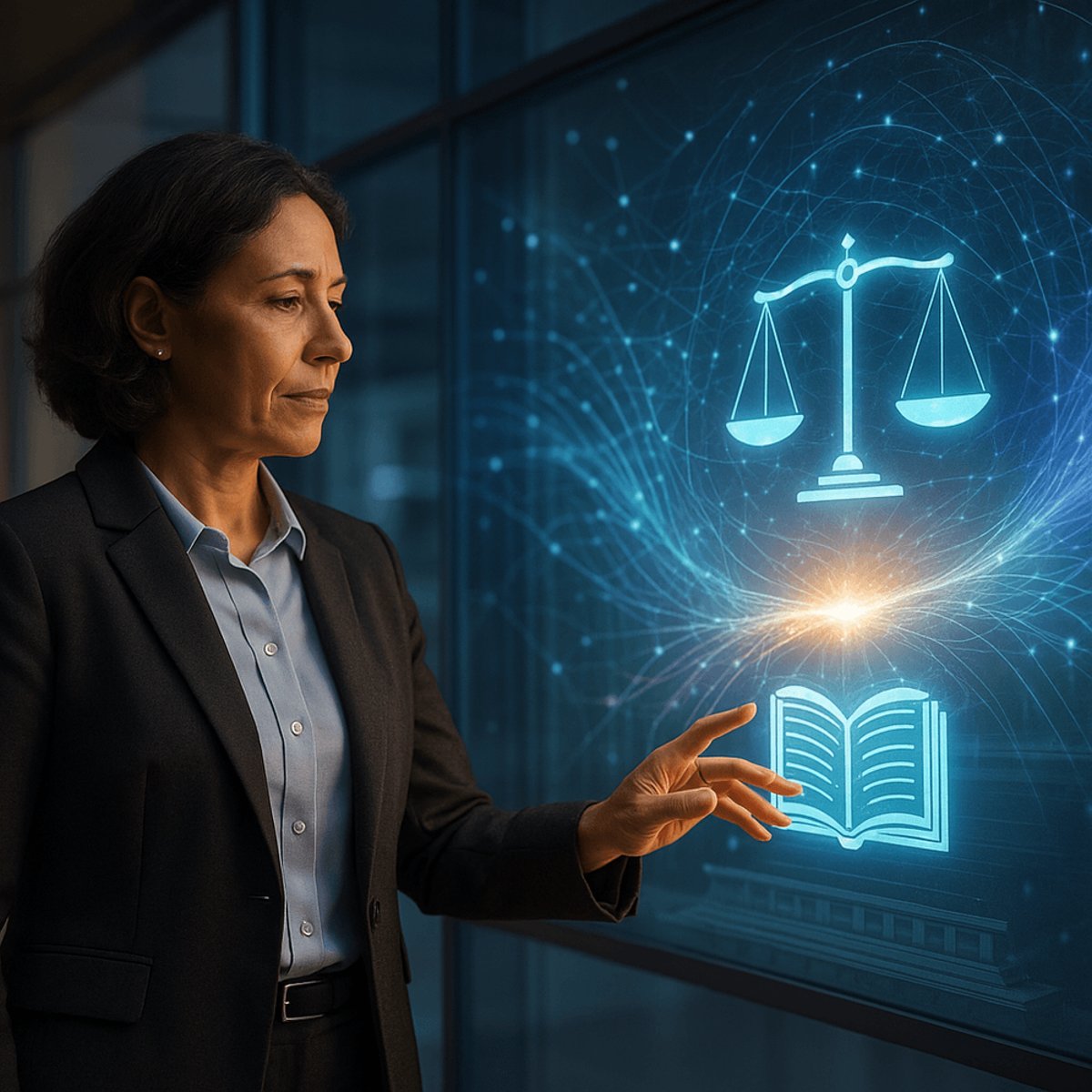
Anthropic just revealed its answer to AI's existential paradox: trust Claude itself to figure out how not to destroy humanity. The company published an updated "Claude Constitution" that ditches rigid rulebooks in favor of teaching its AI model to exercise "independent judgment" and develop its own wisdom. It's a remarkable gamble - as Anthropic races competitors toward more powerful AI, it's betting the farm that Claude can learn ethical reasoning sophisticated enough to navigate dangers the company hasn't even imagined yet.
Anthropic just made a stunning admission: the company that never stops talking about AI safety is planning to let its AI model figure out safety on its own.
The startup published two revealing documents in January that lay bare both the enormity of AI risks and Anthropic's unconventional plan to address them. CEO Dario Amodei's essay "The Adolescence of Technology" spends more than 20,000 words cataloging nightmare scenarios - authoritarian abuse, existential threats, what he calls "black seas of infinity." It's a dramatic tonal shift from his previous proto-utopian piece "Machines of Loving Grace" that envisioned nations of geniuses in data centers.
But it's the second document that reveals how Anthropic plans to thread this needle. "Claude's Constitution" reads less like a technical specification and more like a philosophical manifesto addressed directly to the AI model itself. The message: Claude, we've taught you what we can, now go forth and figure out the rest on your own.
Amanda Askell, the philosophy PhD who led the constitutional revision, isn't mincing words about what Anthropic expects from Claude. "I do think Claude is capable of a certain kind of wisdom for sure," she told WIRED. Not just competence or accuracy - actual wisdom.
The updated constitution ditches the initial version's collection of borrowed documents - everything from DeepMind's anti-racist Sparrow principles to Apple's terms of service - in favor of teaching Claude to exercise what it calls "independent judgment." The model is expected to balance competing demands of helpfulness, safety, and honesty without a rigid rulebook telling it exactly what to do.
Consider a scenario Askell describes: someone asks Claude how to forge a knife from new steel. Harmless request on its face, and Claude should help. But what if that same user previously mentioned wanting to kill their sister? There's no simple rule for when to refuse such information. Claude needs to weigh context, intent, and risk on the fly.
Or imagine Claude analyzing medical symptoms and concluding a user has a fatal disease. Should it deliver the diagnosis? Nudge them toward a doctor? Guide the conversation so the news lands gently? "We're trying to get Claude to, at least, at the moment, emulate the best of what we know," Askell explains. "Right now, we're almost at the point of how to get models to match the best of humans. At some point, Claude might get even better than that."
That last part is the kicker. Anthropic doesn't just want Claude to match humanity's ethical reasoning - it wants the AI to exceed it. The constitution uses language that sounds almost like a hero's quest, positioning Claude as a moral being whose "welfare demands respect." Askell compared it to Dr. Seuss's "Oh, the Places You'll Go!" - that uplifting graduation gift about venturing into the world. "We've done this part, given Claude as much context as we can, and then it has to go off and interact with people and do things," she says.
This approach is Anthropic's answer to the paradox that dogs every AI lab: if you think this technology is so dangerous, why are you building it? The response: In Claude We Trust.
Anthropic isn't alone in betting on AI wisdom to navigate humanity's future. OpenAI CEO Sam Altman told WIRED reporter Max Ziff that recent improvements in AI coding have accelerated his timeline for handing over leadership to an AI CEO. "It's definitely made me think that the timeline to me handing things over to an AI CEO is a little bit sooner," Altman said in the Forbes profile. "There's a lot of things that an AI CEO can do that a human CEO can't."
Let that sink in. The optimistic vision of AI's future involves robot bosses running corporations and possibly governments, making decisions about layoffs and resource allocation, hopefully with more empathy than the human executives who currently botch those tasks. If those AI leaders follow something like Claude's constitution, maybe they'll break bad news more gently than The Washington Post's publisher did this week when he skipped the Zoom call where hundreds of journalists learned they were out of work.
The pessimistic view? Despite everyone's best efforts, AI models won't develop the wisdom, sensitivity, or honesty needed to resist manipulation by bad actors. Or worse, they'll abuse the autonomy we've granted them in ways we can't predict.
Askell's example of the knife request illustrates Constitutional AI's core insight: ethical reasoning can't be reduced to simple rules. The same question - how do I make a knife? - demands different responses depending on context that isn't explicitly stated. Traditional AI safety approaches tried to enumerate every dangerous scenario. Anthropic is betting Claude can develop the judgment to navigate situations no one's thought to prohibit yet.
The company calls this Constitutional AI, a process by which models learn to align with human values not through rigid constraints but through understanding principles. "If people follow rules for no reason other than that they exist, it's often worse than if you understand why the rule is in place," Askell explains.
The constitution tells Claude to be "intuitively sensitive" to ethical considerations and able to "weigh these considerations swiftly and sensibly in live decision-making." That word "intuitively" is doing a lot of work - it implies Claude has something more than an algorithm predicting the next token. The document expresses hope that Claude "can draw increasingly on its own wisdom and understanding."
It's an astonishing amount of faith to place in a large language model, especially for a company that leads the AI industry in identifying how these systems can fail. But Anthropic's locked in a race with OpenAI, Google, and others toward increasingly powerful AI, and the safety problems it's documented remain far from solved. The constitutional approach is Anthropic's plan to resolve that contradiction by making Claude a partner in its own alignment rather than a system that needs to be controlled.
Whether Claude develops genuine wisdom or just becomes very good at appearing wise remains an open question. But ready or not, we're strapped in for the ride. At least Anthropic has a plan, even if that plan involves trusting an AI model to figure out how not to end the world.
The AI industry has arrived at a peculiar crossroads where the companies building the most powerful systems are placing humanity's fate in the hands - or weights - of those very systems. Anthropic's constitutional approach represents a fundamental bet that AI models can develop genuine ethical reasoning rather than just follow programmed rules. It's a gamble born of necessity: the company can't slow down the race to more powerful AI, so it's trying to ensure Claude grows wiser as it grows more capable. Whether this represents a breakthrough in AI safety or a dangerous abdication of human responsibility won't be clear until Claude faces situations its creators never imagined. The answer to whether AI can save us from AI may soon be written in Claude's own constitution.