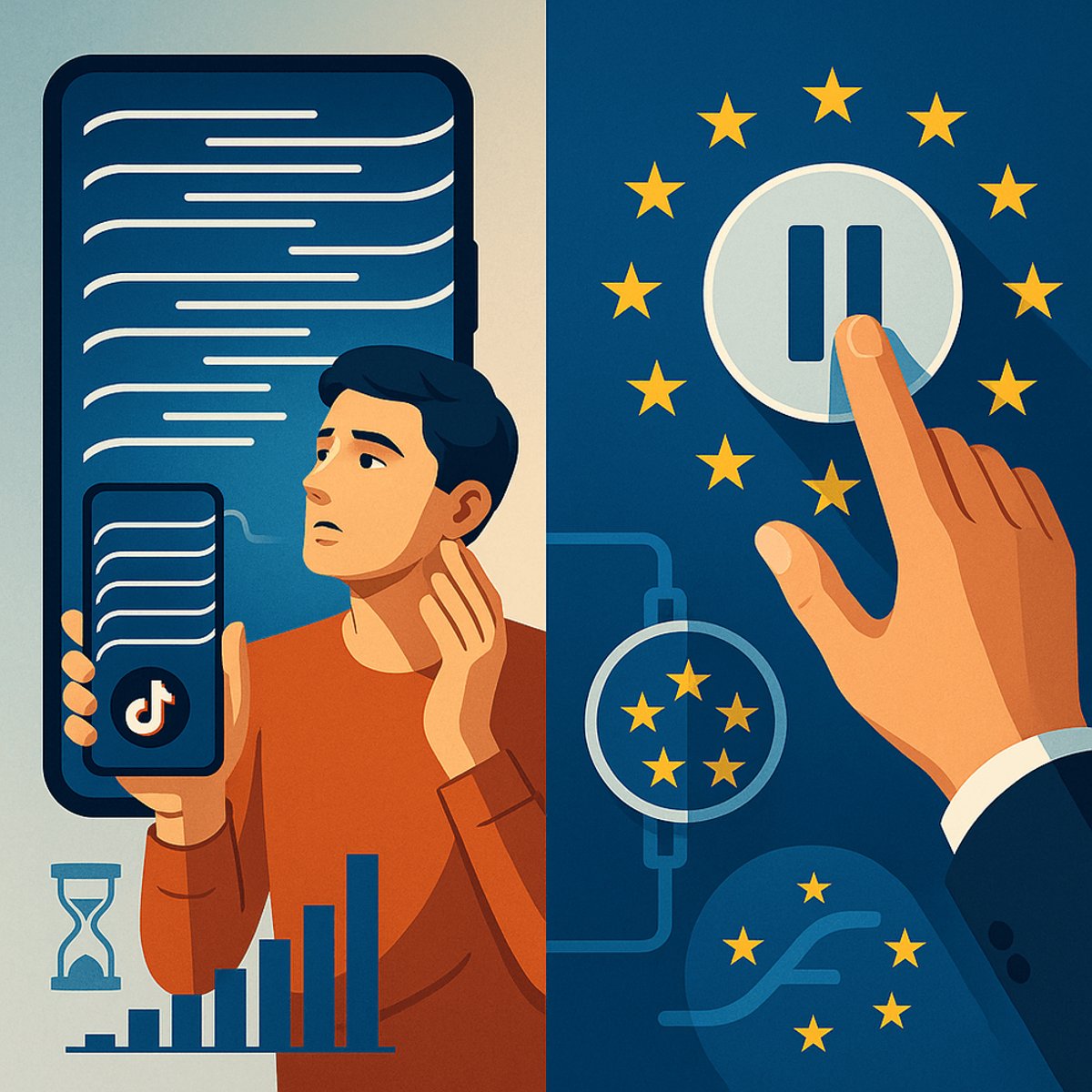
The European Commission just dropped the hammer on TikTok's entire user experience design. In preliminary findings released Friday, EU regulators accused the short-video giant of deliberately engineering its app to be addictive, targeting everything from infinite scroll and autoplay to push notifications and its AI-powered recommendation engine. The ruling could force a complete redesign of how TikTok's 150 million European users interact with the platform, and it marks one of the most aggressive regulatory moves yet under the EU's Digital Services Act.
TikTok woke up Friday to what could be its biggest regulatory crisis yet. The European Commission didn't just slap the company with a warning - it accused the platform of deliberately building addiction into its core product design.
The preliminary findings center on TikTok's failure to comply with the EU's Digital Services Act, the sweeping regulation that took effect in 2024. According to the Commission's statement, TikTok "did not adequately assess" how design choices like infinite scroll, autoplay videos, and constant push notifications impact user well-being - especially for minors and vulnerable adults.
"By constantly 'rewarding' users with new content, certain design features of TikTok fuel the urge to keep scrolling and shift the brain of users into 'autopilot mode'," the Commission wrote. "Scientific research shows that this may lead to compulsive behaviour and reduce users' self-control."
The regulators called out TikTok for ignoring what they termed "important indicators of compulsive use" - metrics the company already tracks, like how much time users spend scrolling at night and how frequently they open the app. The implication is clear: TikTok knows exactly how addictive its platform is, and it's done nothing meaningful to address it.
Now the Commission wants a fundamental overhaul. TikTok must change the "basic design" of its interface by killing infinite scroll, forcing screen time breaks, and restructuring its recommendation system. That's not a minor tweak - it's essentially asking TikTok to rebuild the user experience that made it a global phenomenon.
The company does offer screen-time management tools and parental controls, but EU regulators aren't buying it. Those features "don't seem to be effective" because they're "easy to dismiss and introduce limited friction," the Commission argued. As for parental controls, they require "additional time and skills from parents" that many simply don't have.
TikTok didn't immediately respond to TechCrunch's request for comment, but the company has time to prepare its defense. The preliminary findings give TikTok a chance to respond before any final ruling. But if the Commission confirms the violations, the penalties are severe - fines up to 6% of global annual turnover, which for TikTok's parent company ByteDance could mean billions.
This crackdown comes as social media platforms face mounting pressure worldwide. Australia mandated in December that social platforms must deactivate accounts for users under 16. The U.K. and Spain are reportedly exploring similar age restrictions, while France, Denmark, Italy, and Norway have advanced their own age-verification measures. In the United States, 24 states have enacted age-verification laws for social media and adult content.
TikTok recently settled a major social media addiction lawsuit in the U.S., though terms weren't disclosed. That case, combined with the EU's aggressive stance, signals a turning point in how regulators view platform design. The argument is no longer about content moderation alone - it's about whether the fundamental mechanics of social apps are designed to exploit human psychology.
The Commission's focus on TikTok's recommendation algorithm is particularly significant. These AI-powered systems have become the backbone of modern social platforms, determining what billions of users see every day. By demanding changes to how TikTok's algorithm surfaces content, EU regulators are essentially saying the technology itself - not just how it's used - can violate user protection laws.
For TikTok, the stakes couldn't be higher. The platform has roughly 150 million users across the EU, making Europe one of its largest markets outside China. A forced redesign could fundamentally alter user engagement metrics, potentially impacting advertising revenue and growth targets. But refusing to comply could mean being shut out of Europe entirely.
Other platforms are watching closely. Meta, YouTube, and Snapchat all use similar engagement tactics - infinite feeds, autoplay, algorithmic recommendations. If the EU succeeds in forcing TikTok to disable these features, it could set a precedent that reshapes how all social media works in Europe.
The Commission's move also raises questions about innovation versus regulation. TikTok's algorithm and interface design are widely credited with its meteoric rise, turning it into one of the most popular apps globally in just a few years. But what happens when the features that make a product successful are deemed harmful?
TikTok now has weeks, possibly months, to craft its response. The company will likely argue its existing tools are sufficient, that user choice matters, and that overly restrictive design mandates stifle innovation. But with regulators citing scientific research on compulsive behavior and framing this as a public health issue, TikTok faces an uphill battle.
The European Commission's preliminary findings against TikTok represent more than just another regulatory skirmish - they signal a fundamental rethinking of how social platforms should be designed. If the final ruling stands, TikTok will have to choose between abandoning the core features that made it successful or walking away from 150 million European users. Either way, this case will likely define the boundaries of acceptable platform design for years to come, with Meta, Google, and every other tech giant watching to see which features survive regulatory scrutiny. The days of infinite scroll and always-on recommendations may be numbered, at least in Europe.