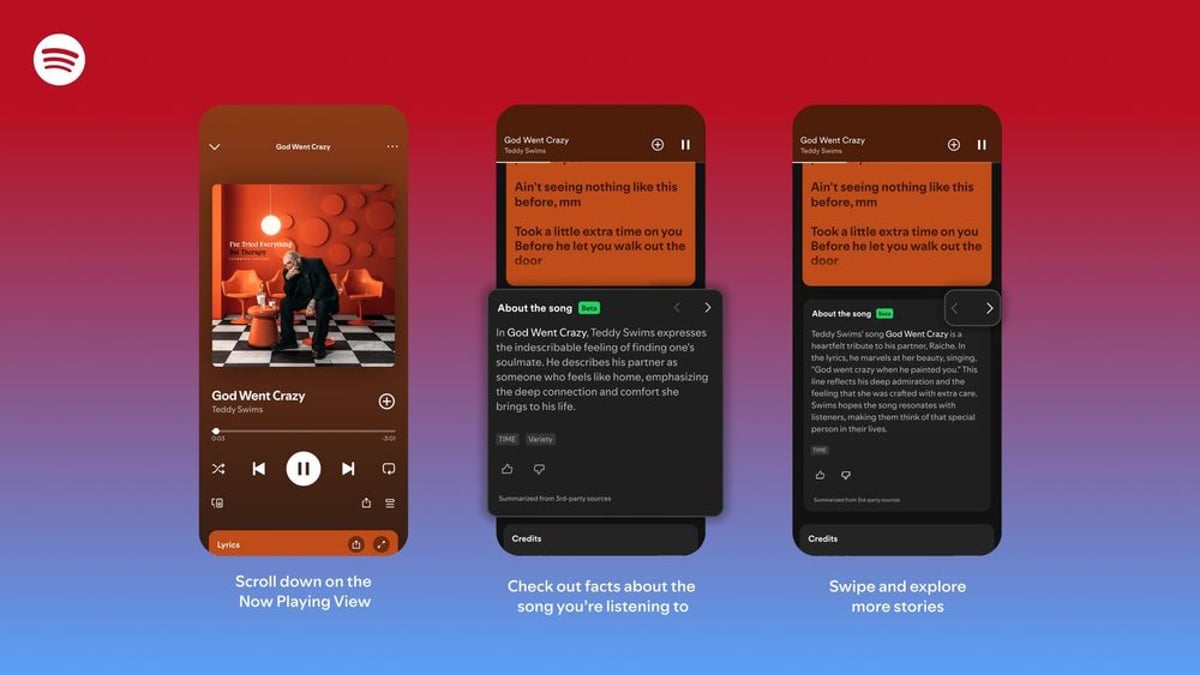
Spotify is rolling out About the Song, a new feature that brings AI-generated liner notes to Premium subscribers. The beta launch taps machine learning to pull trivia and background stories from third-party sources, presenting them as swipeable cards in the Now Playing view. It's a modest but telling move as streaming platforms hunt for ways to deepen engagement beyond just hitting play.
Spotify just turned your music player into a mini encyclopedia. The company announced About the Song today, a beta feature that serves up AI-generated context cards while you listen. Premium subscribers can now scroll down in the Now Playing view to find trivia, backstories, and production details about tracks - think digital liner notes, but generated on the fly.
The feature pulls information from third-party sources and uses machine learning to package it into short, swipeable cards. Spotify at least cites its sources on each card, addressing one of the bigger criticisms of AI-generated content. But the company stayed quiet on key details, declining to say whether free users will eventually get access or when the beta might graduate to full release.
Right now, About the Song only works for a limited number of tracks. Spotify says it plans to expand coverage, but didn't offer a timeline. That measured rollout makes sense - the feature needs solid source material, and that takes time to aggregate and process at scale.
This isn't Spotify's first swing at adding context around music. The company rolled out expanded Song Credits and SongDNA late last year, giving listeners deeper info about the producers, writers, and session musicians behind their favorite tracks. Those features also map connections between artists, showing how collaborators and influences weave through music history.
The real catalyst came in November 2025, when Spotify acquired WhoSampled, the go-to database for sample credits and interpolations. That acquisition handed Spotify a massive repository of music DNA - who sampled what, which beats trace back to which breaks, and how hip-hop producers and electronic artists have recycled and reimagined sounds across decades.
Now that data is feeding into both SongDNA and About the Song, creating a richer layer of discovery. For music nerds who've spent years diving into WhoSampled rabbit holes, having that info surface automatically while listening is a genuine upgrade. It's the kind of feature that won't make headlines but could quietly boost engagement metrics.
The machine learning angle is interesting but not revolutionary. Spotify is essentially automating what music journalists and liner note writers have done for decades - gathering context and presenting it in digestible chunks. The difference is scale. A human can't write personalized notes for 100 million tracks, but an algorithm can at least try.
Still, questions linger about accuracy and depth. Machine-generated text can miss nuance or flatten interesting stories into generic summaries. The caption in Spotify's own promotional image - noting that Teddy Swims hopes his song "resonates" with listeners - already hints at the risk of surface-level fluff. If About the Song ends up serving bland PR speak instead of genuine insight, users will tune it out fast.
The competitive context matters here. Apple Music has long emphasized editorial curation and human-written playlists as a differentiator. Spotify has leaned harder on algorithmic discovery and personalization. About the Song feels like a middle path - using AI to deliver the kind of editorial context that Apple touts, but at Spotify scale.
For now, the feature is Premium-only, which makes sense as a subscriber perk. But keeping it paywalled long-term could limit its impact. Music discovery features tend to work best when they reach the widest audience possible, creating network effects and shared cultural moments. If About the Song stays locked behind a subscription, it risks becoming a footnote rather than a platform staple.
The timing is also notable. Streaming growth has slowed in mature markets, and platforms are hunting for ways to boost average revenue per user without just hiking prices. Adding features that make Premium feel more valuable is a softer path to better unit economics. Whether AI trivia cards move the needle on subscriber retention remains to be seen.
About the Song won't reinvent music streaming, but it's a smart incremental move in the battle for listener attention. By layering AI-generated context onto playback, Spotify is betting that deeper engagement beats pure catalog size. The success hinges on execution - if the trivia feels insightful rather than algorithmic, it could become a sticky feature that keeps Premium subscribers around. If it feels like filler, it'll join the long list of streaming experiments that users ignore. Either way, it's another signal that platforms see their future in curated experiences, not just access to music.