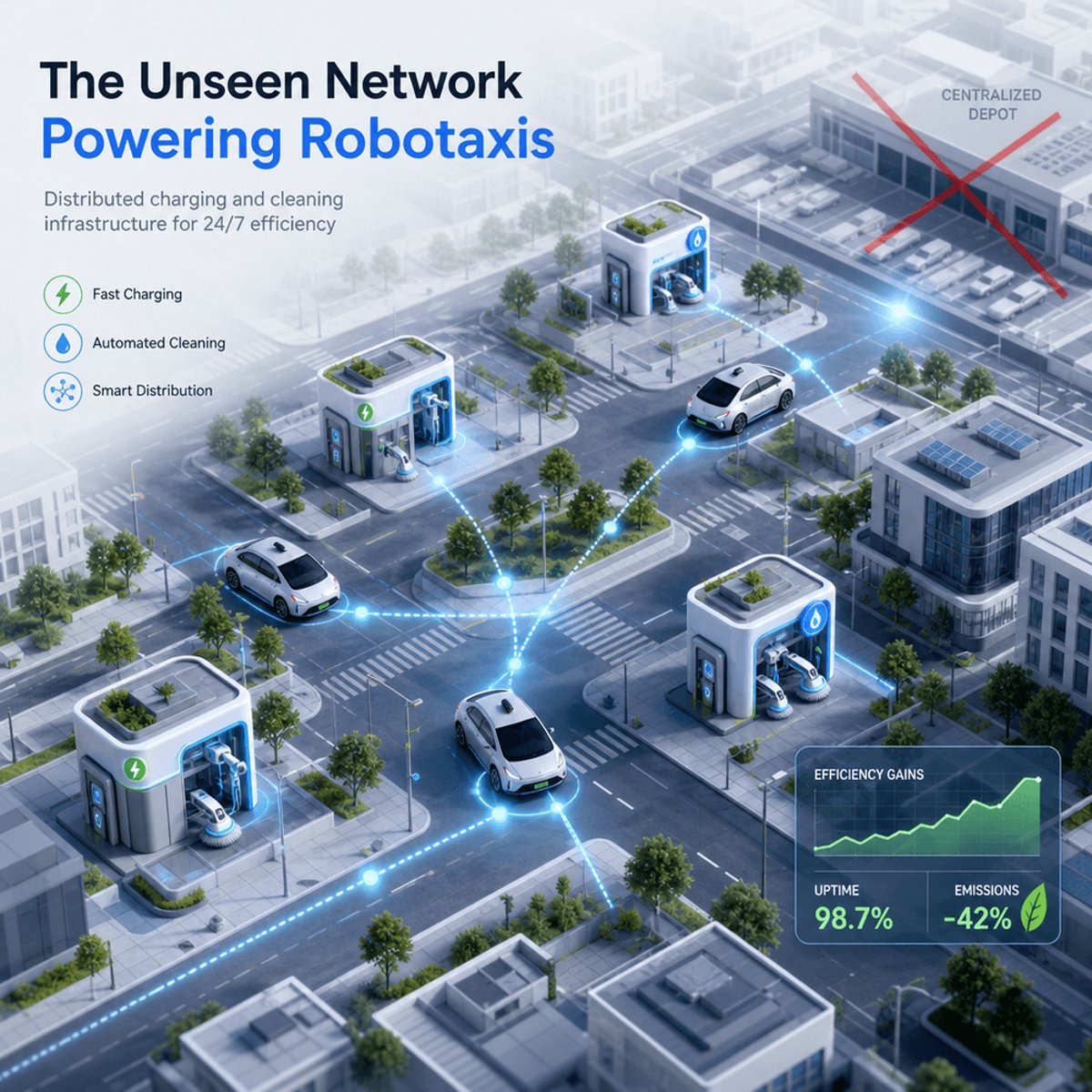
Robotaxis have a dirty secret: they burn thousands of miles driving themselves to centralized depots just to get cleaned and recharged. Aseon Labs, fresh out of Y Combinator's spring 2026 cohort, just raised $10 million from Crane Venture Partners and others to solve what might be the autonomous vehicle industry's biggest operational headache. The startup is building distributed pit-stop infrastructure that brings charging and cleaning to where robotaxis actually operate, potentially slashing the 'empty miles' that are killing unit economics for companies like Waymo.
Aseon Labs is tackling one of those problems hiding in plain sight. While the autonomous vehicle industry obsesses over sensor fusion and regulatory approvals, robotaxis are quietly racking up thousands of unprofitable miles just getting to maintenance facilities. The startup emerged from Y Combinator's spring 2026 cohort with a straightforward pitch: stop making self-driving cars commute to centralized depots when you could bring the infrastructure to them.
The $10 million seed round, led by Crane Venture Partners according to TechCrunch's exclusive report, validates what fleet operators have known for months: the current model doesn't scale. Every mile a robotaxi drives empty to reach a charging station is a mile it's not earning revenue. Multiply that across hundreds of vehicles making multiple depot runs daily, and you've got a unit economics nightmare that threatens the entire business model.
Waymo, which operates the largest commercial robotaxi service in the US, hasn't publicly disclosed what percentage of its fleet miles are non-revenue 'deadhead' trips to maintenance facilities. But industry observers estimate operational overhead including charging, cleaning, and repositioning can account for 15-25% of total vehicle miles in dense urban deployments. That's a massive drag on profitability when your competitors are human drivers who refuel in five minutes at any gas station.
Aseon Labs' solution is decidedly low-tech compared to the vehicles it services. The company is building what it calls distributed pit stops - compact facilities scattered throughout service areas where robotaxis can autonomously pull in for rapid charging and automated cleaning. Think of them as the autonomous vehicle equivalent of convenience store gas stations, strategically placed to minimize detours from active service zones.
The infrastructure play makes sense when you consider how robotaxi economics actually work. Unlike personal EVs that charge overnight at home, commercial autonomous fleets need to maximize road time. Centralized depots made sense when fleets numbered in the dozens, but as Waymo and others push toward thousands of vehicles across multiple cities, the logistics become untenable. You either build massive facilities that vehicles must travel to, or you distribute smaller facilities that come to the vehicles.
Y Combinator's backing signals the accelerator sees this as a picks-and-shovels infrastructure bet on the autonomous vehicle buildout. Rather than gambling on which robotaxi company wins, Aseon Labs is positioning itself as essential infrastructure for whoever succeeds. It's the same playbook that worked for EV charging networks, though the business model here is B2B rather than consumer-facing.
The timing aligns with a broader maturation of the autonomous vehicle sector. Early operators focused on proving the technology worked; now they're grinding through the operational realities of running large fleets. Maintenance, cleaning, charging, and logistics aren't sexy problems, but they're the difference between a demonstration project and a profitable transportation service.
What remains unclear is whether Aseon Labs will own and operate these facilities directly or license the technology to fleet operators. The capital requirements differ dramatically - owning real estate and charging infrastructure across multiple cities demands significantly more funding than software licensing. The $10 million seed round suggests an initial hybrid approach, likely deploying pilot facilities in key markets while developing partnerships with property owners and fleet operators.
Competition is inevitable. Traditional gas station operators, EV charging networks, and even the robotaxi companies themselves could build similar infrastructure. But Aseon Labs has first-mover advantage in a market that's about to explode. As autonomous vehicle deployments accelerate beyond San Francisco and Phoenix into dozens of cities, the infrastructure gap will only widen.
Aseon Labs is betting that the autonomous vehicle revolution will be won or lost not in the algorithms, but in the logistics. As robotaxi fleets scale from hundreds to thousands of vehicles, the operational infrastructure needs to evolve beyond centralized depots that made sense for pilot programs. The $10 million seed round gives the startup runway to prove that distributed charging and cleaning infrastructure can meaningfully improve fleet economics. If they're right, every major robotaxi operator will need what Aseon Labs is building. If they're wrong, they'll have built expensive real estate in service of a market that found another solution. Either way, the empty miles problem isn't going away - and someone's going to make money solving it.