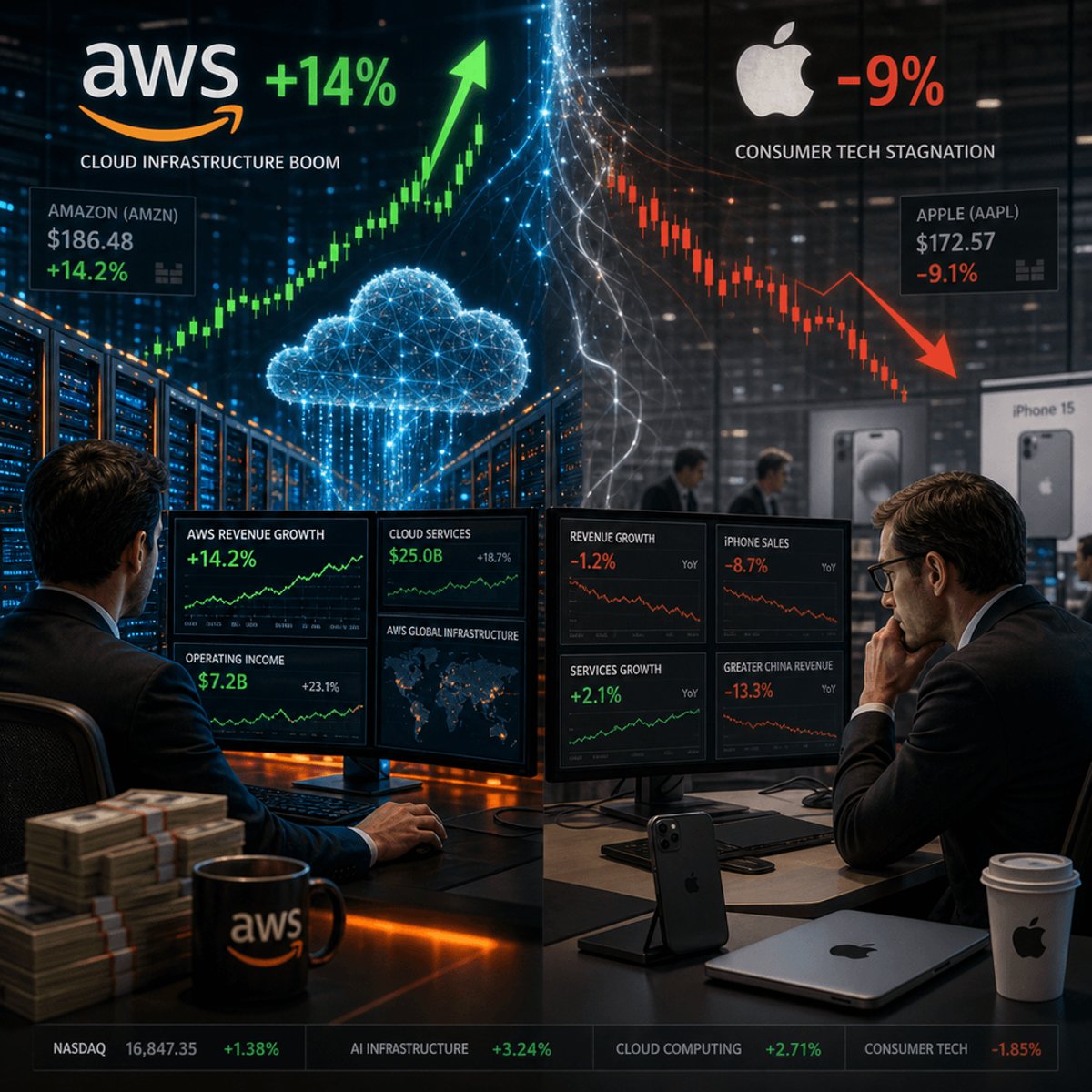
Wall Street just picked its AI winner, and it's wearing Amazon's logo. Amazon stock rocketed 14% in Friday trading after the company reported explosive growth in its cloud computing division, while Apple crashed 9% on disappointing forward guidance. The dramatic split marks one of the sharpest divergences between big tech titans this earnings season, as investors reward companies proving they can monetize AI infrastructure while punishing those still searching for their generative AI strategy.
Amazon just delivered the earnings report every cloud investor wanted to see. The e-commerce and cloud giant's stock exploded 14% higher Friday as Wall Street digested a quarter that showed AWS revenue surging past expectations, driven almost entirely by enterprises rushing to deploy AI workloads. It's the kind of move that doesn't happen often for a company Amazon's size - and it came at the exact moment Apple was collapsing 9% on the opposite news.
The contrast couldn't be starker. While Amazon's cloud division is printing money from companies desperate for GPU capacity and AI infrastructure, Apple issued guidance that sent a chill through the market. Investors had been banking on the iPhone maker's AI features driving a massive upgrade cycle, but the numbers suggest consumers aren't biting yet. According to the earnings report via CNBC, that disconnect between AI hype and actual revenue is now showing up in forward-looking numbers.
AWS has become the undisputed engine of Amazon's profit machine, and this quarter proved the AI boom isn't just talk. Cloud customers are burning through compute resources training models and running inference workloads at a pace that's accelerating, not plateauing. The revenue surge caught even bullish analysts off guard, suggesting enterprise AI adoption is happening faster than Wall Street modeled. Every percentage point of AWS growth drops almost directly to Amazon's bottom line, making this the kind of earnings beat that fundamentally rerates a stock.
But Apple's stumble reveals the other side of the AI trade. Building features is one thing - getting customers to pay for them is another. The company's lackluster guidance implies that whatever AI capabilities it's rolling out in iOS aren't yet compelling enough to drive the device refresh cycle investors expected. That's a problem when your stock trades at a premium multiple based on the assumption that AI will unlock the next supercycle of iPhone sales. The 9% drop reflects Wall Street recalibrating those expectations in real-time.
This earnings divergence is about more than two companies having different quarters. It's a referendum on where value accrues in the AI stack. Amazon is selling the picks and shovels - the infrastructure that every company needs whether they're building the next ChatGPT competitor or just adding a chatbot to their website. Apple is trying to sell the end product, betting consumers will upgrade hardware for AI features that remain largely experimental. Right now, the market is screaming that infrastructure wins.
The move also highlights how quickly sentiment can shift in big tech. Just months ago, Apple was considered an AI laggard that needed to prove it had a strategy. Then came the announcements, the developer tools, the partnership whispers. But talk doesn't move earnings, and earnings move stock prices. Amazon, meanwhile, has been quietly monetizing AI demand through AWS without making grand pronouncements - and investors just rewarded that approach with a $200 billion-plus market cap increase in a single session.
What's particularly striking is the speed of the reversal. Tech stocks have been volatile all year as the market tries to figure out which companies will actually profit from generative AI versus which are just riding the hype cycle. Amazon's surge and Apple's crash suggest investors are done being patient. They want to see revenue and margin expansion now, not promises about what AI might deliver in 2027. The cloud business is delivering that today.
This creates an uncomfortable dynamic for the rest of big tech heading into their earnings prints. Microsoft, Google, and Meta are all facing the same question: can you show AI revenue, or just AI spending? Amazon just set the bar for what a winning answer looks like. The companies that can point to customers actually paying more because of AI will get rewarded. Those still in the investment phase without clear monetization will get hammered, regardless of how impressive the technology sounds.
The competitive landscape is shifting too. Apple's weak guidance hands an opening to Samsung and other Android manufacturers who've been pushing their own AI device features. If consumers aren't upgrading iPhones for Apple Intelligence, maybe they're not upgrading at all - or worse, they're switching to cheaper alternatives that offer similar AI capabilities. That would mark a significant crack in Apple's premium positioning.
For Amazon, the challenge now is sustaining this growth rate. Cloud revenue doesn't accelerate in a straight line forever, and at some point enterprises will finish their initial AI infrastructure buildouts. The company needs to prove this isn't just a one or two-quarter sugar rush as companies spin up initial projects, but rather a fundamental shift in cloud consumption patterns that will persist for years. If AWS growth moderates next quarter, this 14% pop could evaporate just as quickly as it appeared.
The options market is already pricing in continued volatility for both stocks. Implied volatility spiked on both names as traders position for the next leg of the move - either continuation or reversal. For Apple, the question is whether this guidance miss is a blip or the start of a longer malaise as the company figures out its AI revenue model. For Amazon, it's whether AWS can keep posting these kinds of beats or if this quarter represented peak AI infrastructure spending growth.
Friday's dramatic split between Amazon and Apple isn't just about one good quarter and one disappointing outlook - it's the market drawing a bright line between AI companies that are monetizing now and those still searching for a business model. Amazon proved that selling infrastructure to the AI gold rush is a profitable business today, while Apple's stumble shows that converting AI features into consumer upgrade cycles remains elusive. As the rest of big tech reports earnings, they'll be measured against the standard Amazon just set: show us the AI revenue, not just the AI roadmap. The companies that can't will likely join Apple in the penalty box, regardless of how impressive their models or features might be.