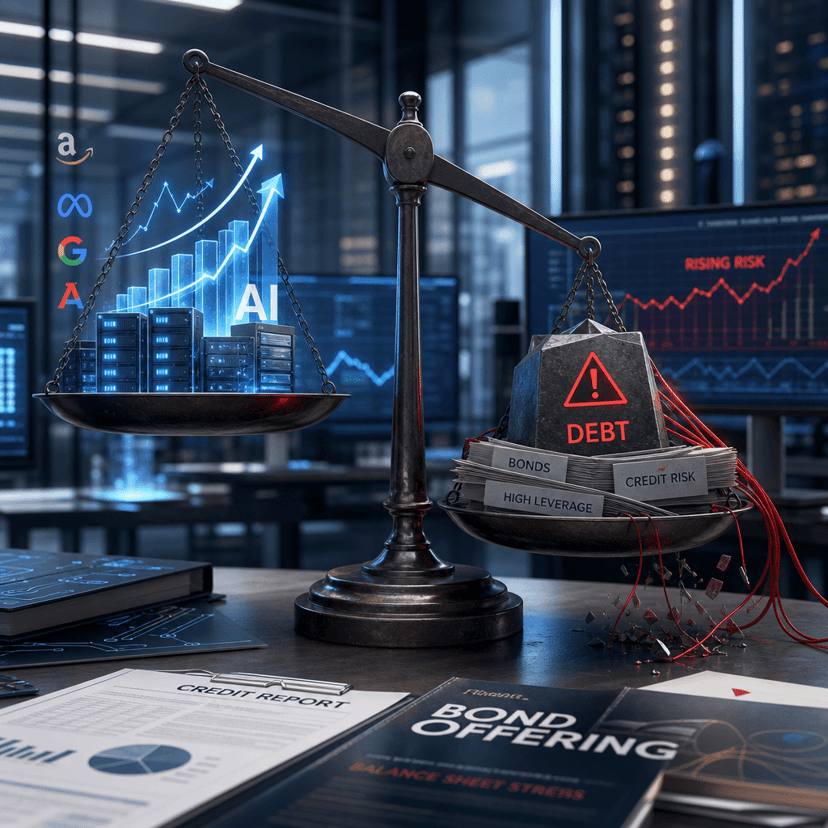
Wall Street's bond traders are sending a clear signal: they're getting nervous about Big Tech's massive AI spending binge. Credit spreads for Google, Amazon, and Meta have widened noticeably in recent weeks as fixed-income investors demand higher returns to compensate for what they see as mounting financial risk. It's a striking shift in sentiment that puts a spotlight on whether the AI infrastructure buildout can actually deliver the returns these companies are promising.
The bond market is staging a quiet rebellion against Big Tech's AI ambitions. While equity investors have been cheering every new data center announcement and chip order, debt holders are taking a harder look at the numbers - and they don't like what they're seeing.
Credit spreads for Google, Amazon, and Meta have been creeping wider over the past month, according to CNBC. That means bond investors are demanding more compensation for the risk of lending money to these companies, even as their stock prices have remained relatively buoyant. It's the kind of divergence that usually signals something important is happening beneath the surface.
The tension centers on capital expenditure budgets that have ballooned to eye-watering levels. Meta alone is expected to spend upwards of $40 billion this year on AI infrastructure, while Google and Amazon are each plowing tens of billions into data centers, custom chips, and the massive energy infrastructure needed to power it all. For context, that's more than most countries spend on their entire technology sectors.
But here's the thing - bond investors care about cash flow and debt service, not moonshots. They want to see returns that justify the spending, and right now, the path from "we built another massive GPU cluster" to "here's the revenue it generated" remains frustratingly unclear for many of these projects.
The widening spreads suggest fixed-income investors are starting to price in real execution risk. What if the AI boom doesn't materialize as quickly as promised? What if competitors end up in a destructive spending war that craters margins? What if regulatory headwinds slow deployment? These are the questions keeping bond traders up at night, even as their equity colleagues remain bullish.
This isn't just academic handwringing. When credit spreads widen, borrowing costs rise. That means future debt issuances become more expensive, which could theoretically force companies to tap the brakes on their AI spending plans - or at least become more selective about which projects get funded. It's a real-world constraint that could reshape the entire AI infrastructure race.
The divergence between equity and debt market sentiment is particularly striking. Stock analysts have largely embraced the "build it and they will come" narrative around AI infrastructure, viewing massive capex as a necessary investment in future dominance. Bond investors, by contrast, operate with a show-me mentality. They've seen tech spending booms before, and they remember how many of those bets didn't pan out.
What makes this moment especially interesting is the timing. We're roughly two years into the generative AI boom that kicked off with ChatGPT's launch, and we're entering the phase where investors - particularly those focused on fixed-income returns - want to see tangible business outcomes, not just impressive demos and proof-of-concept projects.
Amazon Web Services has been making the case that its AI infrastructure investments are already paying dividends through increased cloud customer spending. Google has been highlighting AI-driven improvements in ad targeting and search quality. Meta points to engagement gains from AI-powered content recommendations. But translating those improvements into the kind of revenue growth that justifies $100 billion-plus in combined annual AI spending remains a work in progress.
The bond market's skepticism could actually prove healthy in the long run. It creates a counterpressure to the hype cycle, forcing companies to think harder about ROI and be more transparent about their AI economics. If spreads continue to widen, expect to see more detailed breakdowns of AI-related revenue and profitability in upcoming earnings calls.
For now, the message from fixed-income investors is clear: we're willing to lend you money for your AI dreams, but it's going to cost you more. That's not a vote of no confidence exactly, but it's definitely not a ringing endorsement either. It's a reminder that in the world of corporate debt, enthusiasm only goes so far - eventually, you have to show the math.
The bond market's growing anxiety over AI spending represents a critical reality check for Big Tech's infrastructure buildout. While equity investors remain largely optimistic about long-term AI potential, debt holders are demanding concrete evidence that these massive capital investments will generate returns sufficient to justify the risk. This divergence in sentiment between stock and bond markets could ultimately prove constructive, forcing companies to be more disciplined and transparent about their AI economics. As credit spreads continue to signal caution, the pressure is on Google, Amazon, and Meta to demonstrate that their AI bets are more than just expensive experiments - they're sound business investments that will drive sustainable growth and cash flow generation.