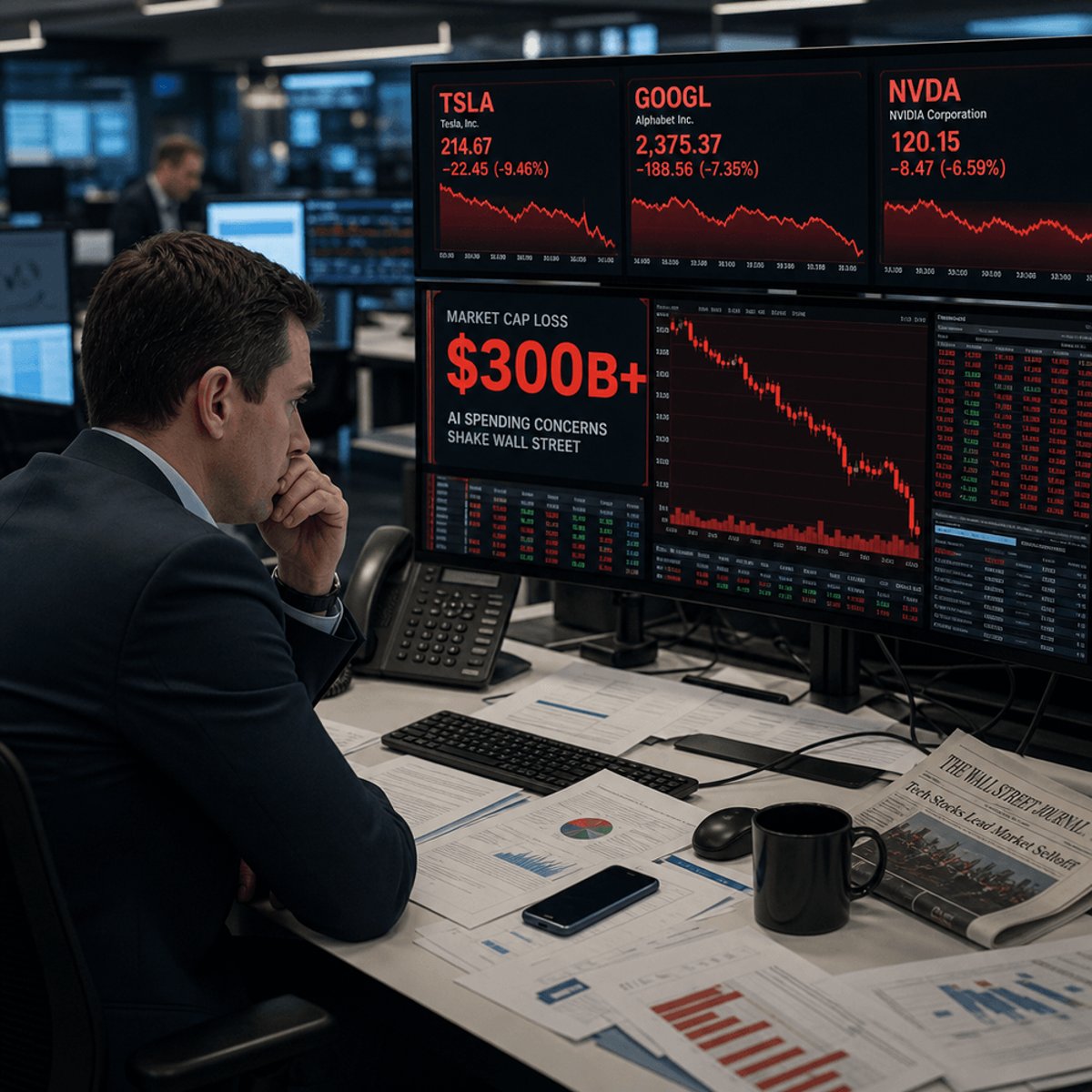
Wall Street just delivered a brutal verdict on the AI arms race. Tesla and Alphabet collectively hemorrhaged over $300 billion in market value Thursday after both tech giants revealed plans to dramatically ramp up AI spending in their latest earnings reports. The synchronized sell-off signals growing investor anxiety that the industry's trillion-dollar bet on artificial intelligence may take far longer to pay off than initially promised, sending shockwaves through a market already jittery about tech valuations.
Tesla shares plummeted 12% in Thursday trading while Alphabet dropped 9%, erasing a combined $320 billion in shareholder wealth in what's shaping up to be the tech sector's worst earnings reaction since the pandemic boom went bust. The carnage started after-hours Wednesday and accelerated through the morning session as investors digested the implications of what both companies are calling "necessary investments" in AI infrastructure.
The trigger wasn't weak revenue or declining profits. Both companies actually beat analyst estimates on the top line. What spooked the Street was the price tag attached to their AI ambitions. Alphabet CFO Ruth Porat revealed during the earnings call that capital expenditures would climb to $75 billion for fiscal 2026, a 35% jump from the previous year, with the bulk earmarked for data center expansion and AI chip procurement. Tesla wasn't far behind, with CEO Elon Musk casually mentioning the company would need to "significantly increase" spending on training compute for its Full Self-Driving system and the Optimus humanoid robot project.
"The market's patience with 'invest now, profit later' narratives is wearing thin," said Daniel Ives, managing director at Wedbush Securities, in a note to clients. "Investors want to see a clearer path to monetization, not just promises that AI will eventually transform everything." The sentiment echoed across trading desks from New York to San Francisco, where portfolio managers who'd been riding the AI wave suddenly found themselves questioning whether the emperor has any clothes.
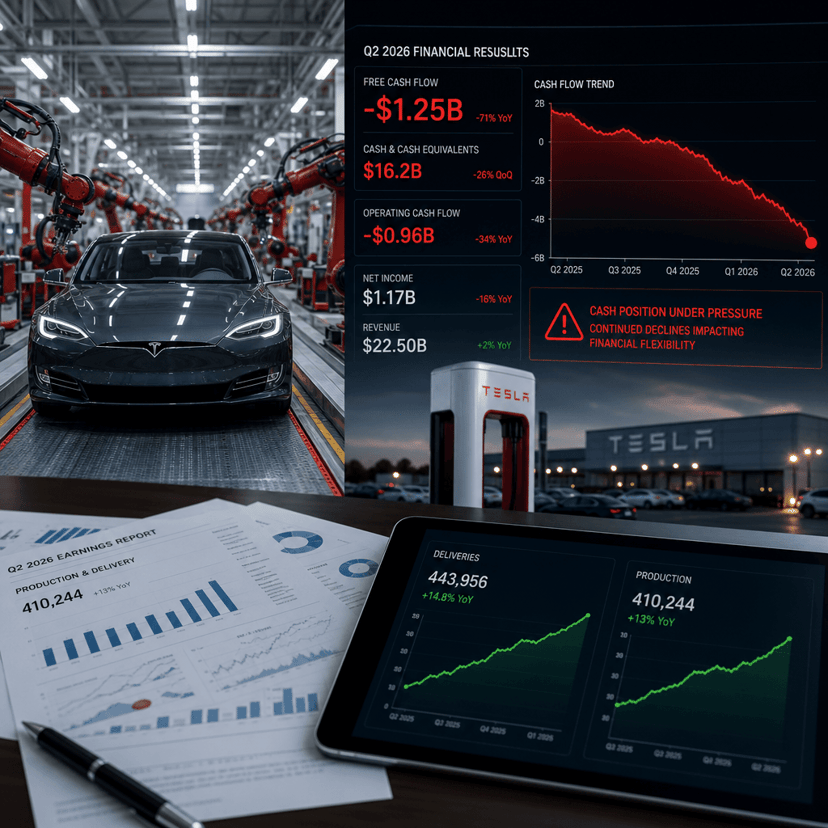
The timing couldn't be worse for Alphabet. The company's been pouring billions into its Gemini large language model and AI-powered search features, but advertiser adoption remains sluggish. Search revenue grew just 4% year-over-year, the slowest pace in three years, according to the company's Q2 2026 earnings report. Meanwhile, Microsoft and OpenAI continue to chip away at Google's search dominance with ChatGPT integrations that feel more natural to users than Alphabet's bolt-on AI features.
Tesla's situation is equally precarious. The company's been promising fully autonomous robotaxis since 2019, but regulators remain skeptical and the technology keeps hitting roadblocks. Automotive gross margins compressed to 16.2% in Q2, down from 18.9% a year ago, as price cuts to stimulate demand ate into profitability. Now Musk wants shareholders to fund another multi-billion-dollar AI spending spree while the core auto business shows signs of strain. "We're basically running the largest AI training operation on real-world data," Musk told analysts, seemingly oblivious to the fact that investors just watched $95 billion in market cap vanish.
The contagion spread beyond just these two names. Nvidia, the chief beneficiary of AI spending, dipped 3% on fears that if customers like Alphabet face investor pushback, future chip orders might get scaled back. Meta and Amazon, both of which report earnings next week, saw their shares slip in sympathy as traders priced in similar spending surprises. The Nasdaq Composite closed down 2.1%, its worst single-day drop in four months.
What's particularly striking is how quickly sentiment shifted. Just six weeks ago, Alphabet and Tesla were trading near all-time highs, buoyed by enthusiasm over their AI roadmaps. Both CEOs had spent months on media tours evangelizing about artificial general intelligence and autonomous everything. Now those same narratives are being used against them. "They oversold the timeline and undersold the costs," said Sarah Chen, tech analyst at Raymond James. "The market's repricing that reality in real-time."
The deeper issue is that neither company has demonstrated a clear return on AI investment yet. Alphabet's AI features haven't meaningfully increased search queries or ad rates. Tesla's Full Self-Driving remains a $15,000 beta product with limited real-world utility. Investors are starting to wonder if they're funding science projects rather than profit centers. The comparison to the dot-com bubble is becoming harder to dismiss, especially when companies are burning cash on infrastructure before proving the business model works.
What happens next depends largely on whether Alphabet and Tesla can show tangible progress on monetization before the next earnings cycle. Analysts expect both companies to provide more detailed AI revenue breakouts in Q3, along with updated timelines for major product launches. If those materialize and show traction, the sell-off could reverse quickly. But if spending keeps climbing while returns remain theoretical, this week's bloodbath might just be the opening act of a broader tech reckoning. With Microsoft, Meta, and Amazon all set to report in the coming days, the pressure's on to prove that AI spending isn't just an expensive bet on a distant future.
Thursday's market carnage marks a pivotal moment for the tech industry's AI narrative. Investors just sent a clear message: show us the money, not just the vision. With over $300 billion in market value erased in a single session, Tesla and Alphabet now face the difficult task of proving their AI investments will generate returns before Wall Street loses faith entirely. The coming earnings reports from Microsoft, Meta, and Amazon will reveal whether this is an isolated correction or the start of a broader reckoning for AI spending across Silicon Valley. For now, the market's verdict is unambiguous: big promises require bigger proof points.