TL;DR:
• Nvidia and AMD agreed to pay US government 15% revenue cut from China AI chip sales per Financial Times
• Deal covers Nvidia's H20 chips and AMD's MI308 processors with licenses now being issued
• Marks shift from security-based export controls to revenue-sharing trade policy
• Critics warn arrangement undermines national security objectives despite $500B domestic investment pledge
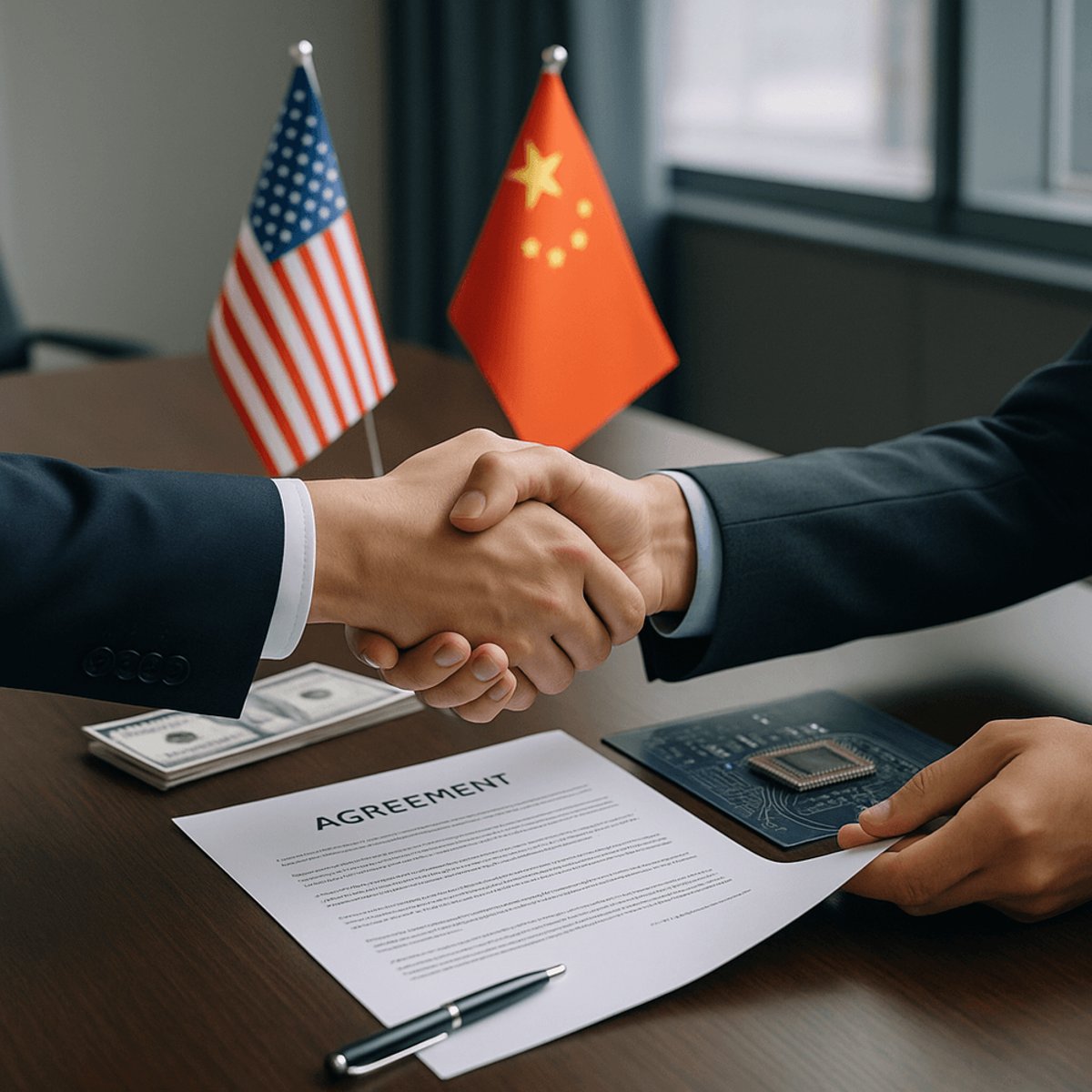
The AI chip war just took a dramatic turn from national security to revenue sharing. Nvidia and AMD have agreed to pay the U.S. government 15% of their high-end AI chip sales revenue to China in exchange for export licenses, according to a Financial Times report citing government sources. The unprecedented deal transforms what was once a security-driven export ban into a profit-sharing arrangement that could reshape global semiconductor trade.
The semiconductor standoff between Washington and Beijing just got a lot more complicated. What started as a straightforward national security play has morphed into something that looks suspiciously like a protection racket, with Nvidia and AMD now paying tribute to Uncle Sam for the privilege of selling their most advanced chips to Chinese customers.
According to government sources speaking to the Financial Times, Nvidia will fork over 15% of revenue from its H20 AI chip sales in China, while AMD faces the same cut on its MI308 processors. The Commerce Department has already started issuing licenses under this new framework, effectively monetizing what was previously a binary export control system.
The arrangement represents a stunning reversal from the Trump administration's original hardline stance. Back in April, the White House had restricted sales of high-performance AI inference chips to China entirely. But that ban lasted only a couple of months before Nvidia negotiated its way back into the Chinese market by promising $500 billion in domestic data center investments.
By July, Nvidia was back to selling its China-specific H20 chips, which the company had originally designed to comply with Biden-era export restrictions. The H20 represents a deliberate downgrade from Nvidia's flagship H100 and H200 processors, offering reduced memory bandwidth and interconnect capabilities to stay within export control thresholds while still delivering substantial AI computing power.
U.S. Commerce Secretary Howard Lutnick later revealed that Nvidia's China pivot was actually tied to broader trade negotiations involving rare-earth elements. China controls roughly 80% of global rare-earth processing capacity, creating a chokepoint for everything from EV batteries to defense systems. The chip-for-minerals swap suggests the administration views semiconductor exports as bargaining chips in a larger economic chess game.
But national security hawks aren't buying the economic logic. Last month, former government officials and security experts sent a letter to Lutnick urging him to reverse course on the H20 approvals. Their argument: allowing any advanced AI chip sales to China, even with revenue sharing, undermines the strategic objective of maintaining America's technological edge in artificial intelligence.
The revenue-sharing model creates perverse incentives for both companies and regulators. Nvidia and AMD now have a direct financial interest in maximizing their Chinese sales, while the Treasury Department gains a stake in ensuring those sales continue flowing. It's unclear whether the 15% cut applies to gross or net revenues, or how the government plans to audit compliance.
For Nvidia, which generated roughly $30 billion in data center revenue last quarter, even a modest China business could translate to hundreds of millions in government payments annually. AMD, still building its AI chip market share, faces the same percentage but from a much smaller revenue base with its MI308 accelerators.
The broader semiconductor industry is watching this precedent closely. If revenue-sharing becomes the new normal for sensitive technology exports, it could fundamentally alter how American tech companies approach global markets. Other chipmakers like Intel and Qualcomm may soon face similar arrangements for their advanced processors.
The transformation of semiconductor export controls from security policy to revenue-sharing scheme marks a pragmatic but controversial shift in U.S.-China tech relations. While the arrangement provides immediate economic benefits and maintains some export oversight, it risks creating long-term dependencies that could complicate future national security decisions. As both Nvidia and AMD navigate this new landscape, the real test will be whether paying for access actually serves American strategic interests or merely delays more difficult policy choices.