TL;DR:
• Nvidia and AMD agree to 15% revenue share with US government for China chip export licenses
• Deal covers Nvidia's H20 and AMD's MI308 AI chips in unprecedented arrangement
• Move follows Trump's 100% tariff threats on semiconductor imports
• Jensen Huang met with Trump last week to negotiate terms
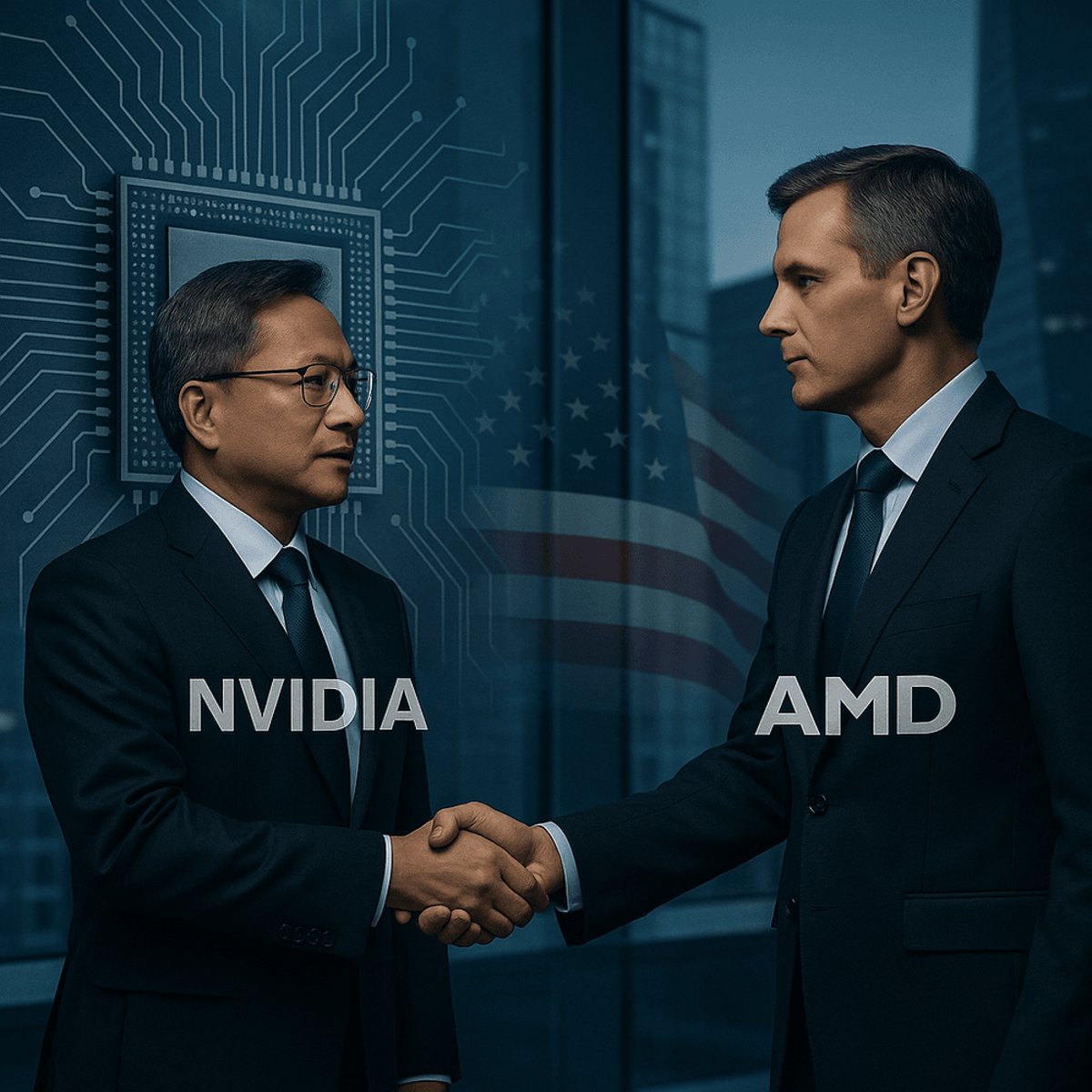
In an unprecedented move that's reshaping the global chip trade, Nvidia and AMD have agreed to hand over 15% of their China chip sales revenues to the U.S. government in exchange for export licenses. The extraordinary arrangement, first reported by the Financial Times, signals a dramatic new chapter in tech diplomacy under Trump's trade policies.
The chip industry just witnessed something that would have been unthinkable just months ago. Nvidia and Advanced Micro Devices have struck a deal with the White House that fundamentally changes how American tech companies access the Chinese market, according to a Financial Times exclusive.
The arrangement is as straightforward as it is extraordinary: in exchange for export licenses to sell specific AI chips in China, both companies will fork over 15% of their revenues from those sales directly to the U.S. government. The deal specifically covers Nvidia's H20 chips and AMD's MI308 processors – both designed to comply with existing export restrictions while still serving China's voracious AI appetite.
Nvidia CEO Jensen Huang personally flew to meet with President Trump last week to hammer out the details, sources told the Financial Times. The meeting underscores how critical China remains to both companies' bottom lines, even as geopolitical tensions reach fever pitch. China represents roughly 20% of Nvidia's total revenue, making it too valuable a market to simply abandon.
The timing couldn't be more telling. Just last week, Trump threatened to slap a crushing 100% tariff on semiconductor and chip imports unless companies were "building in the United States." That ultimatum sent shockwaves through Silicon Valley, where executives scrambled to figure out how to maintain their global supply chains without triggering the President's ire.
"We follow rules the U.S. government sets for our participation in worldwide markets," Nvidia told the Financial Times in a carefully worded statement that reveals little about the company's internal calculations. AMD has remained publicly silent on the arrangement, though industry sources suggest the company had little choice but to accept similar terms.
This revenue-sharing model represents a complete departure from traditional export licensing, where companies typically pay fixed fees or navigate regulatory hurdles. Instead, it creates an ongoing financial relationship between private companies and the government that fluctuates with market success. For every $100 million in H20 chips Nvidia sells in China, $15 million now flows to U.S. coffers.
The competitive implications are staggering. While Nvidia and AMD secured their China access through this unprecedented arrangement, other chip companies are left wondering whether similar deals await them – or if they'll be shut out entirely. The move effectively creates two tiers of American chip companies: those willing to share revenues with Washington, and those locked out of the world's second-largest economy.
Industry analysts are already calling it a "protection racket" model that could spread to other sectors. If this arrangement proves profitable for the Treasury, expect similar revenue-sharing demands to emerge across other strategic industries where American companies compete globally. The precedent is now set: access to contested markets comes with a price tag payable to Uncle Sam.
This revenue-sharing arrangement marks a fundamental shift in how the U.S. government monetizes its regulatory power over global tech trade. What started as export controls to limit China's AI capabilities has evolved into a direct revenue stream for Washington, with American companies paying for the privilege of serving their most lucrative foreign market. The question now isn't whether other industries will face similar arrangements, but when – and how much they'll be willing to pay to keep their global operations intact.