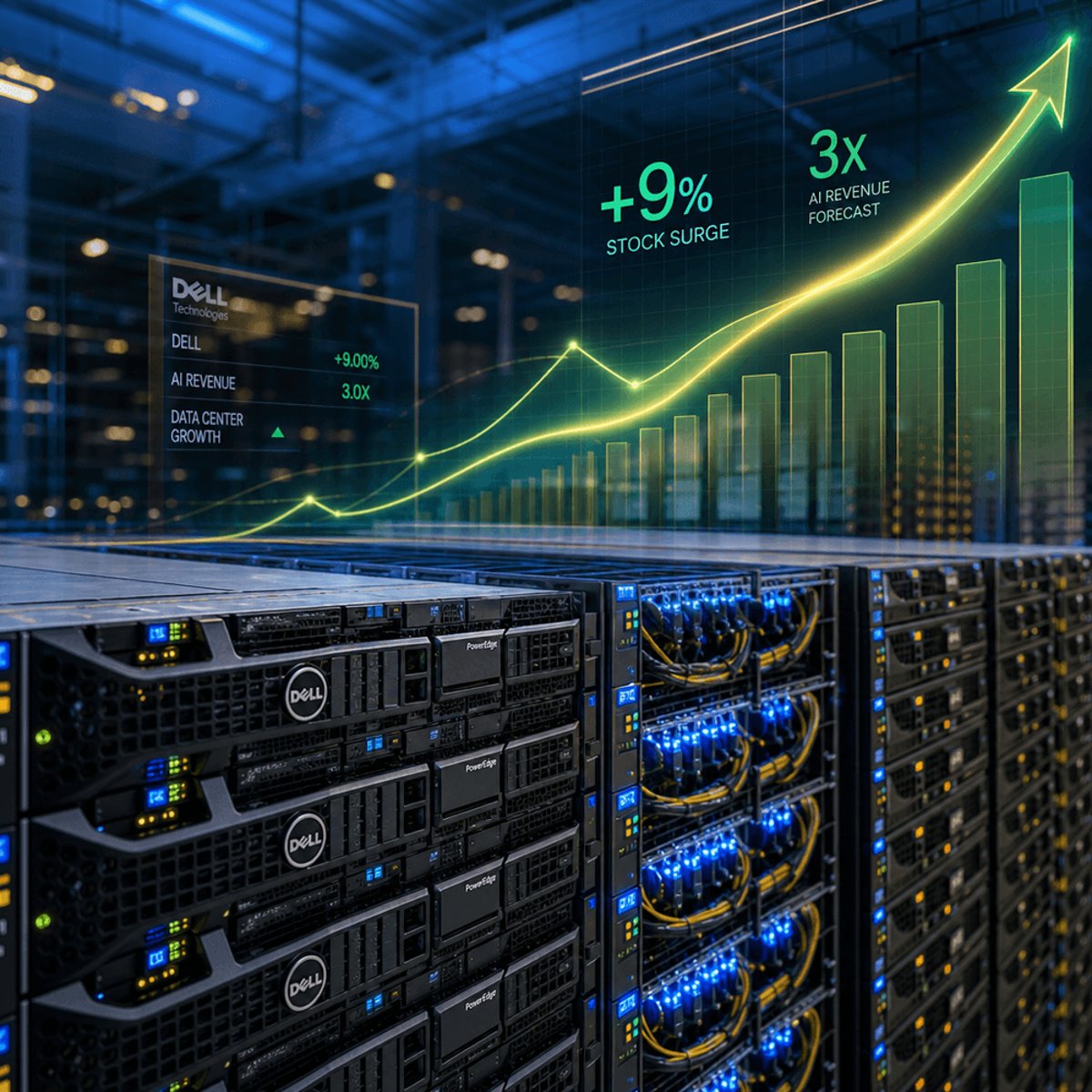
Dell just told Wall Street its AI server business is growing even faster than it thought. The company now expects AI server revenue to triple in fiscal 2027, a sharp jump from the doubling forecast it gave just six months ago, according to CNBC. Shares jumped roughly 9% on the news, as investors bet that the AI infrastructure boom still has plenty of runway left.
Dell just made a pretty bold statement about where the AI hardware market is headed, and investors loved it. The company now expects its AI server revenue to triple in fiscal 2027, a massive upgrade from the doubling forecast it had on the books just six months ago, according to CNBC. Shares popped roughly 9% on the update, giving the stock one of its strongest single-day moves in recent memory.
That kind of forecast revision doesn't happen by accident. Six months is a short window to go from expecting revenue to double to expecting it to triple, and it tells you something about how fast enterprise demand for AI infrastructure is actually moving. Companies across every industry are racing to build out the compute capacity needed to train and run large language models, and that means racks and racks of servers packed with GPUs, high-speed networking, and specialized cooling systems.
Dell has positioned itself as one of the go-to hardware partners for that build-out, competing alongside players like HPE and Super Micro Computer for a slice of a market that's been reshaped almost entirely by Nvidia's dominance in AI chips. Dell doesn't make the GPUs itself, but it packages them into servers that data centers and cloud providers can deploy at scale, and right now that packaging business is booming.
What's notable here isn't just the raw growth number, it's the direction of the revision. Companies typically guide conservatively and beat expectations modestly. Doubling a forecast to tripling within two quarters suggests Dell's order backlog and customer conversations gave management enough confidence to make a much bigger call publicly. That's the kind of signal that tends to move markets, and it clearly did.
It also fits into a broader pattern playing out across the tech sector this year. Hyperscalers and enterprises alike have been pouring capital into AI infrastructure, and the hardware suppliers sitting downstream of that spending, Dell included, have been direct beneficiaries. The same dynamic has shown up in Nvidia's own blockbuster earnings reports, where data center revenue has repeatedly blown past Wall Street estimates.
For Dell specifically, this raised guidance also matters because it comes at a moment when traditional PC and legacy server sales have been sluggish industry-wide. AI servers have effectively become the growth engine propping up the company's hardware division, and a forecast this aggressive suggests management sees that trend continuing well into fiscal 2027 rather than tapering off.
Of course, there are real questions worth watching. Analysts will want to see whether this kind of demand is sustainable or whether it's front-loaded, with customers rushing to lock in capacity now before potential supply constraints or pricing shifts later. There's also the question of margins. AI servers can be lower-margin businesses depending on component costs, particularly given how much of the bill of materials goes toward Nvidia's GPUs rather than Dell's own hardware.
Still, for now, the market's read is straightforward: Dell is riding the AI infrastructure wave harder than expected, and investors are rewarding that with a nearly double-digit stock pop. The bigger story here is what it says about the broader AI buildout. If Dell's internal forecasts are shifting this dramatically in just six months, it's a strong signal that enterprise AI spending isn't slowing down anytime soon, and competitors will be under pressure to show they're capturing similar momentum when they report their own numbers.
Expect rivals to face questions on their next earnings calls about whether they're seeing the same acceleration Dell just flagged, and expect analysts to start recalibrating sector-wide AI hardware demand models based on this single data point.
Dell's decision to triple its AI server revenue forecast in the span of just two quarters is a strong data point in a much bigger story: enterprise AI infrastructure spending isn't cooling off, it's accelerating. For readers tracking the AI hardware race, this is worth watching closely, because it hints at how much runway is left in the current buildout cycle and puts pressure on competitors to show they're keeping pace. The next few earnings seasons across the hardware sector should tell us whether Dell's optimism is the new baseline or an outlier.