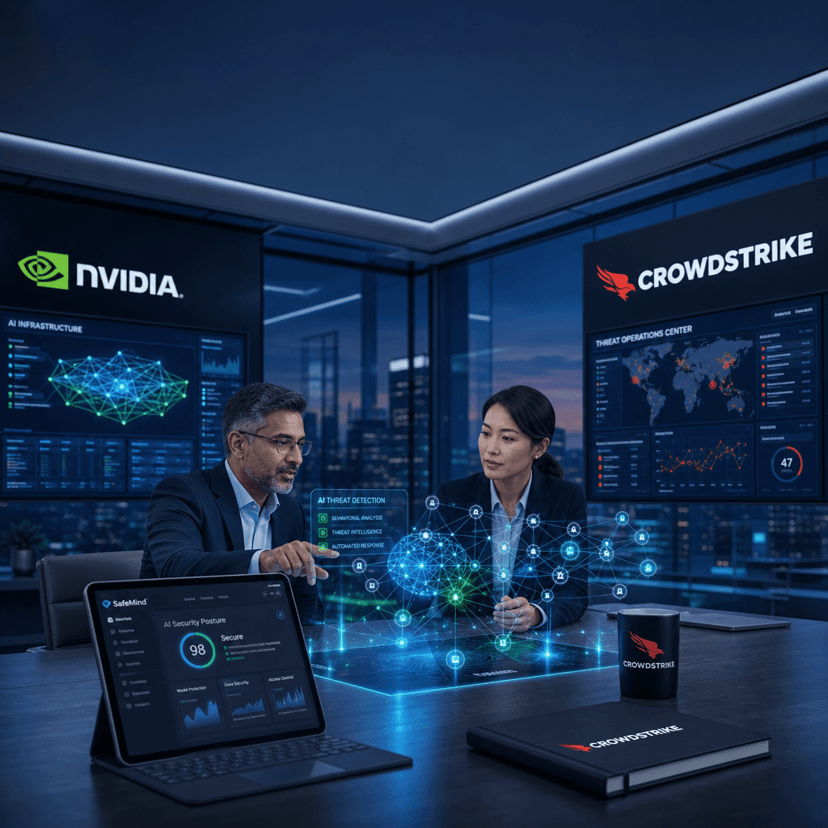
Cybersecurity just got its biggest AI upgrade yet. At CrowdStrike's Fal.Con 2026 conference in Las Vegas, Jensen Huang and George Kurtz took the stage together to unveil CrowdStrike SafeMind, a new agentic cybersecurity system built to fight back against attacks that are increasingly automated themselves. The announcement signals a new phase in the AI arms race, one where defense has to move as fast as offense, or faster.
The cybersecurity industry just got a very public reminder that the rules of the game have changed. Speaking to a sold-out crowd at CrowdStrike's Fal.Con 2026 conference in Las Vegas on Tuesday, NVIDIA founder and CEO Jensen Huang didn't mince words. 'We're at an inflection point in cybersecurity,' Huang told the audience, according to NVIDIA's official blog. 'Attacks are now automated. Defense has to be, too.'
That line pretty much sums up why Huang shared the stage with CrowdStrike CEO and founder George Kurtz to announce CrowdStrike SafeMind, a new agentic cybersecurity system built by the company's Cyber AI team. The framing here isn't subtle. Attackers have been quietly weaponizing automation and AI for a while now, running phishing campaigns, malware variants, and reconnaissance sweeps at machine speed. Defenders, meanwhile, have largely been playing catch-up with human-in-the-loop workflows that just can't keep pace. SafeMind is CrowdStrike's answer to that gap, an attempt to put autonomous, decision-making AI agents on the defensive side of the ledger instead of leaving all the automation advantages to the bad guys.
The partnership itself isn't a surprise to anyone who's been watching NVIDIA's enterprise push. The chipmaker has spent the last two years aggressively courting software and security vendors, positioning its GPUs and AI infrastructure stack as the backbone for what it calls agentic AI, systems that can reason, plan, and act with a degree of autonomy rather than just responding to prompts. CrowdStrike, for its part, has been building out its own AI-native security architecture for years through its Falcon platform, and Fal.Con has become the venue where it stress-tests big claims about where the industry is headed next.
What makes this moment notable isn't just the product announcement, it's the optics of Huang and Kurtz sharing a stage in front of a packed room. Fal.Con draws thousands of security professionals, CISOs, and IT decision-makers every year, and having NVIDIA's chief executive personally vouch for a cybersecurity product is a signal the two companies want this framed as more than a routine integration. It's a joint bet that the next wave of enterprise security spending will be dictated by who can deploy autonomous AI agents fastest and most reliably.
There's real pressure behind that bet. Security teams have been sounding alarms for months about adversaries using generative AI to accelerate social engineering, automate vulnerability scanning, and even generate polymorphic malware that evades traditional signature-based detection. Analysts have repeatedly flagged that the volume and speed of these AI-assisted attacks are outstripping what human security operations centers can triage manually. That's the exact pain point SafeMind appears designed to address, using AI agents that can detect, investigate, and potentially respond to threats without waiting on a human analyst to click through every alert.
Of course, agentic security tools raise their own set of questions. Handing decision-making authority to autonomous systems in a security context means trusting those systems not to make costly mistakes, whether that's a false positive that locks out legitimate users or a missed signal that lets a real breach through. Vendors pitching agentic AI for security have to walk a fine line between speed and reliability, and enterprise buyers are going to want proof points before they hand over the keys.
Still, the timing tracks with where the broader AI infrastructure conversation has been heading. NVIDIA has increasingly positioned itself not just as a chip supplier but as a platform partner across industries looking to operationalize AI agents, and cybersecurity is one of the more urgent use cases given the stakes involved. CrowdStrike, which has built a reputation on speed of detection and response, gets to lean on NVIDIA's compute muscle to power a system that needs to make decisions in near real time.
Neither company detailed specific technical benchmarks, pricing, or rollout timelines for SafeMind during the Fal.Con keynote, based on the available announcement details. What's clear is the strategic intent: both companies are betting that the future of cybersecurity looks less like static rule-based defense and more like an ongoing, autonomous contest between attacking and defending AI agents. How that plays out for the security teams actually deploying these tools, and how quickly rivals like Microsoft and Palo Alto Networks respond with their own agentic offerings, is the next chapter worth watching.
For enterprise security teams, SafeMind is a preview of what's coming across the industry: AI agents that don't just flag threats but actively investigate and respond to them, running at a pace no human analyst could match. Whether that trade-off between speed and control pays off will depend on how SafeMind performs once it's actually deployed in the wild, but the message from Huang and Kurtz was unmistakable. The era of automated attacks demands automated defense, and the companies that build that defense first stand to reshape how the entire cybersecurity market thinks about AI.