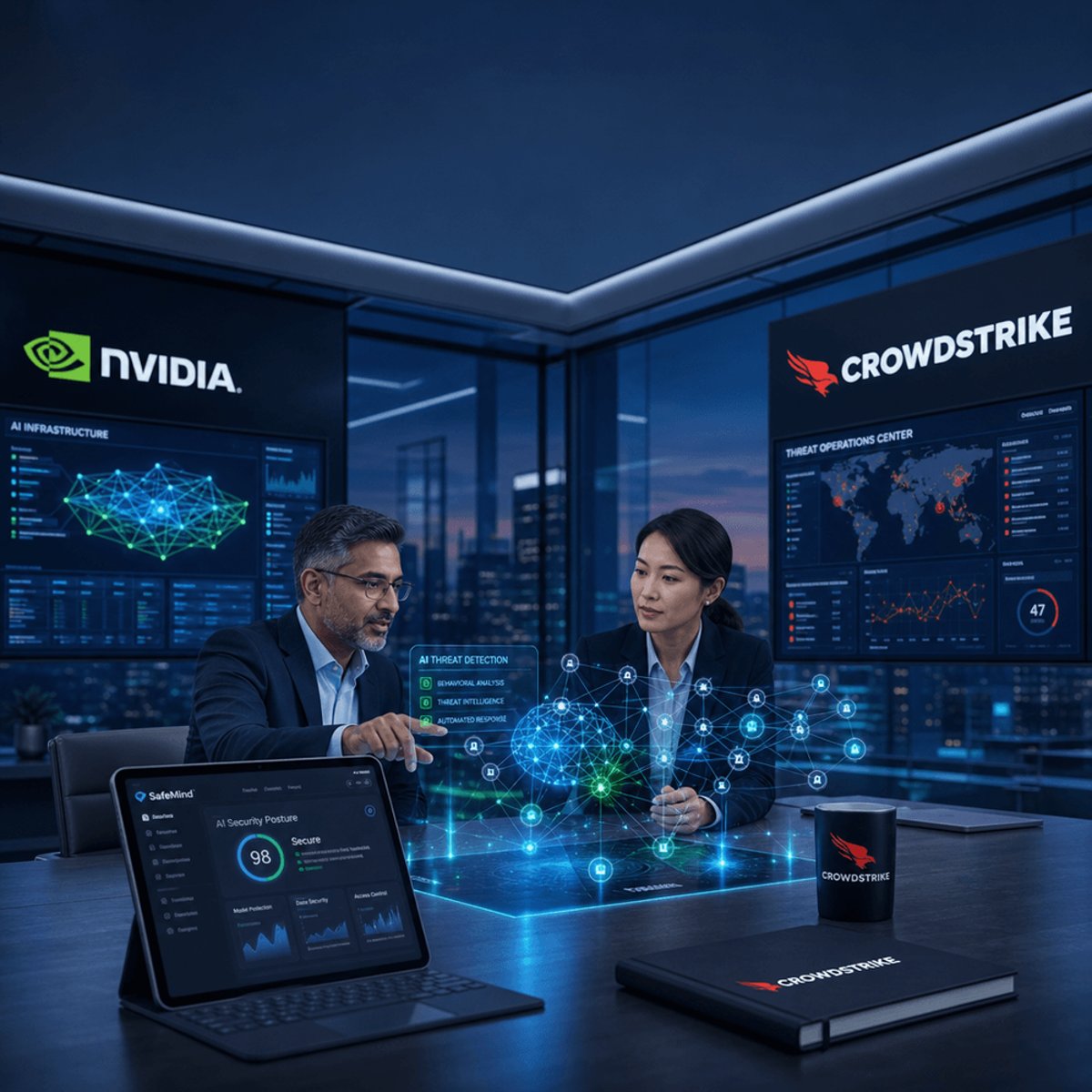
Jensen Huang took the stage at CrowdStrike's Fal.Con 2026 in Las Vegas Tuesday with a blunt warning: cyberattacks have gone automated, and defenses need to catch up fast. Standing alongside CrowdStrike CEO George Kurtz, the Nvidia founder unveiled CrowdStrike SafeMind, a new agentic cybersecurity system built on Nvidia's AI stack, marking one of the most significant enterprise security bets either company has made this year.
"We're at an inflection point in cybersecurity," Nvidia founder and CEO Jensen Huang told a packed room at CrowdStrike's Fal.Con 2026 conference in Las Vegas on Tuesday. Attacks are automated now, he said, so defense has to be too. That single line set the tone for what turned into one of the bigger product reveals of the week: CrowdStrike SafeMind, a new agentic cybersecurity system built jointly by CrowdStrike's threat research arm and powered by Nvidia's AI computing stack.
Huang didn't come alone. He shared the stage with CrowdStrike founder and CEO George Kurtz, and the optics mattered. This wasn't a quiet integration announcement buried in a press release, it was a full keynote moment in front of a sold-out crowd, the kind of joint appearance that signals both companies are treating this partnership as core strategy rather than a side project.
The timing tracks with where the industry has been heading for a while now. Security teams have spent the last two years watching attackers use large language models to write more convincing phishing lures, automate reconnaissance, and probe for vulnerabilities faster than human analysts can patch them. That's pushed vendors across the board, from Microsoft to Palo Alto Networks, to pitch their own flavors of AI-assisted defense. What makes the Nvidia-CrowdStrike pairing notable is the depth of the technical relationship: Nvidia isn't just licensing a chatbot layer, it's supplying the underlying AI infrastructure that SafeMind runs on, according to details shared at the event.
[Image: Jensen Huang and George Kurtz on stage at Fal.Con 2026]
Agentic AI, the idea of AI systems that can take autonomous action rather than just generate suggestions, has become the industry's favorite buzzword this year, and cybersecurity is shaping up to be one of the first real-world proving grounds. Instead of an analyst manually triaging thousands of alerts a day, an agentic system built into SafeMind could, in theory, investigate an incident, correlate it with historical threat data, and take containment action, all before a human even opens the ticket. CrowdStrike has been building toward this for a while through its Falcon platform, but pairing it with Nvidia's compute muscle changes the scale of what's possible.
[Video: Fal.Con 2026 keynote highlights]
For Nvidia, this is also a strategic play beyond selling GPUs to hyperscalers. The company has been steadily pushing into vertical AI applications, and enterprise security is a natural fit given how much sensitive data flows through it and how much budget CISOs are willing to spend to stay ahead of automated threats. Landing a marquee partner like CrowdStrike, which protects a huge share of the Fortune 500, gives Nvidia a visible showcase for its AI stack outside the usual cloud and consumer AI conversations.
For CrowdStrike, the move is as much about competitive positioning as technology. Rivals have been racing to bake AI into their platforms, and a joint launch with Nvidia, timed for maximum visibility at CrowdStrike's own flagship conference, sends a clear signal to customers and competitors alike that the company intends to lead the agentic security category rather than follow it.
What's less clear right now is how SafeMind actually performs in production environments, what it costs, and how fast enterprises will trust an AI agent to take autonomous action inside their networks. Security teams tend to be conservative about automation for good reason: a false positive that shuts down critical infrastructure can be as damaging as the attack it was meant to stop. Nvidia and CrowdStrike will need to answer those questions in the coming months as SafeMind moves from keynote demo to actual deployments.
Still, the announcement fits a broader pattern playing out across the AI industry this year, where infrastructure giants are pairing up with domain specialists to push agentic systems into high-stakes, real-world use cases. Cybersecurity, given the sheer volume and speed of automated attacks, is arguably one of the clearest cases for it. Whether SafeMind becomes the standard other vendors chase, or just another entrant in a crowded field of AI security claims, will depend on what happens after the applause at Fal.Con dies down.
The SafeMind launch is a bet that the next phase of cybersecurity won't be won by faster human analysts but by AI agents that can act on their own, and both Nvidia and CrowdStrike are staking real reputational capital on making that bet pay off. For enterprise security teams already drowning in alerts, the promise of autonomous triage and response is appealing, but the real test starts now, once the keynote lights go down and customers start asking how much they trust an AI agent with the keys to their network.