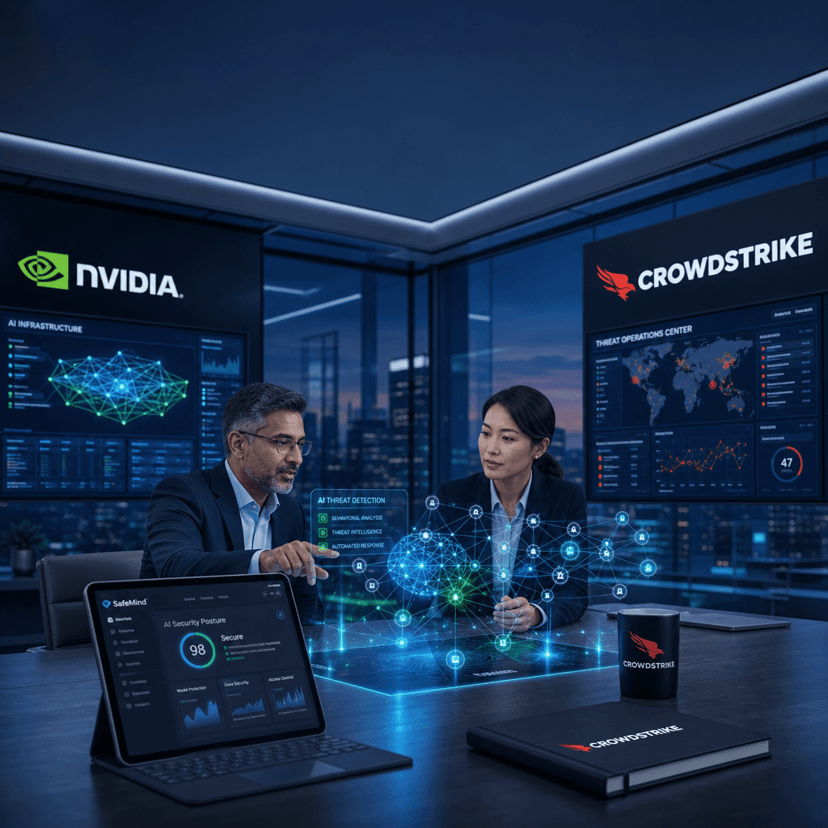
Jensen Huang walked onto the Fal.Con 2026 stage in Las Vegas Tuesday with a blunt warning: cyberattacks have gone autonomous, and defenders who don't keep pace will lose. Standing alongside CrowdStrike founder George Kurtz, the Nvidia CEO unveiled CrowdStrike SafeMind, a new agentic cybersecurity system built to fight AI-powered threats with AI-powered defense, a move that could reshape how enterprises think about security operations.
"We're at an inflection point in cybersecurity," Jensen Huang told a packed room at CrowdStrike's Fal.Con 2026 conference in Las Vegas on Tuesday, according to the company's announcement. His point was simple but urgent: attacks are now automated, and defense has to be too. That framing set up the headline news of the day, CrowdStrike SafeMind, a new agentic cybersecurity system built by the company's Cyber AI team and powered in part by Nvidia's AI computing stack.
The timing isn't an accident. Security teams have spent the last two years watching attackers weaponize generative AI to write phishing lures, probe for vulnerabilities, and even automate parts of ransomware deployment. Defenders, meanwhile, have largely stuck with rules-based detection and human analysts sifting through alert queues. SafeMind is CrowdStrike's answer to that imbalance, an autonomous system designed to reason through threats, correlate signals across a customer's environment, and act, not just flag an incident and wait for a human to respond.
George Kurtz, who joined Huang on stage, has been building toward this moment for a while. CrowdStrike's Falcon platform already processes trillions of security events a week across its customer base, and the company has increasingly leaned into AI to make sense of that firehose. Pairing that data pipeline with Nvidia's compute muscle, think GPU-accelerated inference running at the kind of scale needed to analyze security telemetry in near real time, gives CrowdStrike a technical edge that's hard for smaller security vendors to match on their own.
This isn't the first time the two companies have worked together. Nvidia has spent the past couple of years positioning itself as the infrastructure layer underneath every major AI application, from enterprise copilots to autonomous agents, and cybersecurity is shaping up as one of the more lucrative verticals for that strategy. Rivals in the space, including Microsoft's Security Copilot and Palo Alto Networks' Cortex XSIAM, have been racing to bake similar agentic capabilities into their own platforms, so SafeMind lands squarely in the middle of an industry-wide arms race over who can automate defense fastest.
What makes agentic systems different from the AI security tools that came before is autonomy. Rather than surfacing a recommendation for a human analyst to approve, an agentic AI system is designed to independently investigate, decide, and in some cases remediate a threat without waiting on a person in the loop. That's a meaningful shift in how security operations centers function, and it's also the part that makes some CISOs nervous. Giving software the authority to act on its own inside a corporate network raises obvious questions about false positives, accountability, and what happens when the AI gets it wrong.
CrowdStrike and Nvidia didn't dwell much on those risks during Tuesday's keynote, focusing instead on the speed advantage. Huang's framing, that attackers are already automated and defenders can't afford to lag behind, is becoming a common talking point across the security industry, and it's likely to shape how enterprises budget for AI tooling heading into next year. For CrowdStrike, SafeMind also represents a bet that its next phase of growth comes not from adding more detection signatures but from selling autonomy itself as a product.
The rollout details, including pricing, availability, and which Nvidia hardware SafeMind runs on, weren't fully spelled out in Tuesday's announcement. But the symbolism of the two CEOs sharing a stage in front of a sold-out Fal.Con crowd sends its own message: the biggest AI infrastructure company in the world and one of the most prominent names in enterprise security are now explicitly tying their roadmaps together. Expect more detail to come as CrowdStrike opens up early access to select customers, and expect competitors to start talking up their own agentic roadmaps within weeks.
The SafeMind announcement is less about a single product and more about where enterprise security is headed: away from human-reviewed alerts and toward autonomous systems that act on their own. For businesses already juggling AI adoption across every department, this adds cybersecurity to the list of functions being handed over to agents, with all the efficiency gains and new risks that come with it. The real test will be whether SafeMind can prove it catches more threats than it misses, and whether CISOs are ready to trust software with that much authority inside their networks.