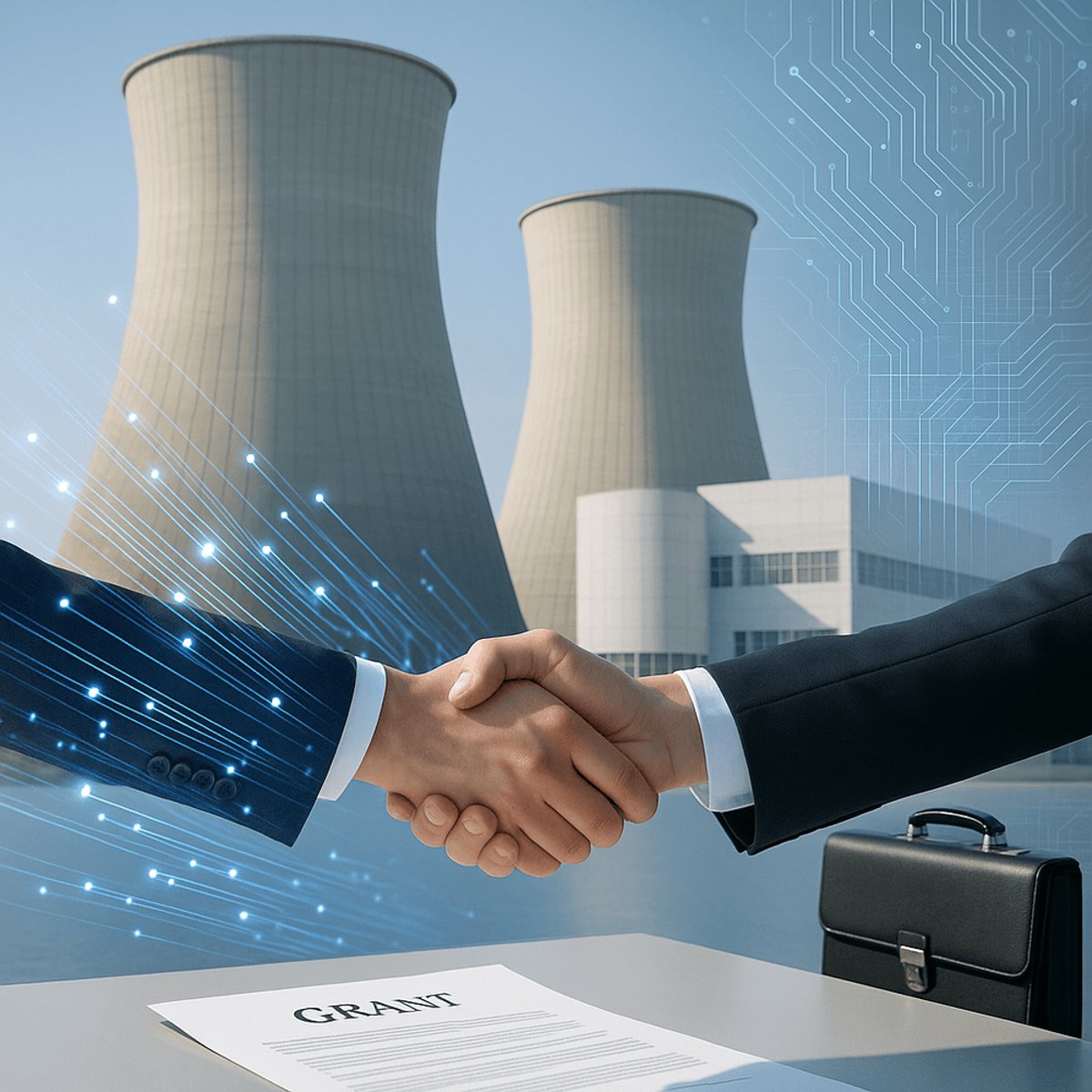
The Department of Energy just dropped $800 million on small nuclear reactors, handing equal $400 million grants to the Tennessee Valley Authority and Holtec International. It's the latest sign that the federal government is betting big on nuclear power as tech companies scramble for electricity to fuel their AI ambitions.
The Department of Energy just made its biggest bet yet on nuclear power's comeback, announcing $800 million in grants split evenly between the Tennessee Valley Authority and Holtec International to build small modular reactors across the Southeast and Midwest.
The timing couldn't be more telling. As Microsoft, Google, and Amazon burn through electricity training AI models, the federal government is doubling down on nuclear as the clean baseload power source that can keep data centers humming 24/7. The DOE announcement comes just months after tech giants started inking nuclear deals left and right.
TVA will use its $400 million to build one 300-megawatt reactor using technology from GE Vernova Hitachi at an undisclosed Tennessee location. Meanwhile, Holtec plans to construct two of its own 300-megawatt small modular reactors in Michigan, marking a significant expansion of nuclear capacity in both states.
What makes these reactors different isn't revolutionary technology - they're Generation III+ designs, essentially refined versions of nuclear tech that's been powering cities for decades. The breakthrough is in the packaging. By shrinking traditional reactor designs into "small modular" units, companies like Holtec promise factory-built components that can be mass-produced and assembled on-site like industrial Lego blocks.
"The hope is that costs will come down as parts are mass produced and engineering and construction crews become more familiar with building them," according to TechCrunch's reporting. It's the same playbook that made smartphones cheap - standardize the design, then scale production.
But here's the reality check: despite all the hype and government backing, only two small modular reactors are actually operational worldwide, according to the World Nuclear Association. That puts pressure on TVA and Holtec to prove the concept can work at commercial scale.
The grants represent more than just infrastructure investment - they're industrial policy in action. While China races ahead with its own small reactor program, the U.S. is trying to rebuild domestic nuclear manufacturing capability that largely evaporated after Three Mile Island. TVA, as a federal utility, gives the government a direct pathway to demonstrate the technology works.
For Holtec, the Michigan project represents a major validation. The company has been pushing its SMR-300 design for years, but securing federal backing puts it in the same league as established players like Westinghouse and GE. The $400 million doesn't just fund construction - it provides the credibility needed to attract private investment for future projects.
The industry backdrop makes these grants even more significant. Microsoft recently announced plans to restart Three Mile Island's Unit 1 reactor, while Google signed deals with startup Kairos Power for advanced reactors. Amazon isn't far behind, exploring nuclear-powered data centers.
What's driving this nuclear renaissance isn't environmental ideology - it's cold mathematics. AI workloads need constant power, and solar panels don't generate electricity at night. Wind farms go calm. Natural gas plants emit carbon that tech companies increasingly want to avoid. Nuclear offers the rare combination of zero-carbon baseload power that can run year-round.
The challenge now is execution. Small modular reactors promise faster construction timelines than traditional nuclear plants, but they still face regulatory hurdles, supply chain bottlenecks, and public skepticism. TVA and Holtec have government money, but they need to prove the technology can compete with cheap natural gas and falling renewable costs.
The $800 million in DOE grants to TVA and Holtec represents more than government spending - it's a strategic bet that small modular reactors can solve America's clean energy puzzle while meeting surging AI power demands. With only two such reactors operational worldwide, these projects will either prove the technology's commercial viability or become expensive lessons in nuclear ambition. For tech companies watching their electricity bills soar alongside their AI investments, the stakes couldn't be higher.