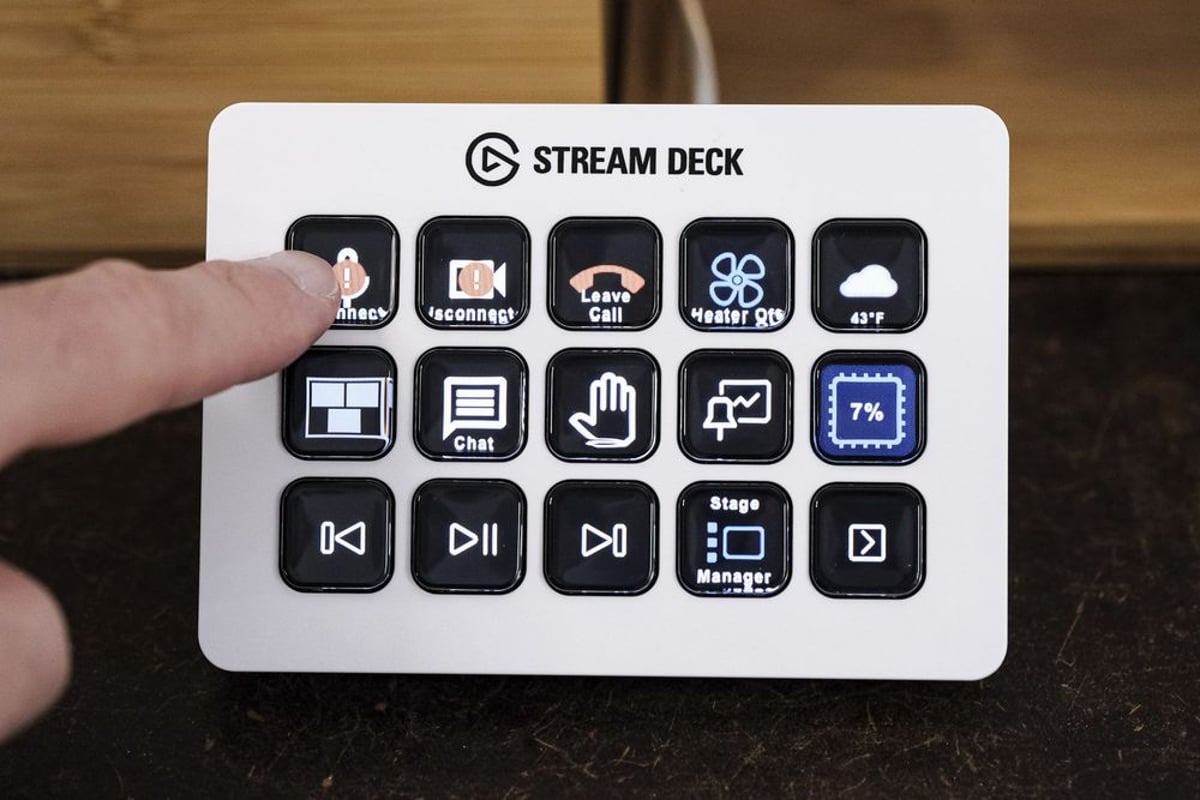
Elgato just rolled out a software update that lets AI assistants control your Stream Deck with voice commands. The Stream Deck 7.4 release adds Model Context Protocol (MCP) support, allowing chatbots like Claude, ChatGPT, and Nvidia G-Assist to trigger actions on the popular streaming hardware without you lifting a finger. It's a surprisingly early consumer hardware play for MCP, which has mostly lived in developer tools until now.
Elgato just opened a new front in the AI assistant wars, and it's happening on your desk. The company's Stream Deck 7.4 software update drops today with Model Context Protocol support, transforming the popular macro pad into something your chatbot can control directly.
The integration works with major AI assistants including Anthropic's Claude, OpenAI's ChatGPT, and Nvidia's G-Assist. Instead of tapping buttons to launch OBS, switch scenes, or control smart lights, you can now just ask your AI assistant to handle it. "You still set up actions in Stream Deck app the same way you always have," Elgato explains in its announcement. "MCP adds a new way to trigger them."
The timing is notable. While Google recently launched MCP tools aimed at developer coding agents, Elgato is betting that everyday creators want their hardware talking to their chatbots. It's a different audience entirely - streamers, podcasters, and productivity nerds who've turned Stream Deck into a Swiss Army knife for workflow automation.
Model Context Protocol itself is still relatively young. Developed by Anthropic, MCP provides a standardized way for AI assistants to interact with external tools and systems. Until now, most implementations have focused on coding environments and developer workflows. Elgato's adoption represents a rare consumer hardware play.
The technical implementation is straightforward. Users connect their Stream Deck software to their preferred AI assistant through MCP configuration. Once linked, natural language requests get translated into Stream Deck actions. Say "start my podcast setup" to Claude, and it could theoretically trigger a chain of actions - launch recording software, adjust audio levels, switch lighting profiles, and post a "going live" message.
But here's where it gets interesting for the broader market. Nvidia including G-Assist in the supported assistant list hints at deeper ambitions. G-Assist started as a gaming performance tool but has evolved into a more general-purpose AI helper. Nvidia's involvement suggests the chip giant sees MCP-enabled hardware control as strategic territory.
The update doesn't change Stream Deck's core value proposition. You're still setting up macros and workflows the same way. What changes is the interface layer - voice and text alongside physical buttons. For accessibility, that's potentially huge. For power users juggling complex multi-app workflows, being able to verbally trigger sequences while hands are occupied could be genuinely useful.
Competitive pressure is building too. Corsair, Razer, and other peripheral makers are watching this space closely. If voice-controlled macro hardware catches on with creators, expect rapid imitation. The barrier to entry isn't high - it's mostly software integration work.
There's also a workflow efficiency question that won't be answered immediately. Is speaking to an AI assistant actually faster than muscle memory button presses for frequent actions? Probably not for streamers who've trained themselves to hit specific keys during broadcasts. But for infrequent tasks or complex sequences, voice might win.
The enterprise angle here is subtle but present. Stream Deck has steadily gained traction beyond gaming and streaming into corporate workflows - video conferencing controls, presentation management, lighting automation for hybrid offices. MCP support could accelerate that trend if IT departments start seeing value in voice-controlled workspace automation.
What's unclear is how reliable the AI triggering actually is. Natural language processing is probabilistic. If you ask for "my morning routine" and the assistant mishears or misinterprets, you could end up with lights dimming when you wanted your microphone muted. Elgato will need to nail the confidence thresholds and confirmation flows.
Elgato's MCP integration is less about revolutionary functionality and more about signaling where consumer hardware is headed. AI assistants are moving beyond screens and speakers into physical device control. For Stream Deck users, it's an optional interface addition that might prove genuinely useful for complex workflows or accessibility needs. For the industry, it's an early test case for whether voice-controlled macro hardware has legs beyond the novelty phase. The real story emerges in six months when we see adoption data and whether competitors follow suit.