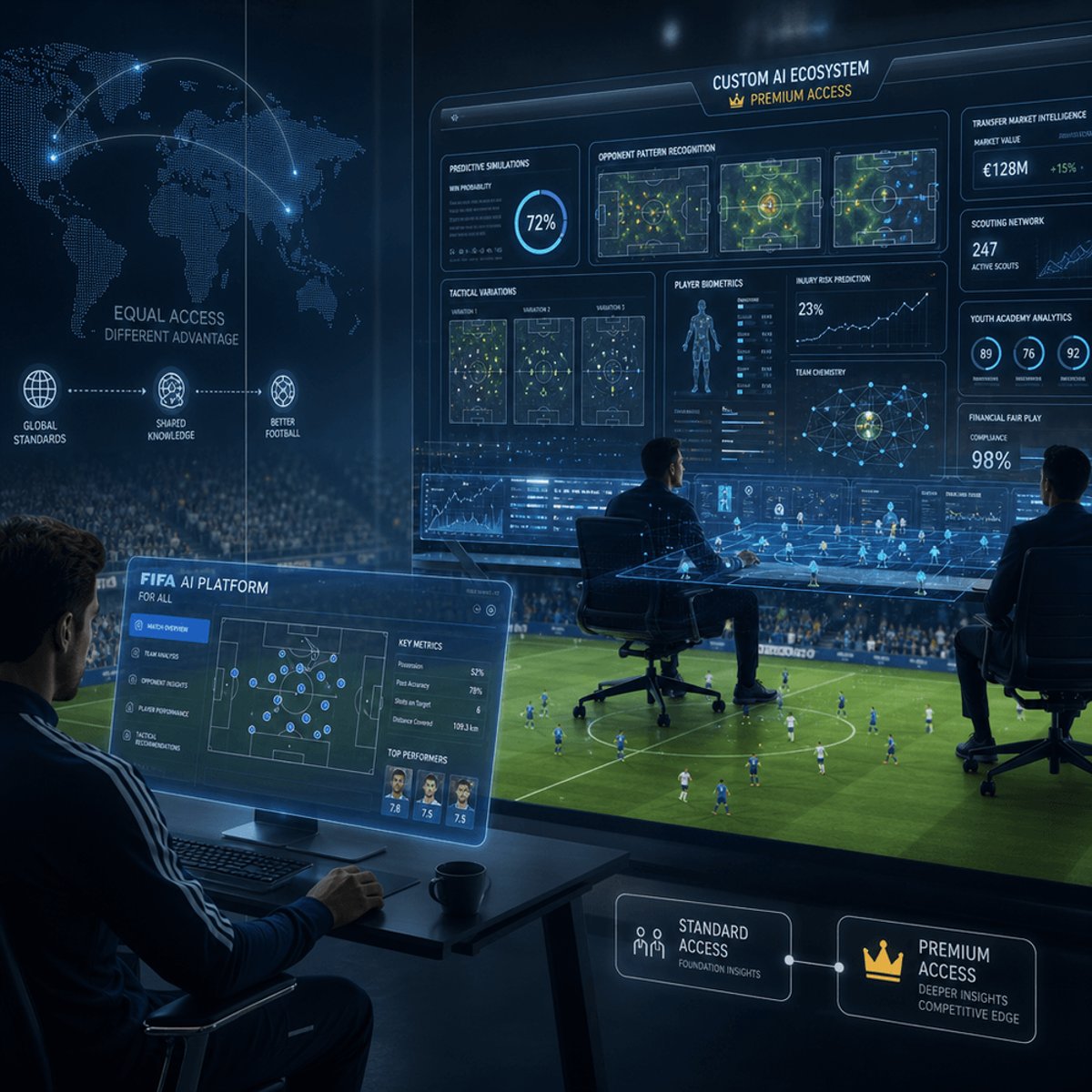
The 2026 World Cup just became an AI battleground. FIFA is handing every team access to a proprietary AI agent designed to analyze opponents, optimize tactics, and predict game outcomes. But the move raises a thornier question than it answers - when the world's richest federations can afford custom AI systems that cost millions, will FIFA's free tool actually level the playing field, or just set a new baseline that deepens the divide between soccer's haves and have-nots?
FIFA's decision to arm every team at the 2026 World Cup with AI technology marks a watershed moment for both soccer and enterprise AI adoption. But it also exposes an uncomfortable truth: democratizing access to baseline tools doesn't eliminate competitive imbalances when the richest players can always buy something better.
The AI agent FIFA is rolling out can process match footage, identify opponent patterns, suggest tactical adjustments, and even simulate game scenarios based on historical data. For federations from smaller nations with limited analytics budgets, it's a game-changer. For powerhouses like Germany, France, and Brazil - who've been pouring millions into proprietary AI systems for years - it's table stakes.
This dynamic isn't unique to soccer. It's playing out across enterprise AI adoption right now. Companies that couldn't afford data science teams suddenly have access to capable AI agents through platforms like Microsoft Copilot or Google Workspace AI. But the organizations that were already ahead? They're building custom models trained on decades of proprietary data, creating moats that free tools can't bridge.
FIFA hasn't disclosed which AI vendor is powering the World Cup agent, but the timing aligns with broader sports tech investments from major cloud providers. Amazon Web Services already powers NFL statistics, while Microsoft has deep partnerships with European soccer leagues. The World Cup deployment represents a scaled test of whether AI can genuinely democratize performance optimization or simply become another axis of inequality.
The skeptics have a point. England's Football Association reportedly spent over $8 million developing custom AI systems that integrate biometric data, psychological profiling, and real-time game state analysis. Argentina's federation partnered with a stealth AI startup to build models trained exclusively on Lionel Messi's decision-making patterns during his prime. These aren't tools you can replicate with a standardized FIFA-provided agent, no matter how sophisticated.
But there's a counter-argument worth considering. When every team has access to competent AI, the marginal value of incrementally better AI diminishes. If FIFA's tool can accurately identify that a team is vulnerable to through-balls down the right flank, does it matter that a $10 million custom system identified it 3% faster? The game is still played by humans making split-second decisions under pressure.
This mirrors debates happening in enterprise SaaS right now. Does every company need a custom AI model, or can most get 80% of the value from well-designed, widely available tools? The answer probably depends on how much winning matters. For a World Cup final, that 3% edge could be everything. For a mid-market SaaS company optimizing email campaigns, probably not.
The darker scenario is that FIFA's AI initiative creates a false sense of parity while actually widening gaps. Smaller federations might over-rely on the provided tool, assuming they've closed the technology gap, while richer teams treat it as supplementary to vastly superior proprietary systems. It's the enterprise AI equivalent of giving everyone access to ChatGPT while ignoring that some companies are building domain-specific models with billions in R&D investment.
There's also the data problem. AI is only as good as what it's trained on, and FIFA's agent will presumably have access to similar match footage and statistics for all teams. But the richest federations have been collecting granular biometric data, training ground performance metrics, and proprietary scouting intelligence for years. An AI trained on that data will always outperform one trained on publicly available match footage.
What FIFA is really testing is whether technology can be a great equalizer or whether it inevitably amplifies existing resource advantages. The same question is rippling through every industry right now as AI tools become ubiquitous. Early evidence suggests it depends entirely on implementation - tools democratize access, but outcomes still favor those who can afford the best data, the best customization, and the best human experts to interpret AI recommendations.
The 2026 World Cup might not answer that question definitively, but it'll provide the highest-stakes, most-watched test case yet. If a federation from a smaller nation uses FIFA's AI to pull off a shocking upset against a traditional powerhouse, it'll validate the democratization thesis. If the same teams that always win keep winning, just with better data visualizations, it'll confirm the skeptics' view that AI is just another way for the rich to get richer.
FIFA's AI experiment at the 2026 World Cup is about more than soccer - it's a live stress test of whether technology can genuinely level playing fields or just raises the floor while the ceiling keeps climbing. The answer will reverberate far beyond sports, offering lessons for every industry grappling with AI democratization. If smaller teams can compete using FIFA's baseline tools, it validates the idea that good-enough AI broadly deployed beats perfect AI narrowly held. But if the usual powerhouses dominate anyway, it'll confirm what many already suspect: that in both soccer and business, money still buys the edges that matter most. Either way, the world will be watching.