Google just threw a curveball at the ed-tech market. The search giant is embedding its Gemini AI models into Khan Academy's learning platform, starting with a new Writing Coach tool that launches today. Rather than replacing teachers, these tools are designed to guide students through the writing and reading process while giving educators better insights into which learners need help most.
Google and Khan Academy are reframing what AI can do in classrooms. At this week's Bett conference in London, the two organizations revealed they're combining forces to put Gemini's most capable models directly into Khan Academy's learning platform, starting today with the Writing Coach tool.
Here's what makes this different from the typical AI education hype cycle: instead of just generating answers, the Writing Coach actually guides students through the messy process of learning to write. The tool works in two modes - full interactive experience or feedback-only - and helps students outline, draft, and refine essays across persuasive, expository, and literary analysis formats. Right now it's available for grades 7-12, with beta access opening for grades 5-6.
"School district leaders are telling us that one of the biggest challenges they face right now is helping middle and high school students who are behind academically, especially in reading and language arts," said Sal Khan, founder and CEO of Khan Academy, in a statement. "We're proud to partner with Google to provide AI tools designed to improve reading and writing, enabling teachers to spend more time directly supporting the students who need their help the most."
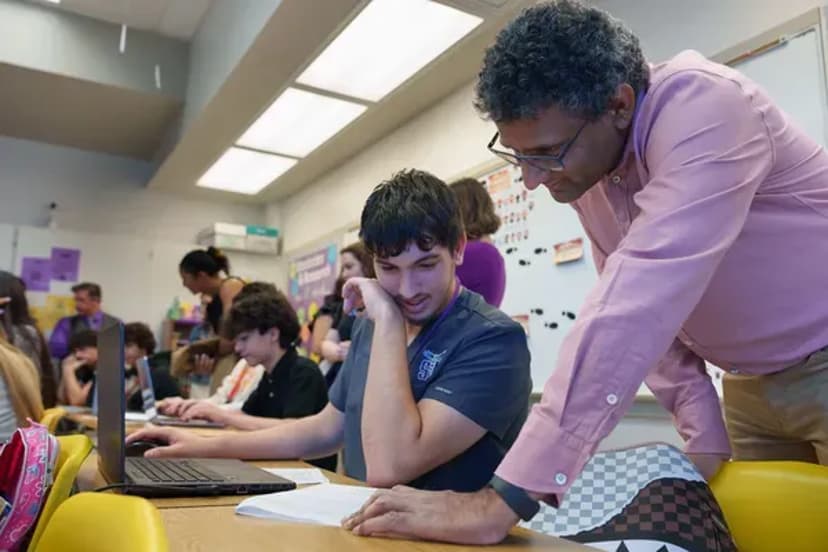
This moves beyond the typical generative AI deployment in education. Ben Gomes, Google's Chief Technologist for Learning & Sustainability, grounded the partnership in learning science rather than just raw model capability. The Writing Coach adapts its feedback based on where individual students get stuck, offering specific examples to help them unstick themselves. Teachers get visibility into which students are struggling, but the system doesn't hand over finished work - it scaffolds the learning process.
The timing is significant. Education has been one of the slower sectors to adopt AI at scale, partly because educators remain skeptical about tools that simply automate thinking rather than enhance it. Recent research on AI in classrooms has shown that students learn better when AI acts as a tutor rather than a shortcut. Google and Khan Academy are betting that positioning AI as a learning coach rather than a homework machine will unlock deeper adoption.
Later this year, Khan Academy will launch Reading Coach, which takes a similar approach to comprehension. The tool will let teachers customize reading experiences with various texts, have Gemini ask comprehension questions tailored to each student's responses, and then surface individual and class-level insights back to the teacher. It's designed for grades 5-12 and positions teachers as orchestrators of learning rather than content deliverers.
But here's where this gets interesting beyond Khan Academy's walls. Schoolhouse.world, the nonprofit peer-to-peer tutoring platform that Khan co-founded, is also embedding Gemini. Rather than tutoring students directly, this implementation is meta-level coaching: Gemini watches tutoring sessions, provides feedback to tutors afterward, and even creates AI-powered practice simulations so human tutors can rehearse with virtual student profiles before working with real learners. The goal here is to make tutors better at their job by increasing their confidence and empathy. That's a deliberately different use case from student-facing AI.
The partnership reflects a broader industry shift in how companies approach education technology. It's no longer just about content delivery or gamification - it's about using AI's pattern recognition to identify struggling learners faster, personalize feedback at scale, and free up teacher time for the stuff that actually requires human connection. Khan Academy's nonprofit status also adds credibility here. This isn't venture-backed experimentation - it's a mission-driven organization partnering with a major tech company on tools they genuinely believe serve learners better.
What's worth watching: Will other platforms follow with their own Gemini partnerships? Can Khan Academy's literacy-focused tools move the needle on actual reading and writing outcomes, or will they remain tools that teachers like but don't fundamentally change results? And critically - how will educators respond to having Gemini analysis flagging which students are behind? There's a privacy conversation waiting to happen.
This partnership signals something bigger than a single feature release. Google and Khan Academy are operating from the premise that AI's highest value in education isn't replacing teachers or automating homework - it's giving teachers superpowers to identify struggling students faster and giving students learning experiences that adapt to how they actually think. Whether this moves the needle on education outcomes depends on adoption and real-world results, but the fundamental approach - AI as a tutor, not a shortcut - feels like the right bet for a sector that's been burned by overhyped tech promises before.