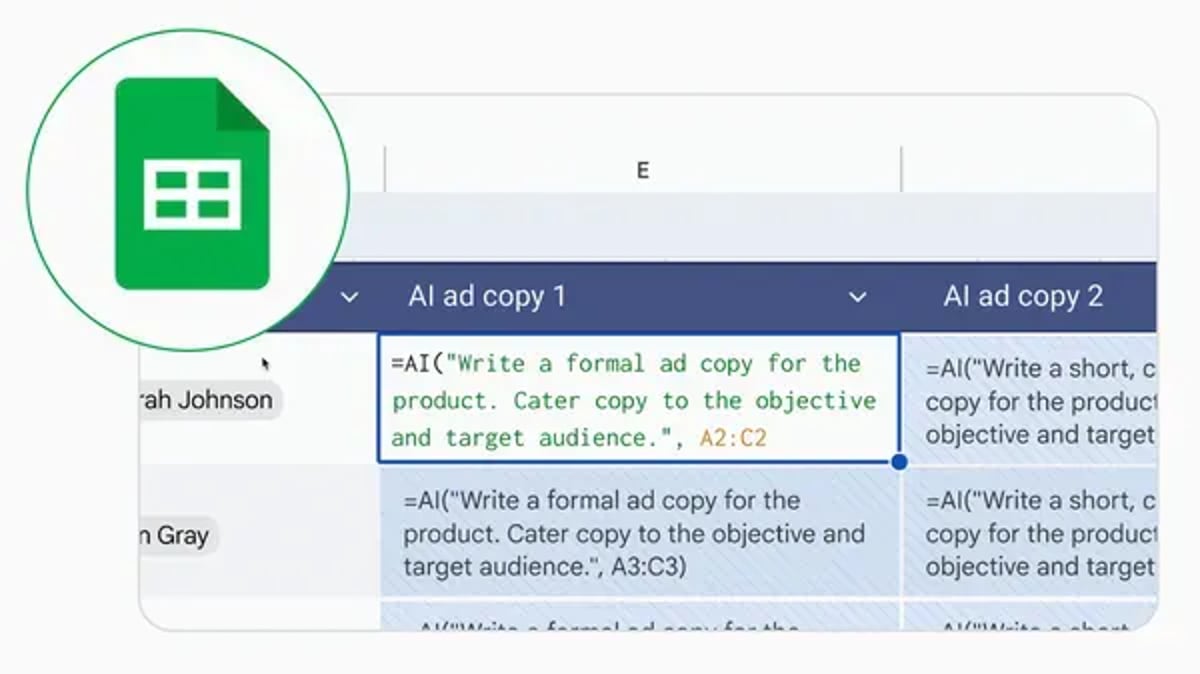
Google just dropped a game-changing update that transforms spreadsheet workflows overnight. The company's new =AI function in Google Sheets lets users invoke Gemini directly from any cell to categorize, summarize, or generate hundreds of rows of text instantly. This isn't just another AI integration—it's democratizing advanced data processing for millions of enterprise users who don't need coding expertise to harness machine learning capabilities.
Google just rewrote the rules for spreadsheet automation. The tech giant's latest Google Workspace feature drop introduces a deceptively simple =AI function that transforms Google Sheets into a powerful machine learning interface accessible to anyone who can type a formula.
The implementation couldn't be more straightforward: users simply type =AI in any cell followed by their instruction for Gemini, and Google's AI model processes the request across specified data ranges. "You can use the AI function to categorize user feedback, summarize product reviews or write personalized copy," Google explained in today's announcement. "You don't need to be an AI or spreadsheet expert to do it, either."
This marks a significant shift in how enterprises handle data processing workflows. Previously, tasks like categorizing hundreds of customer responses or generating personalized marketing copy required either manual labor or complex integrations with external AI services. Now, Google Sheets users can accomplish these workflows with the same ease as writing a SUM formula.
[embedded image: Google Sheets AI function demonstration]
The timing aligns perfectly with Google's broader enterprise AI strategy. As Microsoft continues pushing Copilot integration across its Office suite, Google is responding with native AI capabilities that require zero additional subscriptions or complex setups. The =AI function leverages the same Gemini models powering Google's consumer AI products, but optimized for structured data processing.
The feature addresses a massive productivity gap in knowledge work. According to recent enterprise surveys, workers spend an average of 2.5 hours daily on repetitive data tasks that could be automated. Google's approach democratizes AI by embedding it directly into the world's most widely-used spreadsheet platform, eliminating the technical barriers that have historically limited AI adoption.
Early enterprise testing reveals compelling use cases beyond basic text processing. Marketing teams are using the =AI function to generate A/B test variations at scale, while customer service departments categorize support tickets automatically. Sales teams leverage it for lead scoring and personalized outreach generation, all within their existing Google Sheets workflows.
The competitive implications ripple across the entire productivity software landscape. Microsoft has been promoting its Copilot integration as a key differentiator, but Google's formula-based approach may prove more intuitive for users already comfortable with spreadsheet functions. Unlike Microsoft's chat-based interface, Google's =AI function integrates seamlessly with existing formulas and can be copied across ranges like any other spreadsheet function.
[video iframe: Google Sheets AI function tutorial]
The rollout represents just the latest salvo in Google's August Workspace Drop, which includes enhanced NotebookLM features and expanded Gemini integration across productivity tools. The company is clearly positioning Google Workspace as the AI-native alternative to traditional office suites.
For enterprise customers evaluating productivity platforms, this development significantly tilts the scales. The =AI function eliminates one of the primary friction points in AI adoption—the need for specialized training or additional software purchases. Users can immediately apply AI capabilities to their existing data without changing established workflows or learning new interfaces.
This isn't just another AI feature—it's Google fundamentally reimagining how millions of knowledge workers interact with data. By making advanced AI capabilities as simple as typing a formula, Google has eliminated the technical barriers that kept machine learning locked in specialized departments. As enterprises race to integrate AI into daily workflows, Google Sheets just became the most accessible entry point for AI-powered productivity at scale.