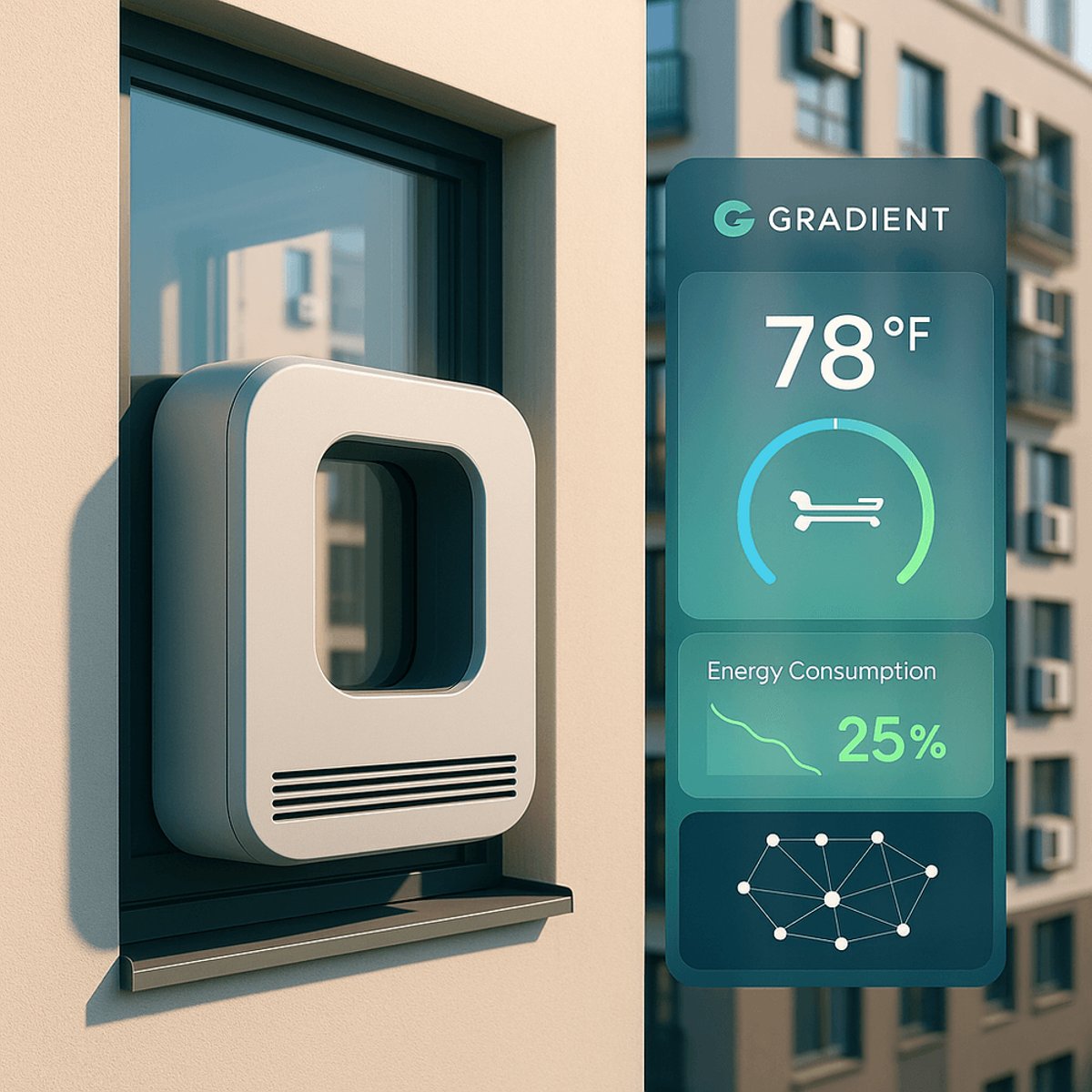
Gradient just turned ordinary window heat pumps into a building-wide smart HVAC network. The climate tech startup exclusively told TechCrunch it's rolling out Nexus, software that links every window unit in multifamily buildings to give managers control without sacrificing comfort. One building saw energy consumption drop 25% overnight after setting heating limits at 78°F. It's a direct play for New York City's aging housing stock, where boilers are dying and traditional retrofits cost a fortune.
Gradient is making a calculated bet that America's oldest buildings don't need to be torn down - they just need smarter windows. The startup just unveiled Nexus, a software platform that transforms its horseshoe-shaped window heat pumps from individual units into a coordinated building-wide system. The move positions Gradient to capture a massive retrofit market that traditional HVAC companies have largely ignored.
"Multifamily buildings are an ignored sector," Vince Romanin, chief technology officer at Gradient, told TechCrunch in an exclusive interview. "It's a place where we can do better for the user."
The timing couldn't be better. New York City alone has thousands of buildings with steam boilers reaching end of life, and the cost of traditional HVAC retrofits can run into millions. Gradient's window units install in hours, not weeks, and don't require the electrical upgrades that typically blow up retrofit budgets. Now with Nexus, building managers get centralized control over every unit without ripping out walls or rewiring buildings constructed when Teddy Roosevelt was president.
The software addresses a problem that's plagued old buildings forever. When you've got one electric meter for an entire building, residents have zero incentive to conserve energy. Crank the heat to 85°F in winter? Sure, it's included in rent. Nexus flips that dynamic by letting managers set temperature guardrails while still giving residents enough control to stay comfortable. In one early deployment, a building manager set the heating limit at 78°F and watched energy consumption drop by a quarter the next day.
Gradient has been testing this approach in the real world. The startup worked with the New York City Housing Authority to install units in public housing, where residents previously relied on unpredictable steam radiators. It also ran a pilot in Tracy, California, in a newer affordable housing complex. The company is now in talks with colleges and universities, many of which have dorms that turn into ovens during increasingly hot autumn months.
The hardware itself resembles a window air conditioner that got folded into a horseshoe, leaving the view unobstructed. But unlike traditional window units, these can heat as well as cool, making them true heat pumps. For buildings that previously only had steam heat, that means residents get air conditioning for the first time - a crucial upgrade as heat waves intensify.
Romanin said Gradient's window units are the "lowest cost option" for old buildings with failing boilers. The installation speed is the killer feature. While a minisplit heat pump requires running refrigerant lines and mounting outdoor compressors, Gradient's units slide into window frames and plug into standard outlets. In buildings with ancient electrical wiring that can't handle a full 12-amp load, Nexus can throttle power consumption to prevent tripping breakers.
Mansi Shah, senior vice president of product and software at Gradient, explained how the software manages power intelligently. By monitoring the electrical load across all units, Nexus can prevent the simultaneous startup surges that typically overwhelm old wiring. It's the kind of unglamorous problem-solving that makes ambitious electrification plans actually feasible.
But Gradient isn't stopping at the building level. The company is developing demand response features that could make utilities very happy. When the grid is maxed out on hot summer days, Nexus could selectively dial back air conditioning in units that can handle it - like those on the shady side of a building. By using sensors in each heat pump along with building data, the system aims to predict which units can reduce load without making residents sweat.
"There's a lot of people who said when we electrify everything, the grid won't handle it," Romanin said. "I think that it is very possible to electrify everything and make the grid better, make the grid's job easier, and make electrons cheaper."
That's a bold claim, but the logic is sound. If thousands of Gradient units can respond to grid signals in real time, they become distributed energy resources that smooth out demand spikes. Traditional air conditioners are dumb loads that all kick on simultaneously when temperatures soar. Smart heat pumps coordinated through software like Nexus could help the grid avoid brownouts without building expensive new power plants.
The multifamily retrofit market is enormous and largely untapped by climate tech startups. Most attention has focused on single-family homes, where homeowners make purchasing decisions and can finance upgrades. But multifamily buildings house millions of Americans, often in dense urban areas where electrification has the biggest climate impact. Gradient is betting that software-enabled hardware, installed at the edge of buildings rather than in their guts, is the path to actually decarbonizing that housing stock.
The approach also sidesteps one of the biggest obstacles to heat pump adoption - the perceived complexity and cost of installation. By keeping it as simple as mounting a window unit, Gradient removes the friction that stops building owners from upgrading. And by adding software that delivers immediate energy savings, the company gives those owners a financial reason to act now rather than waiting for their boiler to catastrophically fail.
Gradient's Nexus software turns a straightforward hardware play into a platform bet on building-scale intelligence. By networking window heat pumps that already install faster and cheaper than alternatives, the startup is making electrification feasible for the massive stock of old multifamily buildings that desperately need HVAC upgrades. The early energy savings are compelling - a 25% drop overnight is hard for building managers to ignore. If Gradient can scale this approach and deliver on its demand response vision, it could prove that you don't need to gut old buildings to make them climate-friendly. You just need smarter windows and software that knows when to dial things back.