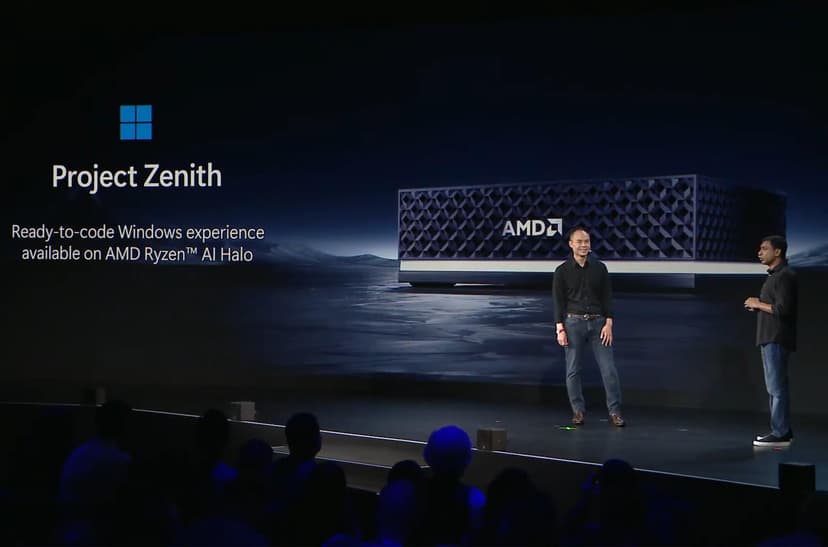
IBM and AMD just announced a strategic partnership to develop hybrid quantum-AI computing architectures, marking a bold attempt to leapfrog Nvidia's dominance by betting on the convergence of two revolutionary technologies. The collaboration could reshape enterprise computing infrastructure as both companies seek to reclaim ground lost during the generative AI boom. (68 words)
IBM and AMD are making their biggest infrastructure bet yet, announcing a partnership that could fundamentally alter the computing landscape. The two tech giants are joining forces to develop hybrid architectures that merge IBM's quantum systems with AMD's AI-specialized chips, creating what they call the next frontier of enterprise computing.
The timing couldn't be more strategic. While Nvidia captured the AI infrastructure market with its GPU dominance, IBM and AMD found themselves watching from the sidelines as enterprise customers poured billions into generative AI deployments. Now they're banking on quantum-AI convergence to leapfrog the competition.
"Quantum computing will simulate the natural world and represent information in an entirely new way," IBM Chairman and CEO Arvind Krishna told reporters in a company statement. "By exploring how quantum computers from IBM and the advanced high-performance compute technologies of AMD can work together, we will build a powerful hybrid model that pushes past the limits of traditional computing."
The partnership targets what both companies see as quantum computing's commercialization moment. Unlike previous quantum initiatives focused on research applications, this collaboration aims to deliver scalable, open-source architectures accessible to enterprise developers. The focus areas include drug discovery, materials science, optimization problems, and logistics – sectors where classical computing hits fundamental limits.
AMD's participation brings critical AI acceleration capabilities to IBM's quantum infrastructure. The chipmaker's EPYC processors and Instinct accelerators will handle the classical computing portions of hybrid workloads, while IBM's quantum systems tackle problems requiring quantum advantage. This division of labor could prove crucial as enterprises seek practical quantum applications.
The move represents a significant strategic pivot for both companies. IBM has invested heavily in quantum research for over two decades but struggled to translate laboratory breakthroughs into commercial revenue. AMD, meanwhile, gained market share against Intel in traditional CPUs but missed the initial AI chip boom that propelled Nvidia to a $2 trillion valuation.
Industry analysts see the partnership as a necessary response to changing market dynamics. "Both companies recognize they need to play in the infrastructure space differently," said one technology strategist who requested anonymity. "Quantum-AI convergence could be their path back to relevance in next-generation computing."
The open-source approach marks another departure from Nvidia's proprietary CUDA ecosystem. By making their hybrid architecture accessible to developers, IBM and AMD are betting on community-driven innovation to accelerate adoption. This strategy mirrors successful open-source initiatives like Linux and could attract enterprises seeking alternatives to vendor lock-in.
Early applications will likely focus on optimization problems where quantum algorithms can deliver measurable advantages. Financial modeling, supply chain optimization, and drug discovery represent prime candidates for hybrid quantum-AI systems. These use cases require both quantum computing's parallel processing power and classical AI's pattern recognition capabilities.
The partnership also signals broader industry recognition that pure-play quantum computing may not achieve commercial viability in isolation. Hybrid systems that combine quantum and classical computing elements could provide a more practical path to market, especially for enterprises already invested in AI infrastructure.
What remains unclear is the timeline for commercial deployment. While both companies emphasized scalability and accessibility, quantum systems still require specialized operating conditions and expertise. The success of this partnership will ultimately depend on how quickly they can bridge the gap between quantum research and enterprise-ready solutions.
The IBM-AMD partnership represents more than a strategic alliance – it's a fundamental bet on the future of computing infrastructure. As generative AI matures and enterprises seek the next technological leap, quantum-AI hybrid systems could provide the computational power needed for breakthrough applications in science, finance, and logistics. Whether this collaboration can challenge Nvidia's dominance remains to be seen, but it signals that the next phase of the AI revolution may require quantum computing to reach its full potential.