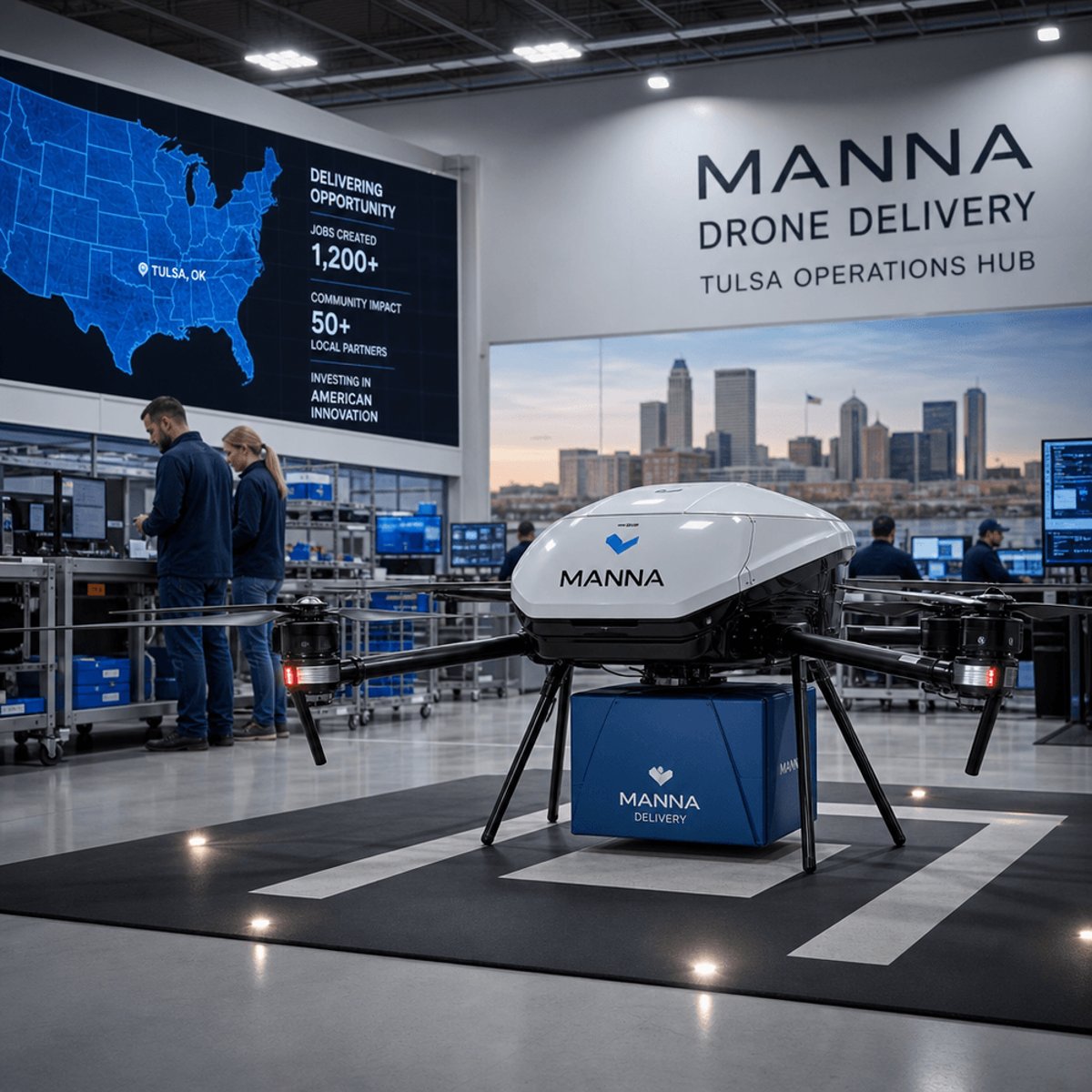
Autonomous drone delivery is officially coming to America at scale. Manna, the Irish startup that's been quietly perfecting aerial food delivery across Europe, just announced a major US manufacturing and operations facility in Tulsa, Oklahoma - complete with plans to hire 1,000 people. It's the clearest signal yet that drone delivery is moving from experimental pilots to genuine infrastructure, and it positions Tulsa as an unlikely hub in the race to dominate last-mile logistics.
Manna is making a statement. The Dublin-based drone delivery company, which has spent years refining its autonomous systems across Ireland and the UK, is planting its flag in the American heartland with a manufacturing and operations center that could employ up to 1,000 workers. The Tulsa facility represents more than just geographic expansion - it's a calculated bet that the US is finally ready to embrace drone delivery at scale.
The timing couldn't be more deliberate. While competitors like Amazon Prime Air and Alphabet's Wing have struggled with regulatory hurdles and limited service areas, Manna has been quietly racking up operational experience. The company claims over 200,000 autonomous deliveries completed across European markets, giving it real-world data that US regulators are hungry to see. Now they're bringing that expertise stateside.
Tulsa might seem like an unexpected choice, but the logic is solid. Oklahoma's central geography offers efficient distribution to both coasts, while the state's aviation-friendly regulatory environment and lower operational costs make it attractive for drone operations. The city has actively courted aerospace and tech companies, offering incentives and streamlined permitting that more congested metros can't match. For a company planning to manufacture drones at scale, that matters.
The 1,000-job figure is ambitious but revealing. It suggests Manna isn't just setting up a small test operation - they're building genuine manufacturing capacity. That means assembly lines for drones, logistics infrastructure, customer service operations, and likely a significant engineering presence to adapt their European systems for American airspace. It's the kind of commitment that only makes sense if you're expecting rapid expansion.
What sets Manna apart in the crowded drone delivery space is their approach to autonomy. Rather than focusing on long-range deliveries, they've optimized for quick, precise drops in dense suburban environments - typically lowering packages on a biodegradable tether rather than landing. Their drones can complete deliveries in under three minutes within a two-mile radius, making them ideal for restaurant delivery and quick commerce. That's a proven model in Europe that translates well to American suburbs.
The regulatory landscape is shifting in Manna's favor. The FAA has been gradually loosening restrictions on beyond-visual-line-of-sight operations, and several states are actively creating drone-friendly frameworks. Oklahoma passed legislation in 2025 streamlining approval processes for commercial drone operations, part of a broader push to position the state as an aerospace innovation hub. Manna is essentially betting that regulatory approval will accelerate as they demonstrate safe operations.
Competition in the US drone delivery market remains fragmented but heating up. Amazon continues expanding Prime Air in select markets, while Walmart has partnered with multiple drone providers including Zipline and DroneUp. Wing operates in parts of Texas and Virginia, but none have achieved the operational density Manna targets. The real race is to prove unit economics at scale - something no one has definitively done yet in the US market.
The manufacturing component is particularly strategic. By building drones domestically, Manna sidesteps potential supply chain issues and tariff complications while appealing to economic development officials who prioritize job creation. It also allows faster iteration on hardware designs based on American market feedback. That vertical integration could prove decisive as the industry matures and margins tighten.
What remains unclear is Manna's funding situation and timeline for US operations. The company hasn't disclosed recent fundraising, though building out manufacturing capacity and hiring 1,000 employees suggests either strong financial backing or confidence in near-term revenue generation. The drone delivery market has seen significant venture investment, but also high-profile setbacks as companies struggle with regulatory delays and operational challenges.
Manna's Tulsa gambit is a genuine inflection point for autonomous delivery in America. If they can replicate their European success while navigating US regulations and building domestic manufacturing capacity, they'll prove the model works at scale. The 1,000-job commitment signals this isn't a test - it's a full-scale assault on the American last-mile delivery market. For Tulsa, it's a chance to become the unexpected epicenter of aerial logistics. For consumers tired of waiting for drone delivery promises to materialize, Manna's expansion might finally deliver the future we've been hearing about for years. The question isn't whether autonomous drone delivery is coming to America anymore - it's whether Manna can execute fast enough to dominate the space before bigger players catch up.