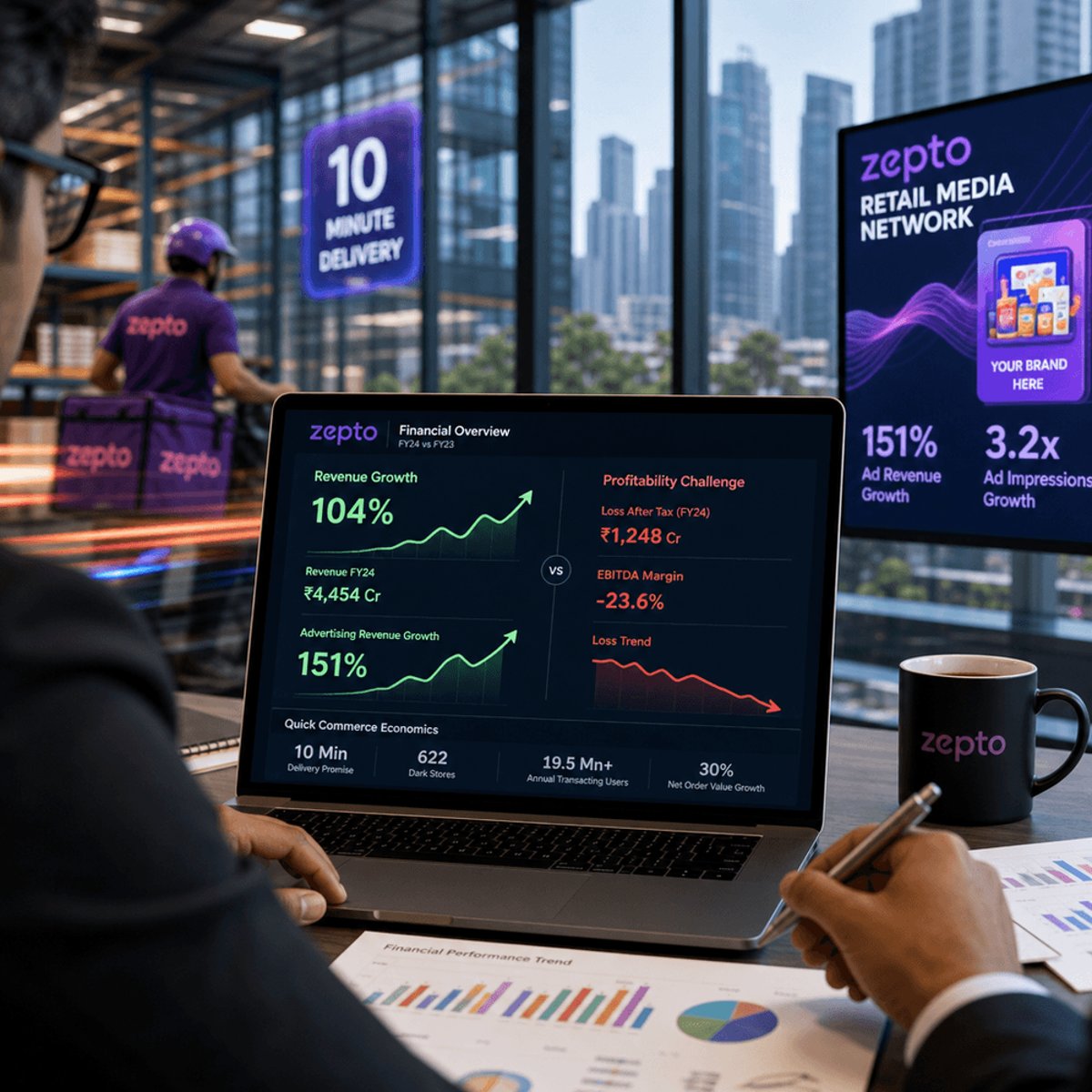
India's quick-commerce darling Zepto just filed for its highly anticipated IPO, and the numbers reveal a company firing on all cylinders—except the one that matters most to public market investors. The Mumbai-based startup posted 104% operating revenue growth while its advertising business exploded 151%, but losses deepened alongside the breakneck expansion. It's the classic growth-versus-profitability paradox that's defined Indian tech's IPO pipeline, and investors are about to decide which side of that equation they believe in.
Zepto just handed public market investors a 10-minute delivery of financial transparency, and it's a mixed bag of eye-popping growth metrics and deepening red ink. The Indian quick-commerce startup's IPO filing reveals a company that's doubled down on expansion while burning through capital at a pace that'll test investor appetite for India's booming but brutal grocery delivery wars.
The standout number isn't the headline 104% operating revenue growth—it's that advertising revenue jumped 151%, outstripping the core business by nearly 50 percentage points. That's not just impressive, it's strategic. Zepto is quietly building a retail media network that's turning its dark stores into digital billboards, and brands are paying premium rates to reach customers who want their groceries now, not later.
But here's the tension investors will fixate on: losses grew alongside revenue. The filing doesn't sugarcoat the math. For every rupee Zepto brought in, it spent more expanding its network of micro-warehouses, subsidizing deliveries, and outmaneuvering rivals like Blinkit (owned by Zomato) and Swiggy Instamart. India's quick-commerce sector is a land grab right now, and Zepto is buying territory with investor capital.
The advertising surge tells a different story though. It's the one bright spot that doesn't require burning cash to acquire customers. Brands like Unilever and Nestlé are already treating quick-commerce platforms as the new impulse-buy channel, and Zepto's 151% growth suggests it's winning that battle. If the company can scale this high-margin revenue stream while moderating delivery subsidies, there's a path to unit economics that make sense.
But that's a big if. The filing leaves the valuation question hanging in the air like a delivery drone with no destination. Zepto raised capital at a reported $3.6 billion valuation in its last private round, but public market comps are tricky. Food delivery peers trade at modest revenue multiples, and none have cracked consistent profitability in India's hyper-competitive consumer internet landscape.
What makes Zepto's bet interesting is timing. The company is going public as India's IPO market heats up again after a sluggish 2025, and as quick-commerce crosses into mainstream adoption beyond metro cities. Order volumes are climbing, average order values are holding steady, and the 10-minute delivery promise has shifted from novelty to expectation for millions of urban Indians.
The competitive math is unforgiving though. Zomato has deep pockets and a profitable food delivery business subsidizing Blinkit's expansion. Swiggy is public and hunting for quick-commerce dominance. Amazon and Flipkart are testing their own ultrafast models. Zepto needs to prove it can achieve scale economies before the capital markets lose patience or bigger rivals squeeze margins further.
Investors will also scrutinize the unit economics buried in the filing. How much does each delivery actually cost? What's the customer acquisition expense versus lifetime value? How fast can Zepto reduce losses per order as density improves in its operational clusters? These are the questions that'll determine whether the IPO prices at the high end of expectations or gets a reality check from public market skeptics.
The advertising play offers a hedge. If Zepto can turn its platform into a must-buy channel for consumer brands—think Amazon's ad business but for impulse grocery purchases—that high-margin revenue could offset delivery economics faster than anyone expects. The 151% growth rate suggests brands see the value, and Zepto's young, urban customer base is exactly who CPG companies want to reach.
What happens next depends on how public investors value growth versus profitability in India's evolving tech landscape. The IPO will test whether quick-commerce is a sustainable business model or a venture-capital-fueled subsidy war that ends badly for latecomers. Zepto's filing makes the case for growth, but it's left the profitability question unanswered—and that's the only question public markets really care about.
Zepto's IPO filing is a bet that India's public markets will reward hypergrowth over near-term profitability, and that quick-commerce is durable enough to justify the cash burn. The 151% advertising revenue surge offers a compelling subplot—a high-margin business within the low-margin delivery grind—but the valuation question looms large. Investors will decide in the coming weeks whether they're buying into the future of Indian retail or just another subsidy-dependent delivery model dressed up for public markets. Either way, the filing signals quick-commerce has arrived as a legitimate sector, even if the path to sustainable profits remains unclear.