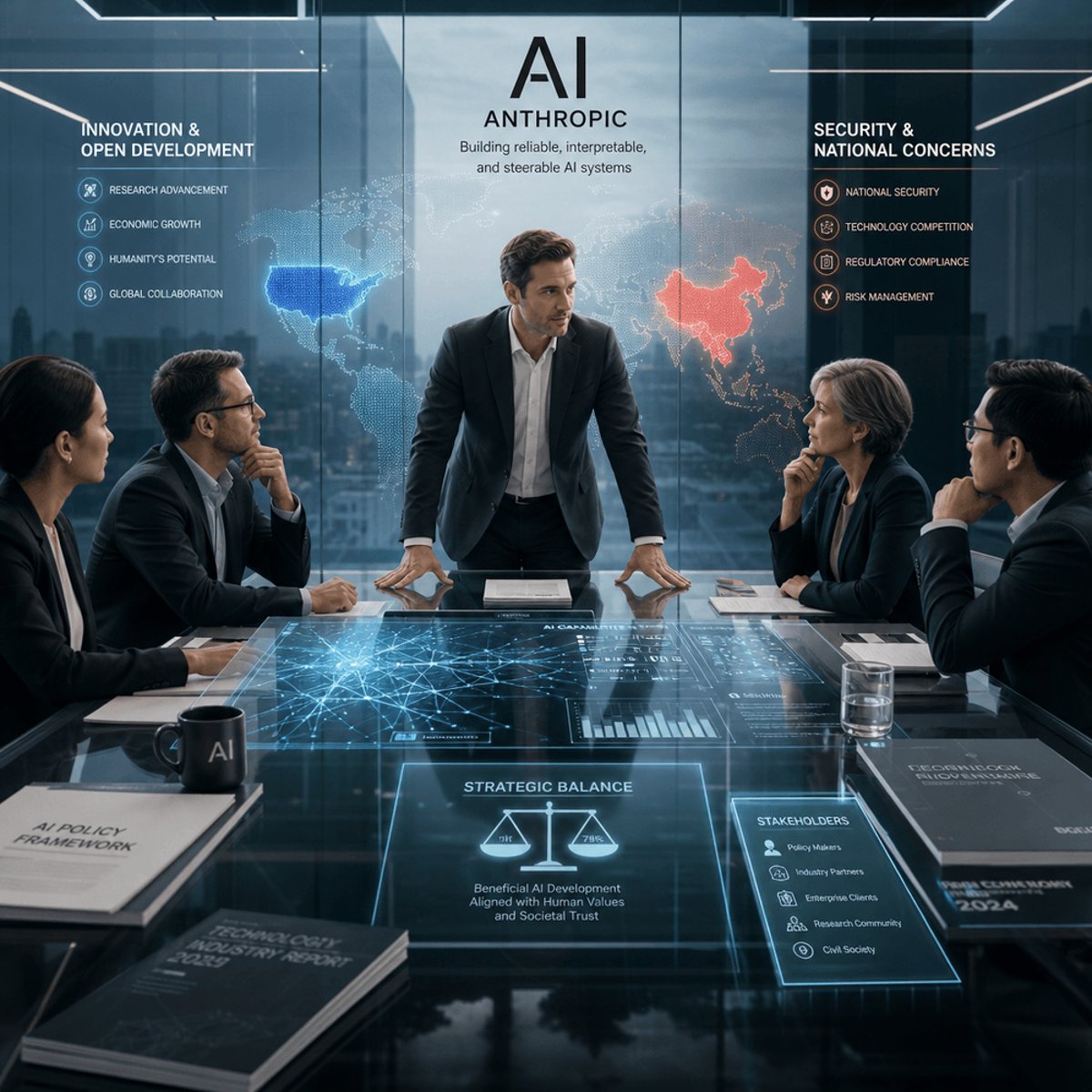
Anthropic CEO Dario Amodei just weighed into one of AI's most heated debates, clarifying his company's stance on open-weight models while raising fresh concerns about Chinese AI capabilities. The statement comes as Washington intensifies scrutiny over whether freely available AI models pose national security risks, putting frontier AI labs in the crosshairs of a widening policy battle.
Anthropic CEO Dario Amodei is drawing a clear line in the sand. The company doesn't oppose open-weight AI models, but it's watching Chinese AI development with growing alarm.
The clarification, reported by TechCrunch, comes at a critical moment for the AI industry. Washington has been ramping up pressure on AI labs to restrict access to powerful models, with some officials arguing that open-weight releases essentially hand cutting-edge capabilities to adversaries. Amodei's statement suggests Anthropic is trying to navigate a middle path between innovation and security concerns.
The timing isn't coincidental. Over the past months, the debate over open-source AI has reached fever pitch. Meta has championed open releases with its Llama models, while OpenAI CEO Sam Altman has voiced concerns about unrestricted model distribution. Now Amodei is adding Anthropic's perspective to the mix, and it's more nuanced than many expected.
By explicitly stating Anthropic doesn't oppose open-weight models, Amodei appears to be pushing back against characterizations of his company as categorically anti-open-source. The distinction matters in an industry where the open versus closed debate has become almost tribal. Developers and researchers have accused closed-model companies of using safety concerns as cover for protecting market advantages.
But Amodei's comments about Chinese AI capabilities reveal where his real concerns lie. China's AI sector has been advancing rapidly despite US export controls on advanced chips. Companies like DeepSeek, Baidu, and Alibaba have been releasing increasingly capable models, often with approaches that differ from Western labs. The concern isn't just about capabilities matching US models, but about the potential strategic implications of that parity.
The geopolitical dimension has become impossible to ignore. US policymakers are wrestling with how to maintain technological leadership while fostering innovation. Export controls on chips were supposed to slow Chinese AI progress, but recent developments suggest those barriers are less effective than hoped. If Chinese labs can match frontier capabilities, the argument for restricting open-weight releases in the US becomes harder to justify.
Amodei's position puts Anthropic in an interesting spot relative to its competitors. The company has built its brand around AI safety and responsible development, raising over $7 billion from investors including Google and various venture firms. Unlike OpenAI, which has moved toward increasingly restricted releases, or Meta, which has embraced open distribution, Anthropic seems to be staking out territory that acknowledges both perspectives.
The practical implications remain unclear. Anthropic hasn't announced plans to release open-weight versions of Claude, its flagship model. The company has historically kept its models behind API access, similar to OpenAI's approach with GPT-4. But by not opposing open-weight models in principle, Amodei leaves room for policy positions that don't automatically restrict all powerful model releases.
What's driving this statement now? Industry insiders suggest it may be a response to ongoing conversations with regulators. The Commerce Department has been soliciting input on potential AI model restrictions, and companies are jockeying to shape whatever framework emerges. Getting ahead of characterizations that might lump all frontier labs into an anti-open camp could be strategic positioning.
The China focus also aligns with broader industry messaging. Most major US AI companies have been emphasizing the need to maintain American leadership in AI, framing it as both an economic and national security imperative. By highlighting Chinese AI as a specific concern, Amodei taps into bipartisan consensus in Washington while potentially deflecting pressure for blanket restrictions on model releases.
Amodei's clarification adds an important voice to the AI policy debate, but it raises as many questions as it answers. The stance suggests frontier labs are trying to avoid a binary choice between completely open or completely closed development. As regulatory frameworks take shape and Chinese AI capabilities continue advancing, companies like Anthropic will need to turn these philosophical positions into concrete policies. The industry is watching to see whether this middle ground can actually hold, or if competitive and security pressures will force everyone to pick a side.