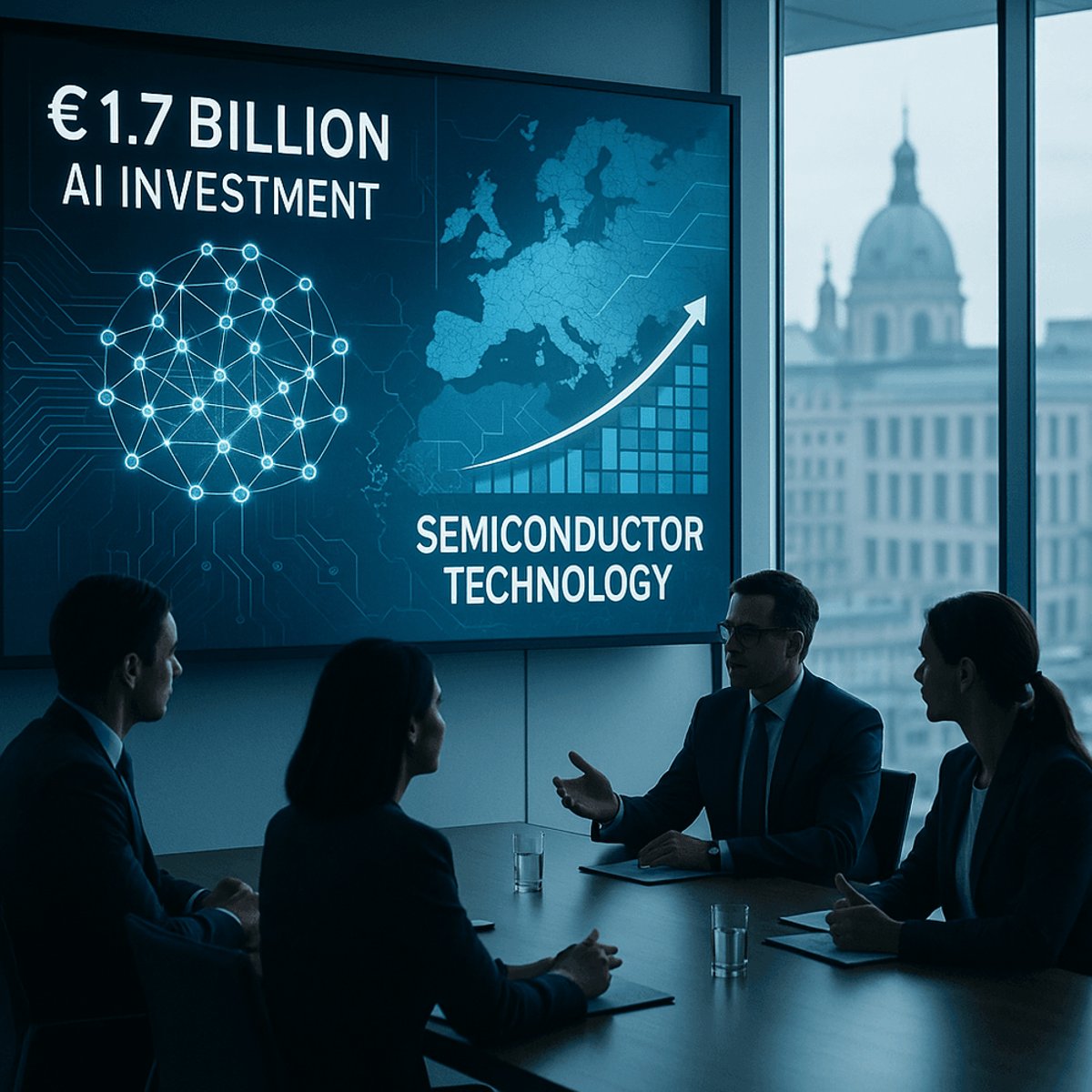
Dutch chip equipment giant ASML just made its biggest AI bet yet, leading a massive €1.7 billion Series C round that catapults French startup Mistral AI to a $13.8 billion valuation. The deal gives ASML an 11% stake in Europe's most promising OpenAI rival, signaling how chip makers are racing to secure positions across the AI value chain.
The AI funding frenzy just hit a new gear. ASML, the Dutch semiconductor equipment powerhouse that controls the world's most advanced chip manufacturing, pumped €1.3 billion into Mistral AI's Series C round, securing an 11% stake in what's become Europe's most formidable challenge to Silicon Valley's AI dominance.
The €1.7 billion round more than doubles Mistral's valuation from €5.8 billion achieved just last year, according to CNBC's breaking report. At €11.7 billion ($13.8 billion), the French startup now ranks among the world's most valuable AI companies, trailing only OpenAI, Anthropic, and a handful of others.
ASML's move represents more than just venture capital - it's strategic positioning. The company that makes the lithography machines essential for cutting-edge semiconductors is now betting that controlling AI model development is just as critical as controlling chip production. "This is ASML hedging the entire AI stack," one industry analyst told us, speaking on background about the deal's implications.
Mistral's rapid ascent reflects Europe's determination to avoid falling behind in the AI race. Founded by former Google DeepMind and Meta researchers, the Paris-based company has positioned itself as a more business-friendly alternative to OpenAI, offering open-source models alongside enterprise solutions. Nvidia previously backed the company, adding credibility to its technical approach.
CEO Arthur Mensch recently told CNBC during London Tech Week that Mistral is launching its first reasoning model designed to compete directly with OpenAI's advanced capabilities and China's DeepSeek. "Great at mathematics, great at coding," Mensch described the upcoming system, which could challenge OpenAI's GPT-4's dominance in complex problem-solving.
The funding timeline tells the story of AI's breakneck pace. Mistral raised €600 million at a €5.8 billion valuation just over a year ago - meaning this latest round represents a 100% valuation increase in roughly 12 months. That acceleration mirrors the broader AI investment boom, where companies are burning through massive rounds to fund the computational infrastructure needed for training increasingly sophisticated models.
ASML's involvement signals how semiconductor companies are moving beyond just selling equipment to chip makers. With AI driving unprecedented demand for advanced processors, equipment manufacturers like ASML are integrating vertically across the entire AI value chain. The company's lithography machines are already essential for producing the H100 and H200 GPUs that power AI training - now it owns a piece of what those chips are creating.
The deal also validates Europe's AI strategy of building alternatives to American and Chinese AI giants. While OpenAI dominates consumer AI and Beijing pushes national champions like DeepSeek, Mistral represents a third path - European-developed AI that can compete globally while remaining aligned with EU regulatory frameworks and business practices.
Industry watchers expect Mistral to use the fresh capital for massive infrastructure investments. Training state-of-the-art language models requires thousands of high-end GPUs running for months, with costs easily reaching hundreds of millions per model. The €1.7 billion war chest positions Mistral to compete in this computational arms race.
ASML's timing appears strategic beyond just AI trends. The company faces growing geopolitical pressure over its China business, with the Netherlands restricting exports of advanced lithography equipment. Diversifying into AI development could provide new growth avenues as traditional semiconductor markets face regulatory headwinds.
ASML's massive bet on Mistral AI represents a pivotal moment for both companies and the broader AI landscape. For ASML, it's a strategic hedge that extends their influence from chip manufacturing into AI development itself. For Mistral, it provides the financial firepower to compete with OpenAI and establish Europe as a legitimate third pole in global AI development. As reasoning models become the next battleground in AI capabilities, this partnership could reshape how we think about the intersection of hardware and software in artificial intelligence - with profound implications for everything from chip demand to geopolitical tech competition.