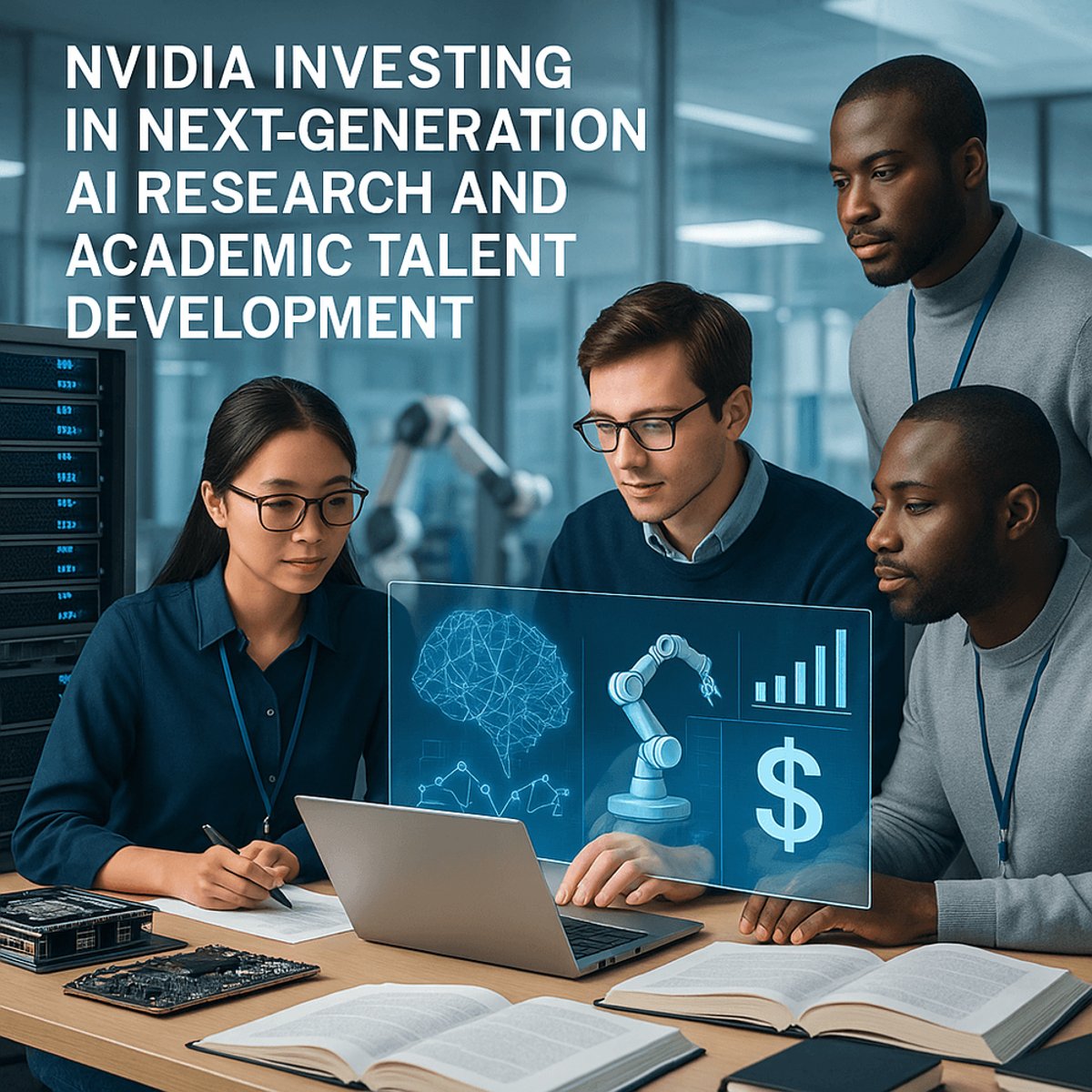
Nvidia just doubled down on the future of AI research, awarding $60,000 fellowships to 10 PhD students whose work spans everything from AI agents that can't be fooled by prompt injection attacks to robots that learn from internet-scale data. The 25-year-old program's latest cohort reveals where the chip giant thinks computing is headed next.
Nvidia isn't just betting on AI hardware anymore - it's investing directly in the minds that will shape the next decade of computing. The company's Graduate Fellowship Program just announced its 2026-2027 cohort, handing out $60,000 awards to 10 PhD students whose research reads like a roadmap for where AI is actually going.
The fellowship recipients aren't working on theoretical problems. Take Sizhe Chen from UC Berkeley, who's developing defenses against prompt injection attacks that could cripple AI agents in real-world applications. Or Yunfan Jiang at Stanford, building "generalist robots" that learn from massive datasets spanning real manipulation tasks and internet-scale supervision. These aren't academic exercises - they're solutions to problems Nvidia knows its customers will face tomorrow.
What's striking about this year's cohort is how it mirrors Nvidia's own strategic pivots. The company has been pushing hard into physical AI and robotics, and nearly half these fellowships fund research in those exact areas. Chen Geng from Stanford is modeling "4D physical worlds" for robotics applications, while Yijia Shao is designing human-agent collaboration interfaces. It's not coincidence - it's strategic talent cultivation.
The technical depth here is remarkable. Manya Bansal at MIT is designing programming languages specifically for modern accelerators, tackling the software bottleneck that's slowing down AI deployment. Irene Wang at Georgia Tech is working on energy-efficient AI training at scale - a critical problem as models grow exponentially larger. These students aren't just studying AI; they're solving the infrastructure problems that will determine who wins the next phase of the AI race.
Nvidia's fellowship program has been running for 25 years, but this cohort feels different. Previous years focused heavily on graphics and traditional HPC workloads. Now it's all about agents, embodied AI, and collaborative systems. Shangbin Feng from University of Washington is even working on "model collaboration" - multiple AI systems trained by different organizations working together. That's not just research; that's the architecture for a decentralized AI future.
The program structure reveals Nvidia's deeper strategy. These aren't just scholarships - they're pipeline investments. Each recipient gets a summer internship before their fellowship year, meaning Nvidia gets first look at breakthrough research while it's happening. Several past fellows have joined Nvidia full-time or launched startups that became acquisition targets.
The international scope is also telling. Recipients come from institutions across the US, but the finalist list includes researchers from Peking University and Max Planck Institute for Informatics. Nvidia isn't just recruiting American talent - it's building a global network of researchers aligned with its technical vision.
Look at the specific research areas getting funded: autonomous systems, computer architecture, deep learning, programming systems, robotics, and security. That's essentially Nvidia's entire product roadmap translated into academic research. The company isn't just supporting interesting science - it's systematically investing in the foundational work that will drive its next decade of growth.
The timing matters too. As AI companies race to build increasingly capable systems, the bottlenecks are shifting from raw compute power to software efficiency, security, and real-world deployment. Nvidia's fellowship picks reflect exactly those challenges. These students will likely produce the algorithms and architectures that become Nvidia's next-generation products.
This isn't just corporate philanthropy - it's strategic talent acquisition disguised as academic support. By funding the researchers tackling tomorrow's biggest AI challenges, Nvidia ensures it stays ahead of problems its customers don't even know they'll have yet. As AI moves from labs to real-world applications, these fellowships represent Nvidia's bet on the human capital that will define the next computing era.