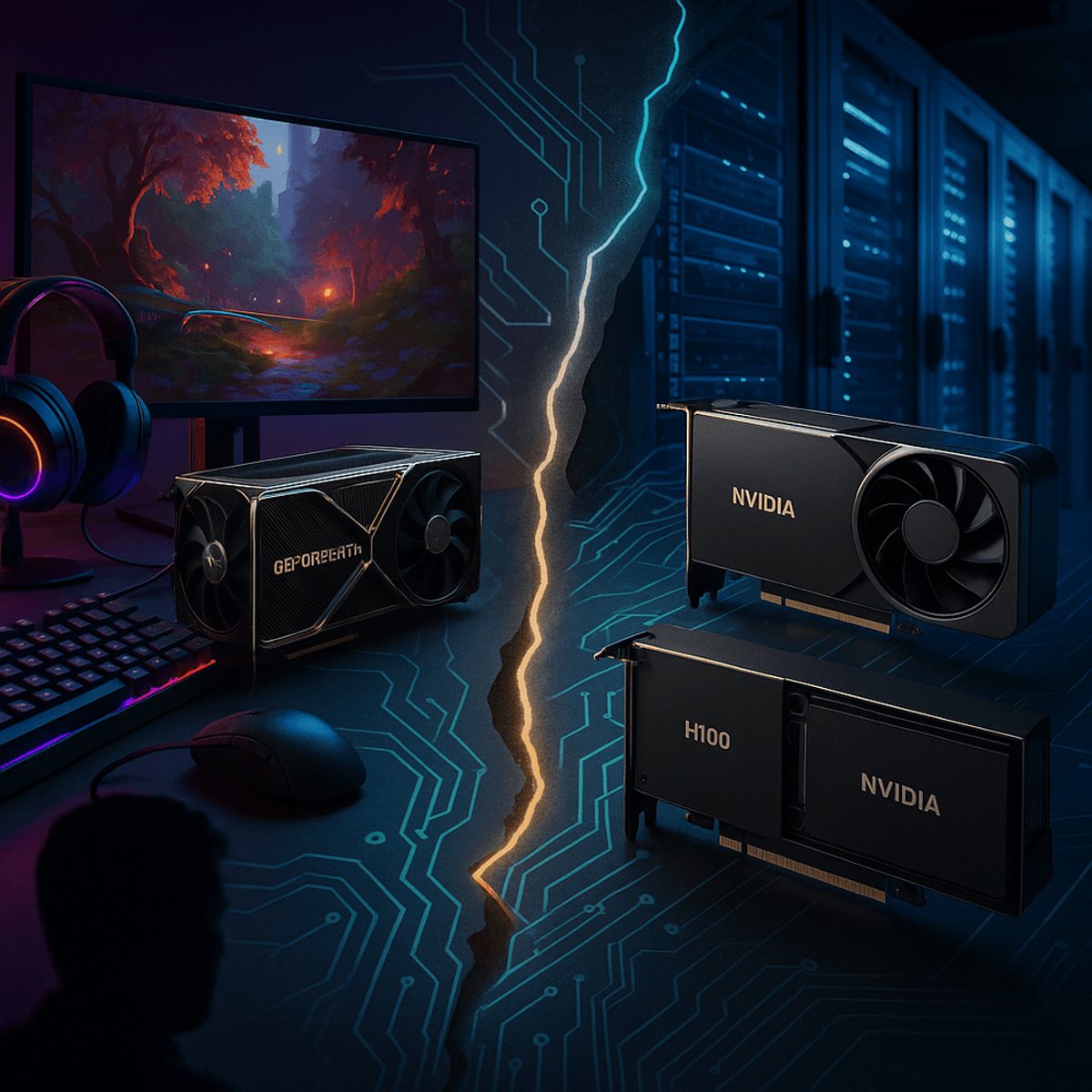
The gaming community that once kept Nvidia afloat is now openly rebelling against the chip giant's AI-first strategy. As memory shortages divert resources to data center GPUs and the controversial DLSS 5 technology reshapes game development itself, longtime GeForce loyalists are questioning whether the company that defined PC gaming still cares about them. It's a rift that reveals the hidden cost of Nvidia's $2 trillion AI boom - and it's happening just as competitors circle.
There's a particular irony in watching Nvidia alienate the very community that kept the lights on during its darkest days. Back in the early 2000s, when the company teetered on the edge of bankruptcy, gamers buying GeForce cards provided the lifeline that allowed Nvidia to survive and eventually dominate. Fast forward to 2026, and those same enthusiasts are openly questioning whether they matter anymore.
The breaking point isn't subtle. Memory supply constraints are hitting GeForce production hard as Nvidia prioritizes its H100 and upcoming Blackwell AI accelerators, which command profit margins that make even high-end gaming GPUs look like budget hardware. According to industry analysts tracking CNBC's reporting, the company is allocating HBM3 and GDDR7 memory to data center products first, leaving consumer GPUs with whatever capacity remains. That's a brutal reversal for gamers who've watched launch after launch get delayed or arrive with limited stock.
But the memory crunch is just the visible symptom. The deeper fracture involves DLSS 5, Nvidia's latest AI-powered upscaling technology that's becoming less of a optional feature and more of a mandatory crutch. Game developers are increasingly designing titles that rely on DLSS 5 to hit playable frame rates, effectively optimizing for Nvidia's AI algorithms rather than raw GPU performance. It's a shift that fundamentally changes what a graphics card does - and not everyone's happy about it.
"We used to buy GPUs for horsepower. Now we're buying them for the AI that fakes the horsepower," one prominent gaming community moderator posted, capturing the sentiment rippling through forums and Reddit threads. The complaint isn't that DLSS doesn't work - by most accounts, version 5 produces impressive results - but that it's becoming the primary design target instead of an enhancement. Games that struggle to maintain 60fps at native 4K suddenly hit 120fps with DLSS 5 Ultra Performance mode, which renders at 1080p internally and uses AI to reconstruct the missing pixels.
For Nvidia, this isn't a bug but a feature of its broader AI strategy. The same tensor cores powering ChatGPT-style inference in data centers are doing real-time upscaling in GeForce cards, creating technological synergy across product lines. CEO Jensen Huang has repeatedly emphasized that Nvidia is "an AI company" first, with gaming as one application of that core competency. That messaging plays well on Wall Street, where the stock trades at valuations driven by enterprise AI growth, but it rings hollow to gamers who remember when GeForce was the flagship brand.
The historical context makes the current tension particularly sharp. Nvidia's near-bankruptcy moment came after the Xbox partnership fell through and the company bet heavily on expensive, power-hungry GPUs that didn't match market demand. Gamers buying mid-range and high-end GeForce cards provided stable revenue that allowed Nvidia to regroup, invest in CUDA parallel computing, and eventually position itself for the AI revolution. The direct line from early 2000s GeForce sales to today's H100 dominance is clear - which is why the community feels entitled to more consideration now.
Competitors are watching closely. AMD has already started marketing its Radeon cards as "built for native performance," a not-so-subtle dig at Nvidia's AI-upscaling dependence. Intel, still building credibility in discrete GPUs with its Arc series, is emphasizing straightforward rasterization performance and open standards. Neither company can match Nvidia's ray tracing performance or AI capabilities yet, but they don't need to if enough gamers decide they'd rather have consistent availability and a focus on traditional gaming workloads.
The memory allocation issue crystallizes the problem. HBM3 production is constrained industry-wide, with Samsung, SK Hynix, and Micron all running at capacity to supply AI accelerators for Microsoft, Google, Amazon, and other hyperscalers. When Nvidia has to choose between a H100 that sells for $25,000-$40,000 to data centers or a RTX 5090 that retails for $1,599 to gamers, the math isn't complicated. Gaming division revenue has actually grown in absolute terms, but its percentage of Nvidia's total business has collapsed from over 40% in 2020 to barely 10% projected for fiscal 2027.
Industry developers are caught in the middle. Major studios have invested heavily in supporting DLSS across their engines, and the technology genuinely enables visual experiences that wouldn't be possible otherwise. But the reliance creates lock-in that makes it harder to optimize for AMD or Intel hardware, fragmenting the PC gaming market in new ways. Some indie developers are pushing back, insisting their games run well at native resolution without upscaling, but AAA titles increasingly treat DLSS as the default path to hitting performance targets.
The backlash is showing up in forums, YouTube comment sections, and even sales patterns. Enthusiast surveys suggest a growing willingness to consider alternatives, particularly among gamers who remember when each GPU generation delivered meaningful native performance improvements. The days of 40-50% generation-over-generation gains in raw rasterization are gone, replaced by incremental native improvements paired with dramatic DLSS-enabled performance that only works in supported titles.
What happens next likely depends on whether Nvidia views this as a temporary PR problem or a strategic risk. The company has weathered gamer discontent before - the GTX 970 memory controversy, the RTX 2000 series pricing backlash, the crypto mining shortages - and emerged stronger each time. But those were tactical missteps, not fundamental strategic pivots. The shift to AI-first development and resource allocation represents something deeper, a recognition that gaming, while important, is no longer the primary growth driver or innovation focus.
For now, GeForce remains the dominant gaming GPU brand by market share and mindshare. DLSS 5, controversy aside, delivers results that keep most users within the Nvidia ecosystem. But the emotional bond that once defined the relationship between Nvidia and its gaming community is clearly fraying. In an industry where brand loyalty often matters as much as raw specs, that's a dangerous position - especially when the competition is finally getting competitive.
The rift between Nvidia and its gaming base isn't just about memory shortages or controversial upscaling tech - it's about identity and priority in an era of transformative change. The company that gamers helped save has become an AI juggernaut that happens to still make gaming GPUs, rather than a gaming company that's good at AI. Whether that evolution costs Nvidia its fiercely loyal enthusiast community remains to be seen, but the backlash signals something significant: in the race to dominate enterprise AI, the world's most valuable chip company may be leaving its oldest friends behind. For competitors and gamers alike, that creates an opening that didn't exist just a year ago.