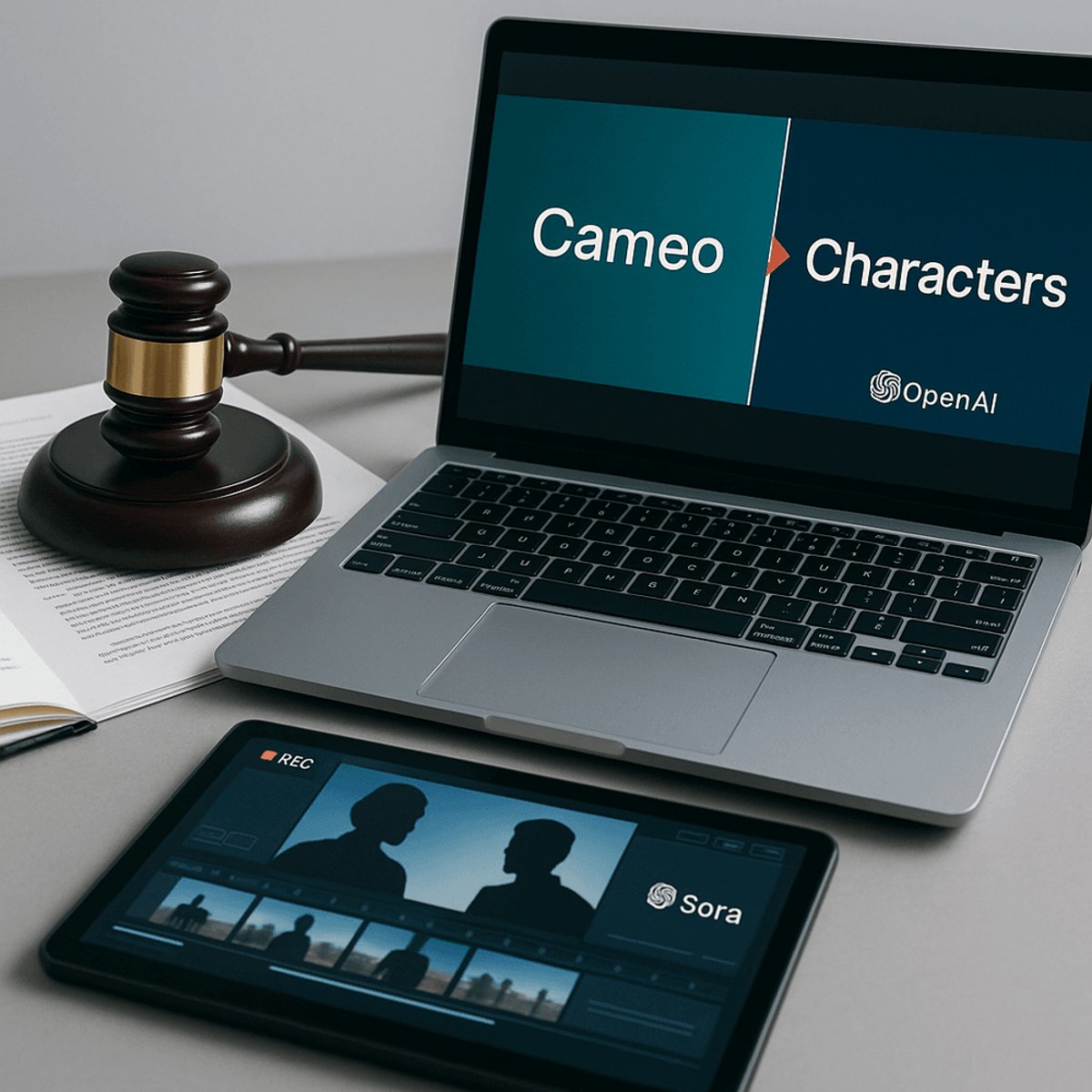
OpenAI just hit a legal roadblock that forced it to rebrand a key feature in its video generator Sora. A U.S. court has barred the AI company from using the name "Cameo" for its video personalization tool, compelling an immediate rename to "Characters." The ruling marks another chapter in the growing tensions between fast-moving AI startups and established tech brands over naming rights, and it shows how trademark disputes can force even the industry's biggest players to back down.
OpenAI thought it had a catchy name for one of Sora's standout features. Turns out, the courts disagreed. The company has been forced to retire the "Cameo" branding for its video generation tool that lets users insert personalized elements into AI-created videos, switching instead to the more generic "Characters" label.
The court order, first reported by TechCrunch, doesn't spell out every detail of the legal clash, but the culprit is almost certainly the celebrity video platform also called Cameo. That company has built a recognizable brand around personalized video messages from celebrities and influencers since launching in 2017. When OpenAI rolled out its own "Cameo" feature in Sora, it apparently crossed into protected trademark territory.
What's striking here is how quickly OpenAI moved to comply. The company has already swapped out the branding across its platform, suggesting the court's injunction came with teeth. It's a rare public stumble for OpenAI, which has otherwise dominated headlines with its product velocity and aggressive feature rollouts. But trademark law doesn't care about your launch momentum.
The original Cameo feature, now called Characters, lets users create consistent character appearances across multiple Sora-generated video clips. It's a technically impressive capability that addresses one of generative video's biggest challenges: maintaining visual consistency. Users can define a character's appearance once, then have that same character appear across different scenes and scenarios. For content creators and marketers, that's potentially game-changing functionality.
But the name clash reveals a broader pattern emerging in the AI boom. Companies racing to ship new features are increasingly colliding with established trademarks. OpenAI isn't alone here. The AI industry's breakneck pace often means legal teams are playing catch-up with product teams, and trademark searches apparently didn't catch this conflict before launch.
The celebrity video platform Cameo has been protective of its brand before. The company raised over $100 million in funding and at one point carried a $1 billion valuation, making it exactly the kind of established player with resources to defend its trademark. While neither company has issued detailed public statements about the dispute, the court clearly sided with the original Cameo.
For OpenAI, this is more embarrassing than existential. Rebranding a feature is annoying and creates some user confusion, but it won't slow down Sora's development or adoption. "Characters" is arguably more descriptive anyway, even if it lacks the Hollywood flair of "Cameo." The bigger worry is whether this signals sloppier processes inside a company that's scaled incredibly fast while juggling multiple product lines.
The timing is also less than ideal for OpenAI. The company is in the middle of raising fresh capital at a reported $300 billion-plus valuation, and it's pushing hard to prove Sora can compete with emerging rivals in the generative video space. Small legal hiccups like this one probably won't move the needle with investors, but they do raise questions about operational maturity.
What this really shows is that AI companies, despite their futuristic products, still have to play by old-school rules around intellectual property. You can't just slap any name you want on a feature and hope nobody notices. As the AI arms race accelerates, expect more of these naming collisions. The product creativity is moving faster than the legal clearances, and courts are happy to pump the brakes when necessary.
This court ruling is a reminder that even the most powerful AI companies aren't above trademark law. OpenAI will survive the rebrand just fine, but the episode highlights a growing pain point across the industry. As AI features proliferate and companies race to ship, the risk of stepping on existing trademarks only increases. For OpenAI, the quick pivot to "Characters" closes this chapter, but it's probably not the last time we'll see an AI giant forced to rename something that sounded great in a product meeting but didn't clear legal review. The AI revolution still has to file the proper paperwork.