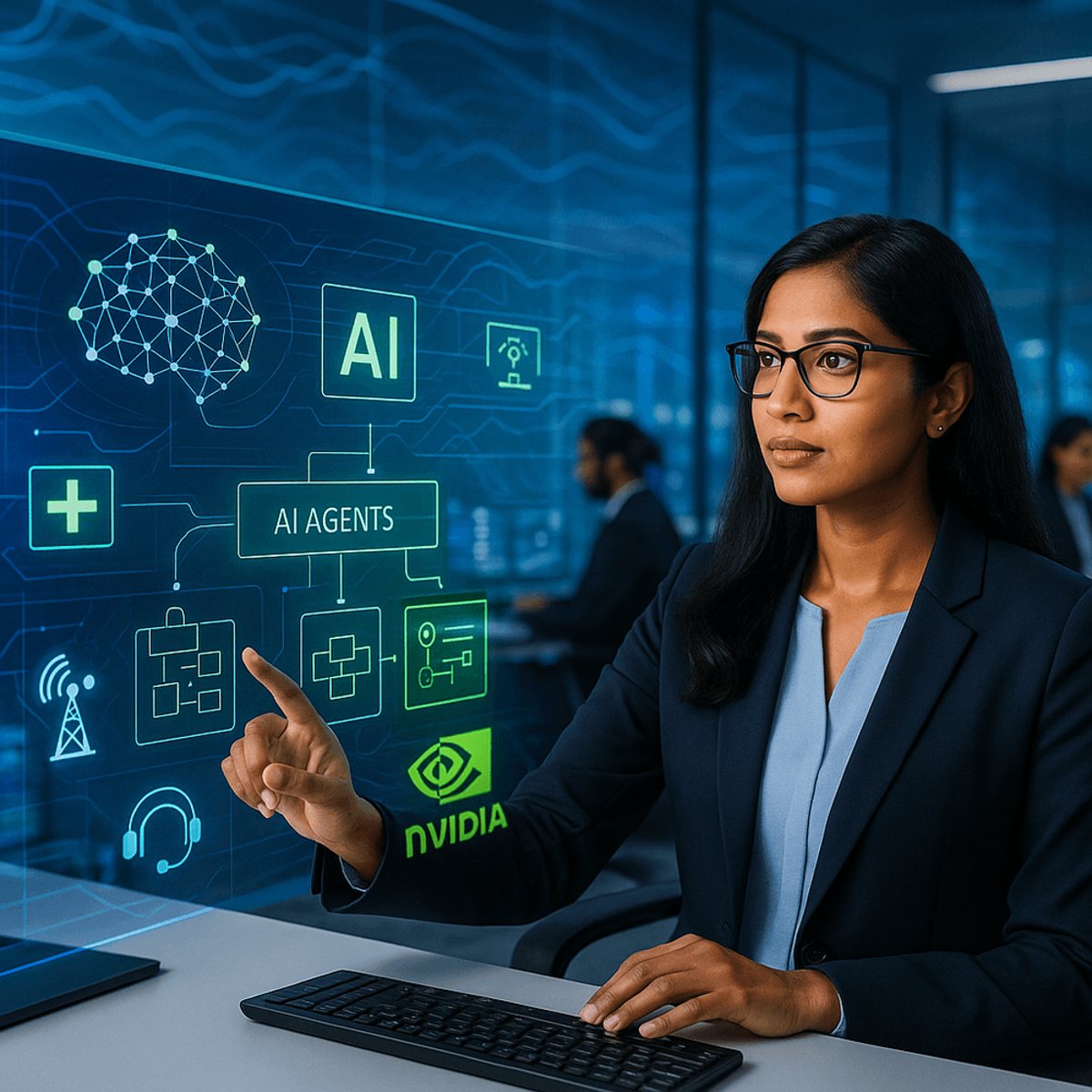
NVIDIA is turning India's tech giants into an AI deployment machine. Infosys, Wipro, Tech Mahindra, and Persistent Systems are rolling out enterprise AI agents powered by NVIDIA AI Enterprise software and Nemotron models, targeting everything from call centers to healthcare operations. The move positions India's global systems integrators as the proving ground for agentic AI at scale, potentially reshaping how enterprises worldwide automate back-office workflows and customer support.
India's biggest tech services players are making their biggest AI bet yet. NVIDIA just revealed that Infosys, Wipro, Tech Mahindra, and Persistent Systems are deploying enterprise-grade AI agents across multiple industries, tapping NVIDIA AI Enterprise software and the company's Nemotron models to automate complex workflows that have resisted previous automation attempts.
The timing matters. While most enterprises spent 2024 and early 2025 experimenting with chatbots and copilots, these Indian integrators are jumping straight to agentic AI, systems that can execute multi-step tasks with minimal human oversight. According to NVIDIA's blog announcement, the focus areas include call center operations, telecommunications infrastructure, healthcare administration, and back-office processing - exactly the domains where India's $250 billion IT services industry has dominated for decades.
But here's the twist: these same companies built their empires on labor arbitrage, employing millions to handle the repetitive tasks they're now automating with AI. The pivot reveals how quickly India's tech leaders recognized that defending their turf means becoming the automation provider rather than the automation victim. Infosys has been particularly aggressive, recently announcing partnerships with multiple AI vendors while simultaneously training thousands of employees on agentic workflows.
NVIDIA's Nemotron models are doing the heavy lifting. Unlike general-purpose large language models, Nemotron is optimized for enterprise deployments where accuracy, compliance, and integration with existing systems matter more than creative writing ability. The models run on NVIDIA AI Enterprise, a software platform that handles the messy reality of deploying AI in regulated industries - think audit trails, data governance, and the ability to explain why an AI agent made a specific decision.
Call centers represent the most immediate battleground. India processes customer support for a huge chunk of global enterprises, but rising wage pressures and quality consistency issues have made AI agents increasingly attractive. Tech Mahindra, which has deep telecom roots, is building agents that can troubleshoot network issues, process service requests, and even handle billing disputes without human intervention. Early deployments reportedly show 40-60% reduction in resolution time for routine queries.
Healthcare presents a trickier challenge but potentially bigger payoff. Persistent Systems is targeting prior authorization workflows, insurance claims processing, and patient scheduling - administrative nightmares that consume roughly 30% of U.S. healthcare spending. Agentic AI can navigate multiple systems, check eligibility, submit forms, and follow up on rejections, tasks that currently require experienced human processors who understand both medical terminology and bureaucratic processes.
The competitive implications extend beyond India. If these integrators succeed at scale, they'll pressure traditional enterprise software vendors who've been slower to ship agentic capabilities. Salesforce, ServiceNow, and Workday have all announced agent strategies, but Indian firms could move faster by building custom solutions that integrate across multiple vendor platforms rather than being locked into a single ecosystem.
NVIDIA clearly sees India as a strategic deployment partner. The company has been aggressively courting Indian enterprises and government agencies, recently announcing multiple AI training centers and cloud partnerships across the country. By enabling systems integrators to build on Nemotron, NVIDIA gets real-world validation for enterprise AI while tapping into distribution channels that reach thousands of global clients.
The workforce question looms large. India's IT services companies employ over 5 million people, many in exactly the roles these AI agents target. The official line from all four companies emphasizes upskilling and shifting workers to higher-value tasks, but the math is unavoidable - if AI agents deliver the productivity gains promised, the labor pyramid that sustained India's tech boom will need radical restructuring. Some analysts predict a 20-30% reduction in back-office headcount over the next three years as agentic AI matures.
What makes this deployment wave different from previous automation hypes is the technology finally matches the ambition. Earlier RPA tools and rules-based systems could only handle perfectly structured workflows. Agentic AI built on large language models can interpret ambiguous requests, navigate unexpected situations, and learn from corrections - closer to how human workers actually operate rather than how process diagrams pretend they operate.
India's systems integrators are making a calculated bet that whoever controls enterprise AI deployment at scale will dominate the next era of tech services. By partnering with NVIDIA and jumping directly to agentic AI, Infosys, Wipro, Tech Mahindra, and Persistent Systems are trying to write the playbook before Western competitors fully mobilize. The real test comes in the next 12-18 months as these early deployments either prove that AI agents can handle enterprise complexity at scale or reveal the gaps that still require human judgment. Either way, the traditional outsourcing model just got a lot more complicated.