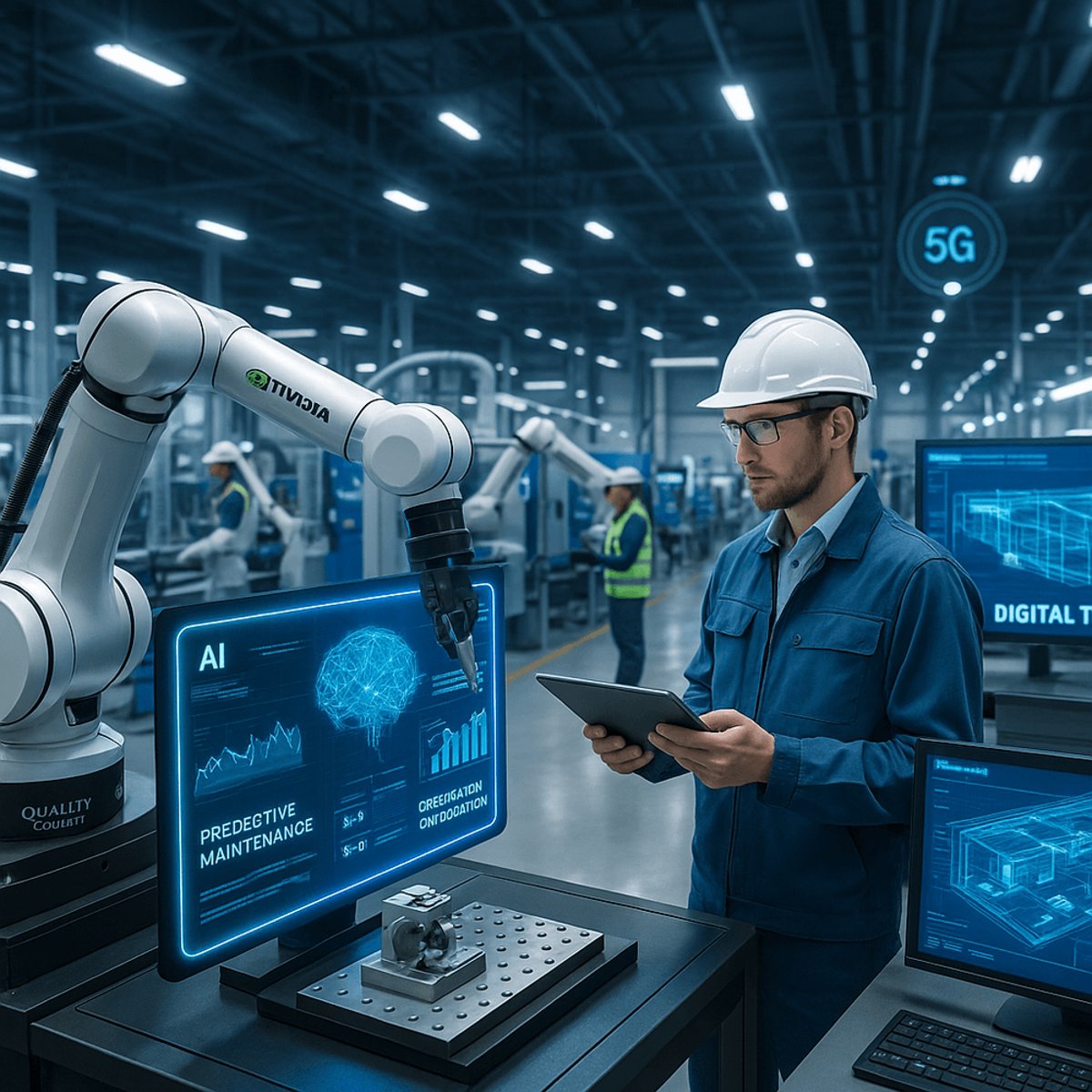
Nvidia is betting big on India's manufacturing renaissance. The chipmaker just announced partnerships with global industrial software leaders to deploy AI across India's $134 billion manufacturing expansion, spanning construction, automotive, renewable energy, and robotics. It's a massive play to embed software-defined factories from day one as India races to become a global manufacturing powerhouse. The move positions Nvidia at the center of what could be the world's largest greenfield industrial AI deployment.
Nvidia is making its move on India's industrial transformation, and the timing couldn't be more strategic. The country is pouring $134 billion into new manufacturing capacity, creating a rare opportunity to build AI-powered, software-defined factories from scratch rather than retrofitting legacy systems. According to Nvidia's official announcement, the company is partnering with global industrial software leaders and India's largest manufacturers to embed AI into every layer of production.
This isn't about adding AI features to existing factories. India's manufacturing expansion spans construction, automotive, renewable energy, and robotics - sectors that are being built with digital twins, predictive maintenance, and autonomous systems baked in from day one. For Nvidia, it's a chance to prove its Omniverse and AI Enterprise platforms can handle real-world industrial complexity at massive scale.
The competitive implications are huge. While Tesla and Amazon have grabbed headlines with factory automation in developed markets, India's greenfield advantage means no legacy infrastructure to work around. Software-defined manufacturing - where production lines adapt in real-time based on AI models - becomes the default, not an upgrade path.
India's $134 billion investment comes as the country positions itself as an alternative manufacturing hub to China. The renewable energy and automotive sectors are particularly critical, with India pushing aggressive EV adoption targets and solar manufacturing scale-up. AI-powered quality control, supply chain optimization, and energy management aren't nice-to-haves in this context - they're requirements to compete globally.
Nvidia's industrial software partnerships are key here. Companies like Siemens, Rockwell Automation, and Schneider Electric have spent decades building factory control systems, but they've struggled to integrate modern AI at scale. Nvidia's GPU infrastructure and pre-trained models give them a shortcut, while Nvidia gains distribution into manufacturing environments it couldn't reach alone.
The robotics angle is especially interesting. India's labor cost advantage is eroding, and manufacturers are betting on collaborative robots and autonomous systems to maintain competitiveness. Nvidia's Jetson platform for edge AI and Isaac robotics framework are designed exactly for this use case - running computer vision and decision-making models directly on factory floors.
What's less clear is how quickly these deployments will scale. Software-defined factories sound great in press releases, but industrial environments are notoriously conservative. Downtime costs money, and untested AI systems create risk. Nvidia will need to show ROI fast - reduced defect rates, lower energy costs, faster line changeovers - to justify the infrastructure investment.
The broader trend here is AI moving from the cloud to the physical world. Microsoft and Google dominate enterprise AI for knowledge work, but Nvidia is carving out industrial AI as its territory. India's manufacturing boom gives it a proving ground that's both massive in scale and greenfield in deployment - exactly the conditions Nvidia needs to show its full stack works.
Competitors are watching closely. AMD has been pushing its Instinct GPUs for AI training, while Intel's edge AI chips target factory deployments. But Nvidia's end-to-end platform - from data center training to edge inference, with Omniverse tying it together - is tough to replicate. The question is whether that integration advantage translates to market share in a price-sensitive market like India.
For India's manufacturers, the calculus is straightforward. Global buyers increasingly demand traceability, sustainability metrics, and just-in-time delivery - all of which require digital infrastructure. Building that in from day one is cheaper than retrofitting later. If Nvidia's platforms deliver on the promise, India could leapfrog established manufacturing powers in operational efficiency.
The renewable energy sector adds another dimension. Solar panel and battery manufacturing require extreme precision and quality control, areas where AI excels. India's aggressive renewable energy targets mean massive production capacity coming online fast, and defect rates directly impact economics. Computer vision systems catching manufacturing flaws in real-time could be the difference between profitable and struggling facilities.
Nvidia's India manufacturing play is a bet that industrial AI's future will be written in emerging markets, not retrofitted into legacy systems. The $134 billion investment scale gives Nvidia a massive deployment opportunity, but success depends on proving real-world ROI in demanding industrial environments. If software-defined factories deliver on efficiency and quality promises, India's manufacturing renaissance could establish the template for AI-native production globally. The stakes are high - for Nvidia's industrial ambitions, for India's manufacturing competitiveness, and for the broader question of whether AI can truly transform physical production at scale.