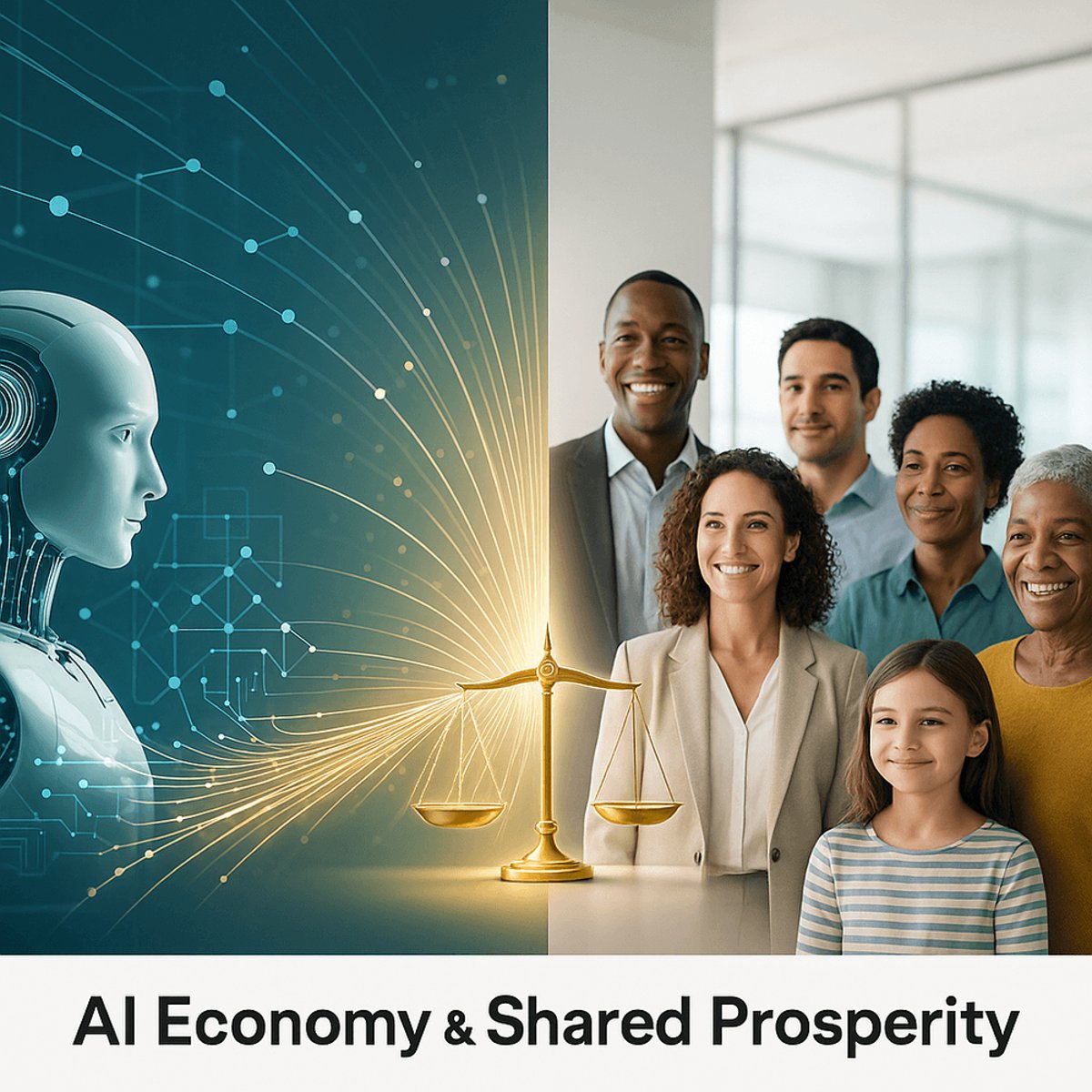
OpenAI just laid out its most detailed vision yet for how society should handle AI's economic disruption. The company's new policy framework proposes taxing AI-generated profits, establishing public wealth funds, and transitioning to four-day work weeks as automation reshapes the workforce. It's a striking pivot for a company racing to build artificial general intelligence - now publicly grappling with how to distribute the wealth it creates.
OpenAI is making a calculated bet that the AI economy needs guardrails before the disruption hits full force. The company's sweeping policy proposal, released Monday, tackles the thorniest question in tech: what happens when AI systems start doing jobs currently held by millions of people?
The answer, according to OpenAI, involves a fundamental restructuring of how we think about work and wealth. The company wants governments to tax profits generated by AI systems - essentially a robot tax by another name - and funnel those revenues into public wealth funds that distribute payments directly to citizens. Think Alaska's oil dividend, but for the AI age.
It's a remarkable document coming from the company at the center of the AI revolution. OpenAI spent years building ChatGPT and pushing toward artificial general intelligence, and now it's publicly wrestling with the consequences. The timing isn't accidental. As enterprise AI adoption accelerates and automation anxiety spreads, the company is positioning itself as a responsible actor thinking beyond quarterly earnings.
The four-day work week proposal stands out as particularly bold. OpenAI suggests gradually reducing working hours as AI productivity gains free up human time, rather than simply eliminating jobs. It's an attempt to reframe the automation conversation from job loss to work-life balance, though critics will note that shorter weeks don't help workers whose jobs disappear entirely.
The public wealth fund concept draws from existing models but scales them for an AI-driven economy. Instead of one-time universal basic income payments, OpenAI envisions sustained distributions funded by taxing the enormous productivity gains AI systems generate. The company argues this creates a direct link between AI's economic benefits and public welfare, turning automation from a threat into a shared resource.
But the proposal raises as many questions as it answers. How do you tax AI profits when they're embedded in every business process? Which jurisdiction collects revenue when AI systems operate globally? And who decides how wealth fund payments get distributed - equally per capita, or weighted by economic displacement?
OpenAI isn't offering detailed implementation plans, and that's likely intentional. The framework reads more like a conversation starter for policymakers than a legislative blueprint. The company is essentially saying: we're building systems that will reshape the economy, and here's how we think society should adapt.
The expanded safety net provisions acknowledge that transition periods will be brutal for displaced workers. OpenAI calls for stronger unemployment benefits, retraining programs, and healthcare access independent of employment. These aren't revolutionary ideas, but bundling them with robot taxes and wealth funds creates a comprehensive vision that goes beyond standard tech industry talking points about reskilling.
Timing matters here. Government AI policy debates are intensifying globally, from the EU's AI Act to ongoing discussions in Washington. OpenAI is staking out a position that blends progressive redistribution with capitalist innovation - let companies profit from AI, but tax those profits to fund public benefits. It's a middle ground designed to appeal to both sides of the political spectrum.
The proposal also reflects OpenAI's evolving corporate identity. The company started as a nonprofit research lab, converted to a capped-profit structure, and now operates as a major commercial player while maintaining its safety-focused mission. This policy framework attempts to reconcile those tensions by arguing that aggressive AI development can coexist with robust social protections.
Not everyone's buying it. Labor advocates argue that profit taxes come too late, after jobs are already automated away. Free market proponents see the proposal as government overreach that will stifle innovation. And rival AI companies might view OpenAI's policy push as a strategic play to shape regulations in its favor while it maintains a technical lead.
The wealth fund mechanism also faces practical hurdles. Alaska's oil dividend works because oil extraction is geographically fixed and easily taxable. AI profits are diffuse, global, and notoriously difficult to pin down for tax purposes. Tech companies already exploit loopholes to minimize tax bills - adding AI-specific levies invites new forms of avoidance.
What's clear is that OpenAI is trying to get ahead of a backlash. As its systems become more capable and automation accelerates, the company faces growing scrutiny over its role in economic disruption. This policy proposal is both a genuine attempt to address those concerns and a public relations move to position OpenAI as thoughtful and responsible.
The four-day work week element, in particular, feels designed to generate positive headlines and shift the narrative from job destruction to lifestyle improvement. It's harder to demonize a company proposing shorter work weeks than one simply saying displaced workers should learn to code.
For policymakers, OpenAI's framework offers a starting point but not a solution. The challenge isn't just redistributing AI wealth - it's managing the transition period when disruption hits faster than safety nets can adapt. The company's proposal doesn't fully address that timing gap, when millions could lose jobs before wealth funds and reduced work weeks materialize.
The broader tech industry is watching closely. If OpenAI's policy vision gains traction with governments, other AI companies will face pressure to support similar frameworks or risk being painted as less responsible. That could reshape corporate lobbying strategies across Silicon Valley as AI capabilities advance.
OpenAI's policy framework represents the most comprehensive economic vision yet from a major AI company, but it's ultimately a proposal, not a solution. The real test comes when governments decide whether to embrace robot taxes and wealth funds, or chart their own path through AI's economic disruption. What's certain is that the conversation has shifted - AI companies can no longer just build powerful systems and leave the societal consequences to others. Whether OpenAI's specific proposals gain traction or not, the company has placed economic equity at the center of the AI development debate, and that's a position it will be judged by as automation reshapes the workforce in the coming years.