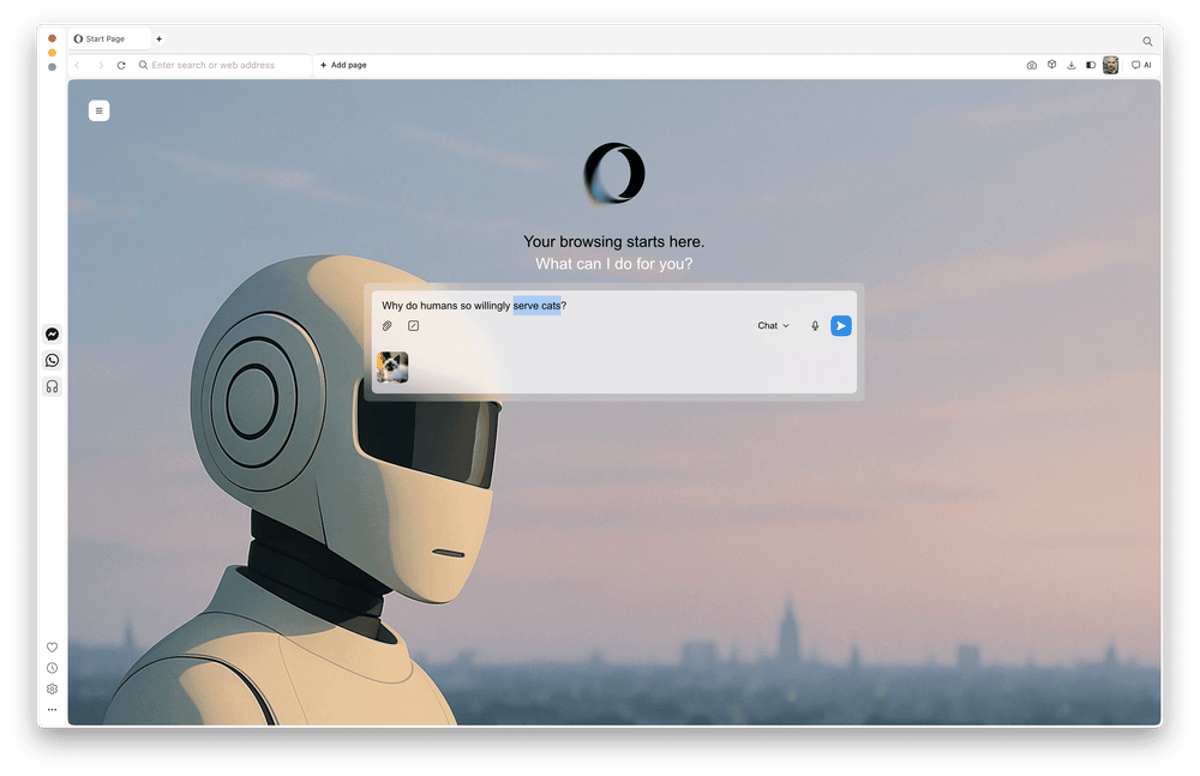
Opera just launched its much-anticipated AI browser Neon to a limited group of users at $19.90 per month, marking the Norwegian company's ambitious entry into the rapidly heating AI browser wars. The "agentic browser" promises specialized AI agents that handle different tasks - from workspace management to actual web browsing - putting Opera in direct competition with recent launches from Perplexity, OpenAI, and Google's enhanced Chrome.
Opera is betting big on AI agents to reshape web browsing. The Norwegian software company's long-awaited Neon browser goes live today with a $19.90 monthly price tag that immediately sets it apart from free competitors like Chrome and Edge. But Opera isn't just charging for the privilege - it's promising an entirely different way to navigate the web through what it calls "agentic" AI.
The browser's core innovation lies in its specialized AI agents, each designed for specific functions rather than a one-size-fits-all chatbot approach. The Tasks agent creates dedicated workspaces for particular activities, while the Do agent handles the actual web browsing within those spaces. Users can save custom prompt instructions as Cards, building a personalized toolkit of AI behaviors. It's a modular approach that suggests Opera has been studying how people actually want to interact with AI while browsing.
Opera first teased Neon back in May with sparse details, leaving the tech world guessing about its capabilities. Now we're seeing the company's vision: not just another browser with AI features bolted on, but a fundamentally different approach to web navigation built around AI agents from the ground up.
The timing couldn't be more competitive. Perplexity launched its Comet browser in July, positioning itself as an AI-first search and browsing experience. OpenAI quickly followed with its ChatGPT Agent capabilities, allowing users to delegate complex web tasks to AI. Even Google has been rapidly rolling out new Gemini-powered features for Chrome, and Atlassian recently acquired The Browser Company, maker of the AI-focused Dia browser.
What makes Opera's approach intriguing is the subscription model. While most browsers remain free and monetize through ads or data collection, Opera is asking users to pay upfront for premium AI capabilities. It's a bold bet that people will value sophisticated AI assistance enough to open their wallets, especially when free alternatives exist.
The limited rollout suggests Opera is being cautious about server capacity and user experience. The company hasn't specified how many users will get immediate access, but the waitlist approach mirrors successful product launches from companies like OpenAI and Anthropic, building anticipation while managing technical constraints.
For Opera, this represents more than just a product launch - it's a potential lifeline. The company has struggled to gain significant market share against Chrome's dominance, holding just a small fraction of the global browser market. Neon could be Opera's chance to leapfrog into relevance by defining what AI-native browsing looks like.
The real test will come in user adoption and retention. Can Opera's specialized agents justify the monthly fee when users can get basic AI assistance free elsewhere? The answer may determine not just Neon's fate, but whether subscription-based browsers become a viable business model in the AI era.
Opera's Neon launch represents a fascinating experiment in premium AI browsing, but success will ultimately depend on whether users find the specialized agent approach compelling enough to justify the monthly cost. With major players like Google, OpenAI, and Perplexity all vying for browser AI dominance, Opera faces an uphill battle to prove that agentic browsing is worth paying for. The limited rollout gives the company time to refine the experience, but it also means most potential users will be watching from the sidelines as competitors continue advancing their own AI capabilities.