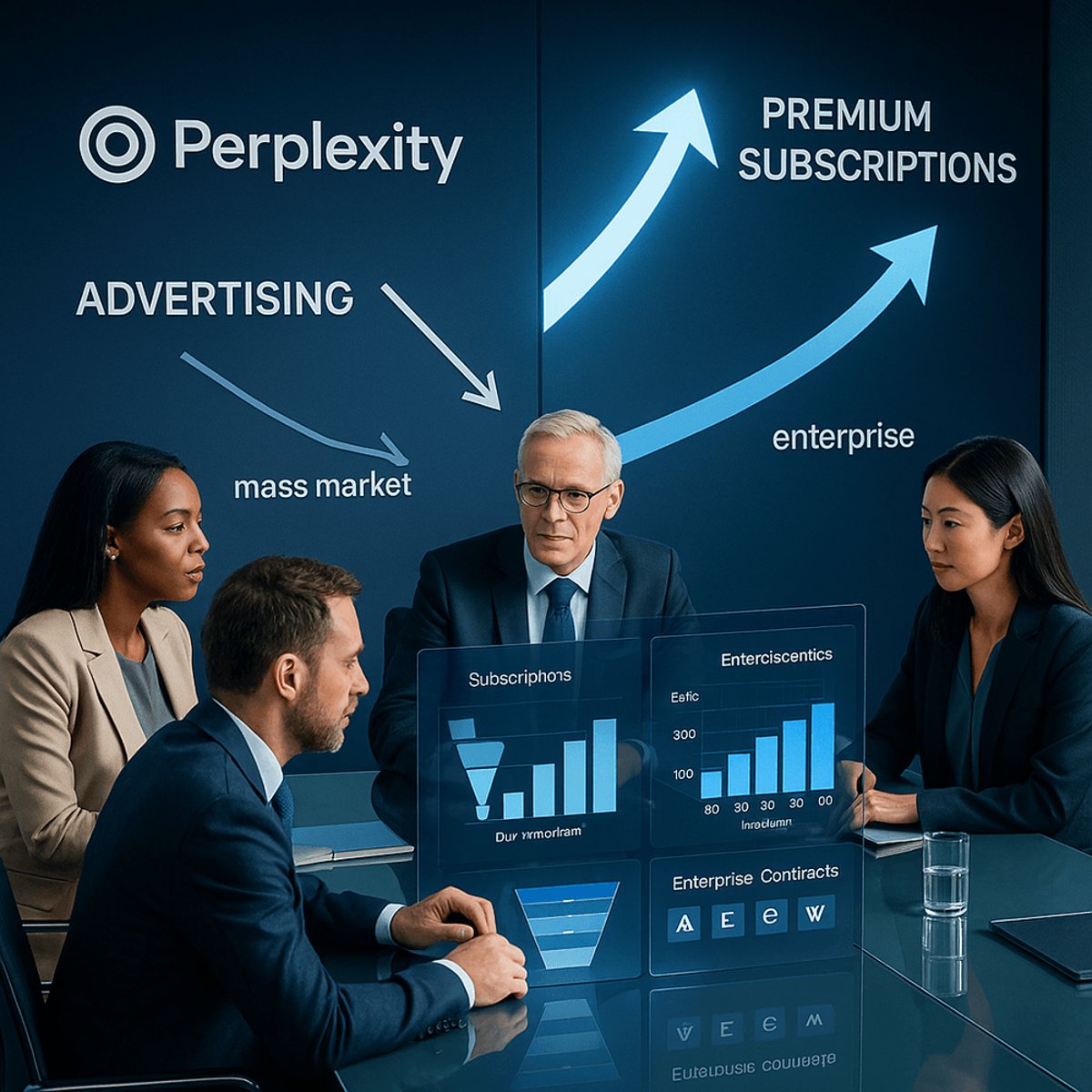
Perplexity is making a dramatic U-turn on its business strategy. The AI search startup, which just months ago touted advertising as its path to massive revenue, is now pulling back from ads entirely to focus on premium subscriptions and enterprise customers. It's a telling admission that competing with Google's ad-driven search model might be harder than Silicon Valley's AI optimists predicted, and signals a broader reckoning about how AI search companies actually make money.
Perplexity just admitted what many in the industry suspected: building an ad business to rival Google isn't as simple as slapping AI onto search results.
The AI search startup is dramatically scaling back its advertising ambitions, pivoting instead toward premium subscriptions and enterprise customers. It's a striking reversal for a company that, less than a year ago, was publicly predicting advertising would become a cornerstone of its revenue strategy. CEO Aravind Srinivas had painted an optimistic picture of sponsored answers and native ad placements generating significant income as query volume scaled.
But something changed. According to sources familiar with the company's internal discussions, advertiser interest didn't materialize at the pace Perplexity anticipated. The startup discovered that brands were hesitant to buy ads in AI-generated answer formats where their messaging might get rewritten, condensed, or worse - attributed incorrectly. Unlike traditional search ads that sit cleanly alongside results, advertising in conversational AI search creates thorny questions about brand safety and message control.
The economics told a sobering story too. While Google commands premium rates because advertisers know exactly what they're buying - placement next to specific search terms with decades of performance data - Perplexity was asking brands to take a leap of faith on an untested ad format. Early experiments reportedly showed click-through rates that couldn't justify the engineering investment required to build out a full ad platform.
"We're focusing on our most engaged users who see the real value in what we're building," a company spokesperson told reporters, though they declined to provide specific subscription numbers or enterprise contract details. Translation: it's easier to charge power users $20 a month than convince CMOs to shift search budgets from Google.
The shift mirrors a pattern emerging across AI startups. OpenAI built ChatGPT Plus subscriptions into a revenue engine before seriously pursuing advertising. Anthropic went straight to enterprise with Claude. Even Microsoft, with all its resources, has struggled to meaningfully dent Google's search ad dominance with Bing's AI features.
Perplexity's new strategy centers on converting free users to a $20 monthly Pro tier and landing enterprise contracts for team deployments. The company is pitching itself as a research tool for professionals rather than a Google replacement for the masses. It's a smaller market, but potentially more defensible. Enterprise customers sign annual contracts, create switching costs, and don't churn at the first algorithm change like ad revenue can.
The timing is notable. This pivot comes as Perplexity faces mounting pressure from investors to demonstrate a clear path to profitability. The company raised funding at a reported $520 million valuation in late 2025, but venture investors want to see recurring revenue models, not theoretical ad businesses that might materialize in three years.
There's also competitive pressure. Google has been aggressively rolling out AI Overviews across search results, leveraging its existing advertiser relationships and massive scale. For Perplexity to compete on advertising would mean going head-to-head with a company that generated over $200 billion in ad revenue last year and has spent two decades perfecting search monetization.
The enterprise angle offers a different battlefield. Companies are actively looking for AI research tools that can be deployed internally, with proper data controls and usage analytics. Perplexity can pitch features like team workspaces, citation tracking, and integration with corporate knowledge bases - things Google Search was never designed to do.
Some industry observers see the move as pragmatic rather than desperate. "They're playing to their strengths," one former Google executive noted. "Perplexity built a product that power users love. Monetizing those users directly is a lot more straightforward than building an ad network from scratch."
But the retreat from advertising also reveals the limits of the AI search revolution that venture capitalists have been betting billions on. If Perplexity, one of the category leaders, can't make search advertising work at scale, what does that mean for the dozens of other AI search startups pursuing similar models?
Perplexity's strategic retreat from advertising is more than one company's pivot - it's a reality check for the entire AI search sector. The path to profitability in AI search looks less like replicating Google's ad empire and more like carving out premium niches with high-value users willing to pay directly. As the AI gold rush continues, expect more startups to follow Perplexity's lead, trading dreams of massive scale for the steadier economics of subscriptions and enterprise contracts. The question now isn't whether AI will disrupt search, but whether that disruption can actually generate the returns investors are expecting.