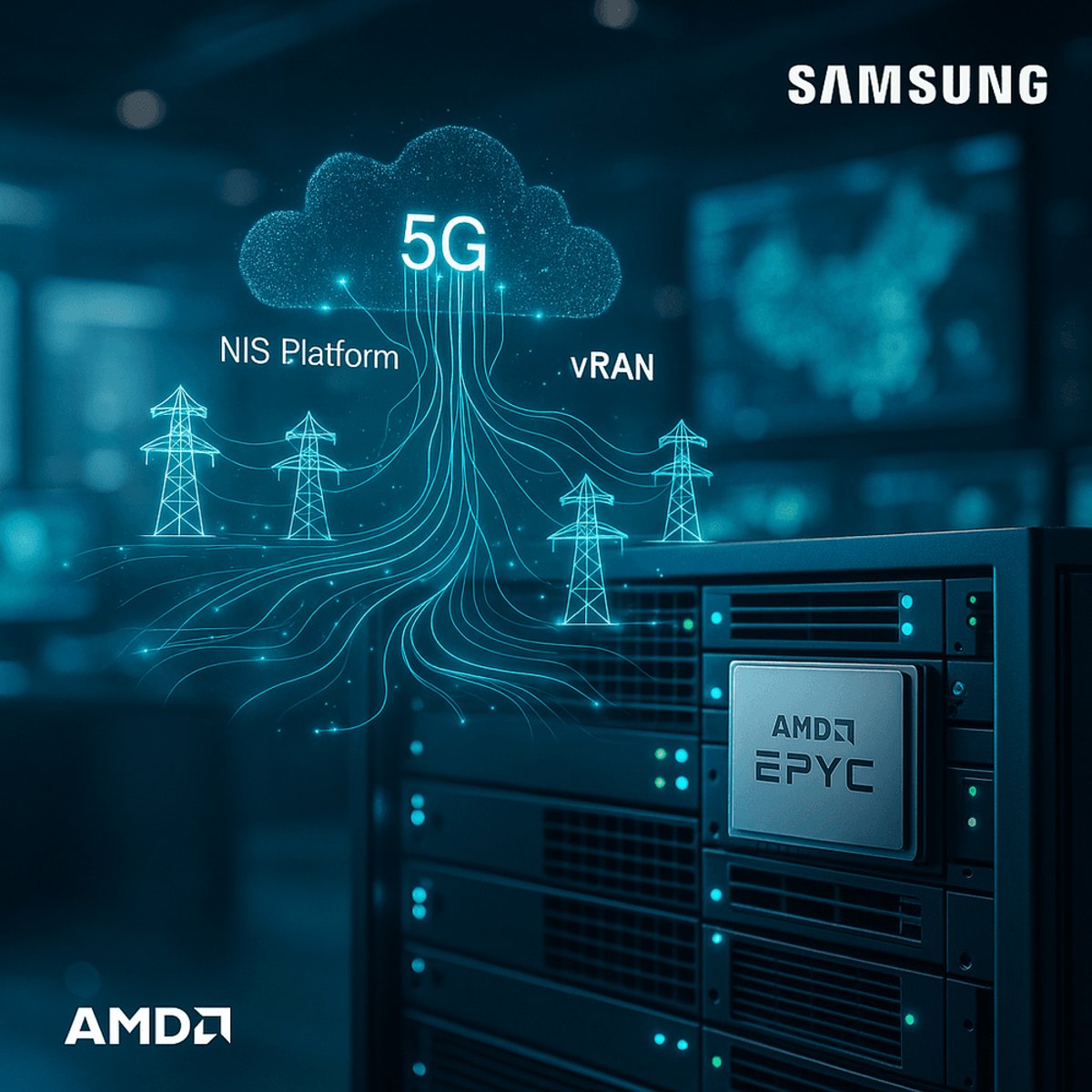
Samsung and AMD are moving their AI-powered network collaboration from lab testing to real-world commercial deployments. Canadian carrier Videotron just selected Samsung to deploy 5G and 4G LTE core gateway solutions running on AMD EPYC 9005 Series CPUs, while the companies prepare to showcase multi-cell AI-RAN breakthroughs at Mobile World Congress 2026. The partnership marks a shift toward software-driven, virtualized network architectures that reduce hardware dependency and give telecom operators more flexibility as they scale AI-native infrastructure.
Samsung and AMD are taking their AI-powered network partnership from verification labs to live commercial networks. The move comes as Samsung secures a deployment deal with Canadian carrier Videotron, which selected the company's 5G Non-Standalone and 4G LTE core gateway solutions running on AMD EPYC 9005 Series processors, according to Samsung's announcement.
The Videotron deployment expands Samsung's presence across Canada and signals growing operator confidence in the company's cloud-native AI core technology. But it's the breakthrough in virtualized RAN that could reshape how telecom operators build next-generation networks.
At Mobile World Congress 2026 in Barcelona, Samsung plans to demonstrate successful multi-cell testing of its AI-powered vRAN running on AMD EPYC processors. The testing, conducted at Samsung's R&D lab, achieved commercial-grade performance using a fully virtualized software stack on the latest AMD CPU - without needing additional accelerators. That's significant because it points to a future where operators can mix and match hardware components rather than being locked into proprietary systems.
"Samsung's accomplishment with AMD emphasizes what's possible when AI-native, open and virtualized architectures meet advanced compute innovations," Keunchul Hwang, Executive Vice President and Head of Technology Strategy Group at Samsung Electronics Networks Business, said in the company statement. "We're making headway to help operators fully scale AI-native networks today with commercial-grade performance and greater infrastructure optionality."
The collaboration builds on last year's validation milestone between the two companies. Moving from single-cell to multi-cell testing represents a critical step toward real-world deployment scenarios where networks must handle multiple simultaneous connections across different coverage areas. Scalable deployments and processor flexibility within software-based environments are what operators need to justify infrastructure investments.
AMD's EPYC processors are designed to handle the compute-intensive demands of modern telecom infrastructure. "Our latest multi-cell vRAN testing with Samsung demonstrates how our latest generation EPYC processors deliver the performance, efficiency and scalability that network operators and enterprises need to build next-generation networks that are ready for AI, automation and future innovations," Derek Dicker, corporate vice president at AMD's Enterprise Business Group, told Samsung.
Beyond carrier-grade 5G deployments, the companies are also pushing into enterprise edge computing. Samsung will showcase its Network in a Server (NIS) platform at MWC - a fully virtualized edge-AI solution powered by AMD CPUs. The system has already been verified in real-world environments with a major Japanese operator, according to the announcement.
The NIS platform enables what Samsung calls "AI on RAN" use cases, including video analysis, sensor and radar detection services based on Integrated Sensing and Communication (ISAC) technology, and hyperconnectivity for next-generation devices. These capabilities let operators turn their network infrastructure into AI-powered platforms that can deliver new services without massive hardware overhauls.
The strategic collaboration reflects broader industry trends toward open, virtualized network architectures. Traditional telecom infrastructure relied on purpose-built hardware from single vendors, creating vendor lock-in and limiting operators' ability to adapt quickly to new technologies. Virtualized RAN and software-defined networking flip that model by separating software from hardware, letting operators choose components from different vendors and update systems through software rather than hardware swaps.
For Samsung, the partnership reinforces its position as a network infrastructure provider with a "robust, technology forward ecosystem of chipset partners." The company provides end-to-end 5G solutions spanning chipsets, radios, cores, and now AI-powered automation tools. Its network solutions currently serve hundreds of millions of users globally through partnerships with mobile operators worldwide.
The timing aligns with growing operator interest in AI-native network architectures. As telecom companies face pressure to monetize 5G investments and prepare for eventual 6G transitions, flexible infrastructure that can adapt to emerging use cases becomes increasingly valuable. AI-powered networks promise improved efficiency through automated optimization, predictive maintenance, and intelligent resource allocation.
What to watch at MWC 2026 is whether other operators follow Videotron's lead in deploying these AI-powered, virtualized network solutions at commercial scale. The technology has moved beyond proof-of-concept demonstrations, but widespread adoption will depend on proving reliability, performance, and cost advantages in live production environments.
The Samsung-AMD partnership signals a meaningful shift in how telecom infrastructure gets built and deployed. By proving that AI-powered virtualized networks can deliver commercial-grade performance on general-purpose processors without proprietary accelerators, the companies are giving operators the flexibility to build adaptable, software-driven networks. The Videotron deployment and upcoming MWC demonstrations will test whether this approach can scale beyond lab environments to become the foundation for AI-native 5G and eventual 6G networks. For an industry historically dominated by vendor lock-in and proprietary systems, that represents a fundamental change in how networks evolve.