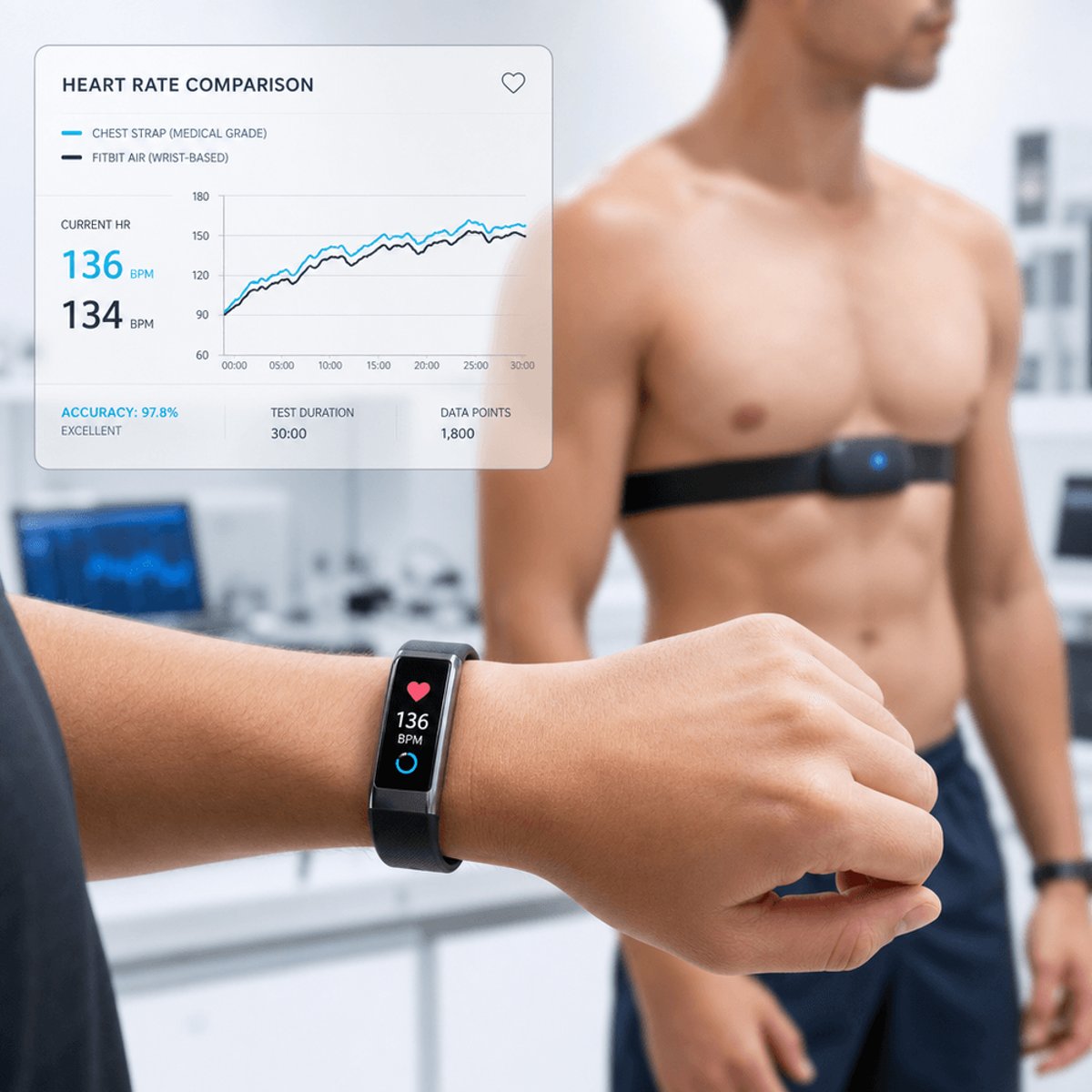
Google's newest wearable just got put through the ringer. A hands-on accuracy test comparing the Fitbit Air against EKG-accurate chest strap monitors revealed surprising gaps in heart rate tracking performance, raising questions about whether optical wrist sensors can truly match medical-grade hardware. For the millions relying on fitness trackers for health insights, the findings matter more than ever as Google pushes deeper into the health tech space.
Google is betting big on wearables, but the latest Fitbit Air just faced a reality check. Independent testing against professional-grade heart rate monitors exposed the persistent gap between consumer fitness trackers and medical equipment, a divide that matters increasingly as people make real health decisions based on wrist-worn data.
The test pitted Google's optical sensor technology against chest strap monitors that deliver EKG-level accuracy, the gold standard for heart rate measurement. While Fitbit has refined its photoplethysmography (PPG) sensors over multiple generations, the fundamental physics of measuring blood flow through skin remains challenging. Movement, skin tone, tattoos, and fit all introduce variables that lab-grade equipment sidesteps entirely.
According to ZDNET's testing methodology, the results surprised even seasoned reviewers. The discrepancies matter because Google positions the Fitbit Air as a serious health companion, not just a step counter. Features like irregular heart rhythm notifications and stress management depend entirely on accurate baseline readings.
The timing is critical for Google. After acquiring Fitbit for $2.1 billion in 2021, the company faces mounting pressure to justify the investment while competing against Apple's increasingly medical-focused Watch lineup and Samsung's Galaxy wearables. Both rivals have poured resources into sensor accuracy, with Apple earning FDA clearance for AFib detection and Samsung partnering with medical institutions for validation studies.
Optical heart rate monitoring works by shining LED light through skin and measuring how much blood absorbs on each pulse. It's elegant technology that enables slim, comfortable wearables, but it can't match the direct electrical signals that chest straps capture. During high-intensity intervals, rapid movement, or activities involving wrist flexion, optical sensors struggle to maintain lock on the pulse signal.
The Fitbit Air represents Google's attempt to close that gap through software and AI-driven signal processing. Machine learning algorithms now filter out noise and compensate for motion artifacts in real-time. But physics still imposes limits that clever code can't entirely overcome, especially during the exact moments when accurate tracking matters most like peak exercise intensity or stress events.
For consumers, the accuracy question isn't academic. People use heart rate data to set training zones, monitor recovery, track calorie burn, and increasingly, spot potential health issues before they become serious. A 10-beat-per-minute error might seem trivial, but it can mean the difference between effective cardio training and wasted effort, or between catching an arrhythmia early versus missing warning signs.
Google hasn't publicly responded to the specific testing results, but the company has historically emphasized that Fitbit devices meet regulatory standards for consumer wellness products. That's a carefully worded distinction. Consumer trackers aren't medical devices and don't claim diagnostic accuracy, even as marketing materials highlight health benefits and clinical-sounding features.
The wearables industry faces a broader credibility challenge. As devices add more health sensors, from blood oxygen to skin temperature to ECG, users assume medical-grade reliability. But regulatory pathways, validation requirements, and accuracy standards remain murky for features that straddle the line between fitness tracking and health monitoring.
Competitors aren't standing still. Apple recently expanded its research partnerships to validate Watch sensors against hospital equipment, while Samsung added bioelectrical impedance analysis for body composition tracking. Google's response with the Fitbit Air suggests the company recognizes that sensor accuracy has become a key differentiator, not just a spec sheet footnote.
What happens next likely depends on whether casual users notice the discrepancies. Most won't have access to EKG-accurate reference devices for comparison. But serious athletes, health-conscious consumers, and anyone relying on wearables for medical insights deserve to know the limitations of the technology strapped to their wrist.
The Fitbit Air accuracy test reveals what the industry already knows but rarely admits: consumer wearables still can't match medical-grade monitoring, especially when it matters most. For Google, that's both a technical challenge and a market positioning problem as competitors race toward clinical validation. Users don't need perfect accuracy for counting steps, but as wearables become health guardians, the gap between marketing promises and sensor reality grows harder to ignore. The question isn't whether optical sensors will improve, but whether that improvement comes fast enough to match the health claims already on the box.