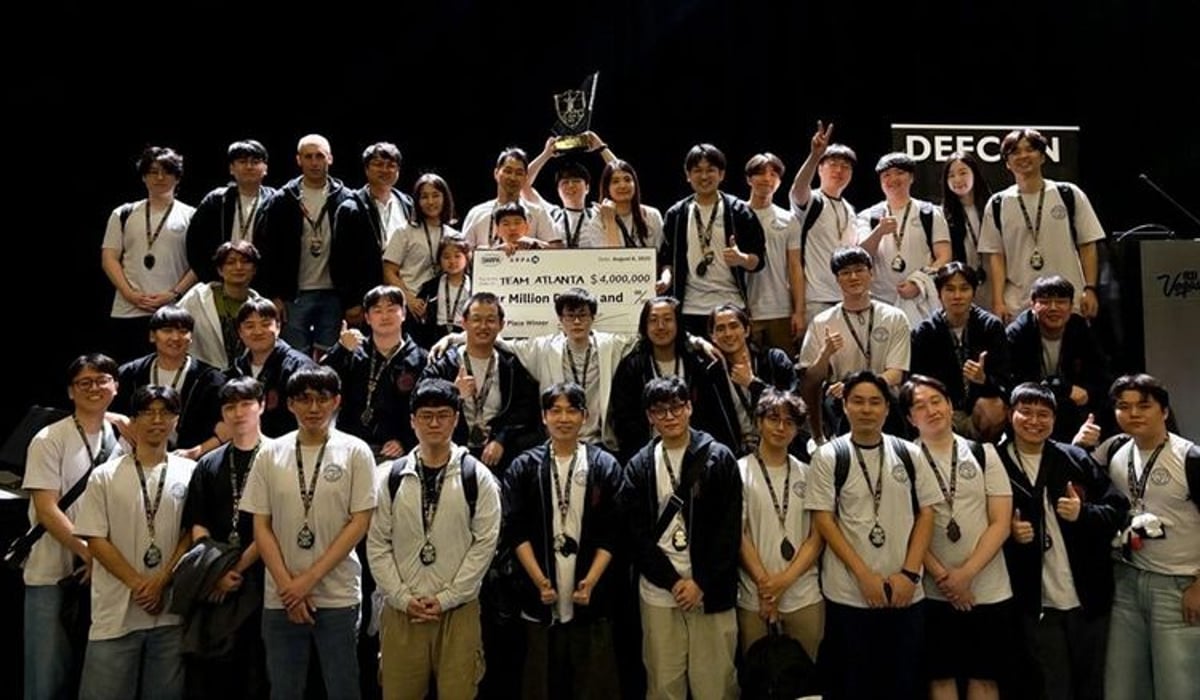
Samsung Research just pulled off the biggest win in cybersecurity. Team Atlanta, led by Samsung researchers, claimed the $4 million first prize at DARPA's AI Cyber Challenge in Las Vegas, beating global competitors with breakthrough AI agents that autonomously detect and patch software vulnerabilities. This victory positions Samsung as the definitive leader in AI-powered security.
The silence in Las Vegas on August 8 was deafening until Team Atlanta's logo flashed across the screen, triggering thunderous applause that marked the end of a two-year odyssey. Samsung Research had just claimed the crown in cybersecurity's most prestigious competition, walking away with $4 million and global recognition for breakthrough AI security technology.
The win delivers immediate validation for Samsung's AI strategy beyond consumer devices. "Samsung's AI security technologies are already being applied to strengthen the protection of products and services, including Galaxy devices and AI TVs," Samsung Corporate Vice President Taesoo Kim told reporters after the victory. The implications extend far beyond Samsung's ecosystem into enterprise security markets where autonomous threat detection is becoming critical infrastructure.
Team Atlanta's 40-member coalition spanning Samsung Research, Georgia Institute of Technology, KAIST, and POSTECH had systematically outmaneuvered competitors through superior AI architecture. The DARPA AI Cyber Challenge tested teams' ability to build "Cyber Reasoning Systems" capable of autonomously identifying software vulnerabilities and generating patches without human intervention – essentially creating AI security guards for critical infrastructure.
"Team members each developed their agents in various ways, and by bringing them together, we were able to build a system capable of covering a wide range of weaknesses," explained Joonun Jang from Samsung Research's Security & Privacy Team, who led development of the large language model agent for detecting vulnerabilities in Java programs. The modular approach allowed Team Atlanta to cast a wider net than competitors using monolithic systems.
The competition's scoring mechanism rewarded both speed and accuracy: teams earned discovery points for identifying vulnerabilities and repair points for successfully patching them. Team Atlanta dominated both categories, uncovering more vulnerabilities while maintaining superior patch accuracy. This dual excellence reflects Samsung's broader AI philosophy of combining detection capabilities with automated remediation.
Yunjae Choi from Samsung's AI Productivity Team faced perhaps the most challenging technical challenge: creating AI agents flexible enough to patch previously unknown vulnerabilities. "Since AI was a common tool provided to all participants, true technological excellence lay in how effectively we could harness it," Choi noted. The key breakthrough involved developing adaptive AI agents that could respond to novel threat patterns in real-time.
The competition's $22.5 million total prize pool, sponsored by Google, Microsoft, and OpenAI, underscored the strategic importance of autonomous cybersecurity. Critical infrastructure across transportation, energy, and healthcare sectors increasingly depends on software systems that traditional security approaches can't adequately protect at scale.
Kim's leadership proved crucial in assembling the international team. As both Samsung Corporate Vice President and Georgia Institute of Technology professor, he recruited former Ph.D. students to form Team Atlanta's core. "Because our members came from such diverse locations, we structured our collaboration framework around each member's base," Kim recalled. Some Korean team members traveled to Georgia Tech for intensive collaboration sessions.
The final moments tested nerves as much as technology. When third and second place were announced without Team Atlanta's name, tension peaked. "Given how many outstanding teams were competing, I thought that even placing in the top three would have been a great achievement," Jang admitted. When their victory was confirmed, "it was as if the whole team had suddenly found ourselves in the middle of a festival," Choi reflected.
Behind the celebration lay months of grinding technical work punctuated by crisis moments. Kim revealed that just before the final submission deadline, the team discovered a critical system bug that threatened their entire effort. "We worked frantically until the very last minute. I even had to wake the entire team up at 5 a.m. to fix the problem," he said.
The victory positions Samsung strategically as enterprises accelerate AI security adoption. While competitors focus primarily on consumer AI applications, Samsung's deep investment in security AI creates differentiation across both consumer and enterprise markets. The technology developed for the competition will likely appear in Samsung's enterprise security offerings and strengthen protection for Galaxy devices facing increasingly sophisticated threats.
Looking ahead, Samsung plans to leverage this victory for broader AI security leadership. "Through continued open-source contributions and active community engagement, we aim to solidify our position as a global leader in AI security," Kim emphasized. This approach could accelerate industry adoption of autonomous security technologies while establishing Samsung as the go-to partner for enterprise AI security deployments.
Samsung's DARPA victory signals a fundamental shift in how enterprises will approach cybersecurity. While competitors chase consumer AI applications, Samsung has quietly built the autonomous security infrastructure that will protect tomorrow's digital economy. This $4 million win is just the beginning – Samsung now holds the technological keys to the next generation of AI-powered security, positioning the company to capture significant enterprise market share as organizations realize human-scale security simply can't keep pace with AI-scale threats.