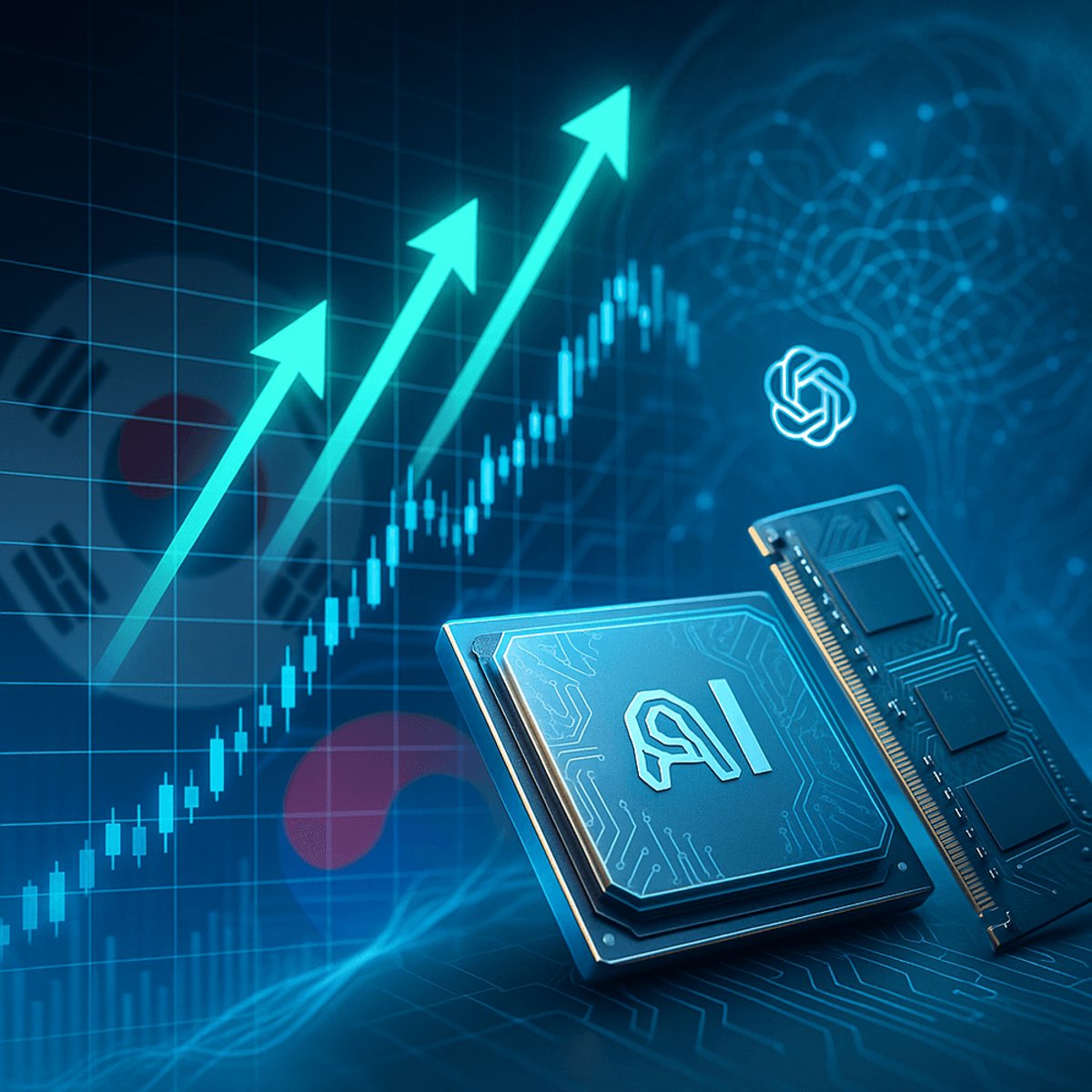
OpenAI just sent Korean chipmaker stocks into hyperdrive. SK Hynix rocketed over 9% to levels not seen since 2000, while Samsung hit its highest mark since January 2021 after both companies inked a partnership with the ChatGPT maker to massively scale AI memory chip production under OpenAI's Stargate initiative.
The AI gold rush just got very real for Korean semiconductor giants. SK Hynix and Samsung are riding a massive wave after announcing their partnership with OpenAI under the company's ambitious Stargate infrastructure project.
SK Hynix absolutely exploded on Seoul exchanges, jumping more than 9% to hit levels not seen since the dot-com boom of 2000. Meanwhile, Samsung climbed over 4% to reach its highest point since January 2021, when the entire tech sector was hitting pandemic-era peaks.
The timing couldn't be better for these Korean powerhouses. OpenAI CEO Sam Altman was in Seoul meeting with South Korean President Lee Jae Myung and the top brass at both chip companies, cementing what could be one of the most significant AI infrastructure deals of the year.
"This partnership will focus on increasing the supply of advanced memory chips essential for next-generation AI and expanding data center capacity in Korea," OpenAI said in its official statement. Translation: the ChatGPT maker needs a lot more horsepower to keep up with explosive demand for its AI models.
The real story here is high-bandwidth memory (HBM) chips - the specialized memory components that make modern AI computing possible. These aren't your average computer chips. HBM technology is what powers Nvidia's cutting-edge AI processors, and both Korean companies are racing to dominate this critical market.
SK Hynix has already claimed the early lead. Earlier this month, the company announced it was ready to mass-produce its next-generation HBM4 chips, positioning itself as the go-to supplier for Nvidia's upcoming Rubin architecture - the next evolution of AI processors designed for global data centers.
The competitive dynamics are fascinating. SK Hynix has been Nvidia's primary HBM supplier, giving it a massive head start in the AI boom. But Samsung isn't sitting idle - the company has reportedly been working overtime to get its own HBM4 chips certified by Nvidia, according to Business Korea.
This OpenAI partnership could be the catalyst that helps Samsung break into the AI memory market more aggressively. The company's stock surge suggests investors believe this deal gives Samsung a direct path to the AI infrastructure boom, regardless of Nvidia certification timing.
The broader implications are massive. OpenAI's Stargate initiative represents a fundamental shift in how AI companies think about infrastructure. Instead of relying solely on cloud providers or existing data centers, OpenAI is building its own massive computing infrastructure - and it needs Korean chip expertise to make it happen.
For Korea's semiconductor industry, this partnership validates years of heavy investment in advanced memory technology. Both companies have poured billions into HBM development, betting that AI would create unprecedented demand for specialized memory chips. That bet is now paying off in spectacular fashion.
Investors are clearly buying into the long-term AI story. SK Hynix's jump to 25-year highs shows just how much confidence the market has in the company's AI-focused strategy. The fact that Samsung is also surging despite being the number-two player in HBM suggests there's room for multiple winners in this exploding market.
The OpenAI partnership marks a pivotal moment for Korean chipmakers, validating their massive bets on AI infrastructure. With SK Hynix hitting 25-year highs and Samsung reaching 2021 peaks, investors are betting that Korean semiconductor expertise will be essential to power the next wave of AI development. As OpenAI builds out its Stargate infrastructure, these partnerships could reshape the global AI supply chain and cement Korea's position as the memory chip capital of the AI economy.