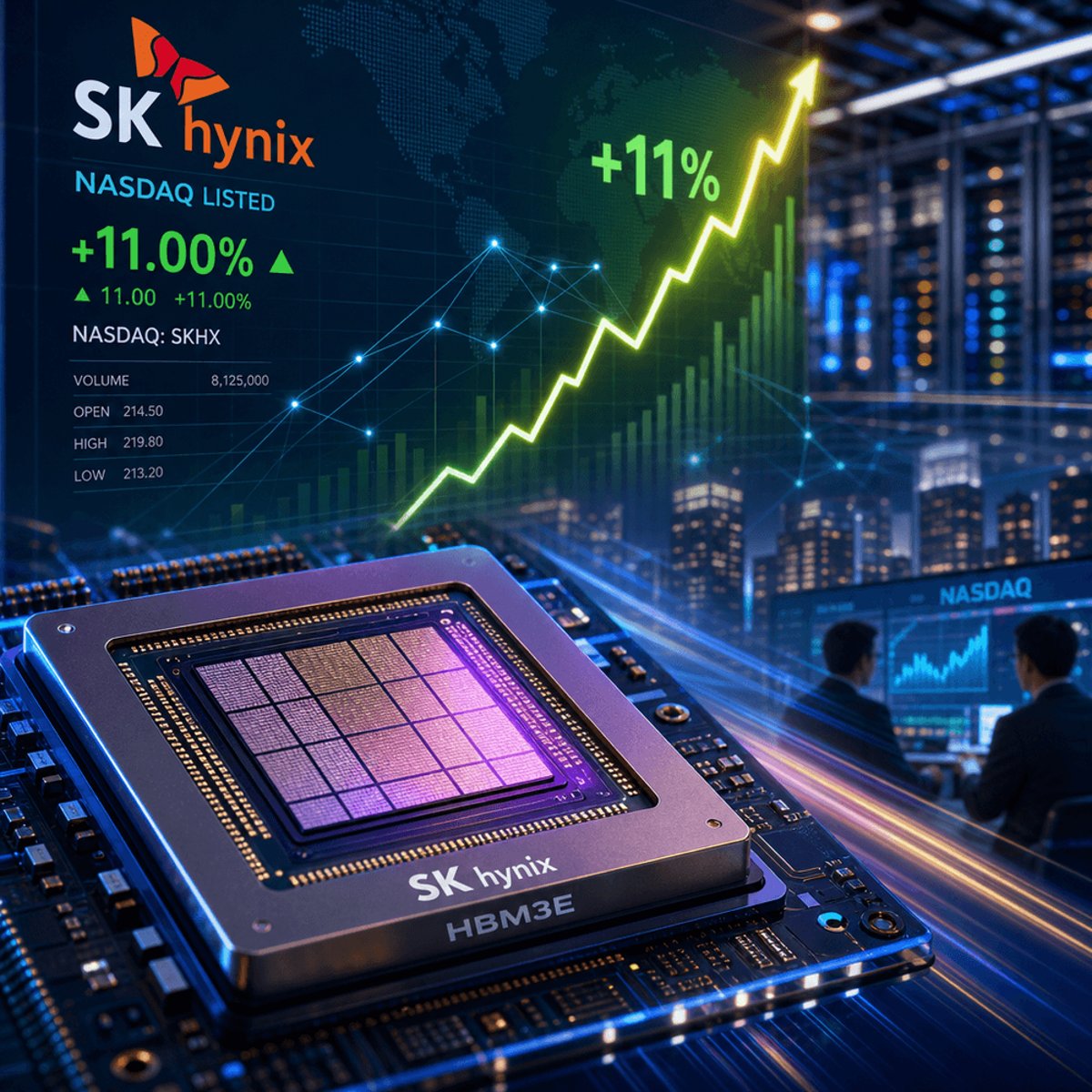
SK Hynix just sent shockwaves through the semiconductor market. The South Korean memory chip giant's shares rocketed 11% Thursday morning after filing for what could become one of the largest tech listings in Nasdaq history - a $29.4 billion capital raise that signals how serious the AI infrastructure arms race has become. The market's reaction isn't just about the money. It's validation that investors are willing to bet billions on the picks-and-shovels suppliers powering the AI boom, even as concerns about chip oversupply continue to swirl.
SK Hynix is making its boldest move yet in the AI chip wars, and Wall Street is eating it up. The company's shares jumped 11% in Thursday trading after it filed paperwork for a Nasdaq American Depositary Receipt listing that could raise up to $29.4 billion - a figure that would rank among the largest tech capital raises of the decade.
The timing isn't coincidental. SK Hynix has emerged as the critical supplier of high-bandwidth memory chips that power Nvidia's AI accelerators, and demand has been nothing short of explosive. According to CNBC's reporting, the company is capitalizing on its position as the dominant HBM provider at exactly the moment when AI infrastructure spending shows no signs of slowing.
The stock surge reflects something deeper than typical IPO excitement. Investors are essentially placing a massive bet that the AI buildout isn't a bubble but a genuine infrastructure transformation. SK Hynix's HBM3E chips have become as essential to AI training as GPUs themselves, creating what analysts call a "structural demand advantage" that could last years.
What makes this particularly interesting is the competitive landscape. While rivals like Samsung and Micron scramble to ramp up their own HBM production, SK Hynix maintains a commanding lead in both capacity and technical specifications. The company's HBM3E chips deliver bandwidth speeds that current alternatives can't match, giving it pricing power that's rare in the typically commoditized memory market.
The $29.4 billion war chest will likely fund an aggressive expansion of fabrication capacity. SK Hynix has been running its HBM production lines at maximum capacity for months, with lead times stretching into 2027 for some customers. Industry sources suggest the company is already in negotiations for new fab equipment orders that would double its HBM output by late 2027.
But there's a strategic dimension beyond just capacity expansion. By listing on Nasdaq, SK Hynix gains direct access to U.S. capital markets at a moment when American investors are hungry for AI infrastructure exposure. The company is essentially positioning itself as the safe, scalable way to bet on AI without the valuation concerns surrounding GPU makers or the execution risks of AI software startups.
The market reaction also tells us something about investor sentiment toward semiconductor capital intensity. Despite ongoing concerns about chip oversupply in legacy nodes, traders are clearly distinguishing between commodity chips and specialized AI components. SK Hynix's surge suggests investors believe HBM is in a different category entirely - one where supply constraints could persist for years.
What's notable is how this contrasts with broader semiconductor market anxiety. While chip stocks have faced pressure over inventory concerns and slowing PC demand, SK Hynix is moving in the opposite direction. The 11% single-day gain on a company of this size reflects genuine conviction that AI memory is insulated from broader industry cycles.
The filing comes at an interesting moment in the AI infrastructure buildout. Cloud giants like Microsoft, Google, and Amazon are collectively spending over $200 billion annually on data center expansion, much of it focused on AI training clusters. Each of those clusters requires thousands of GPUs, and each GPU needs multiple HBM modules. Do the math, and SK Hynix's growth runway starts to make sense.
There are risks, of course. HBM production is notoriously complex, with yields that can swing wildly based on minor process variations. Any stumble in execution could hand market share to Samsung, which is aggressively courting Nvidia and other GPU makers. And if AI demand does cool - a big if, but possible - SK Hynix could find itself with expensive overcapacity.
But for now, the market is betting those risks are manageable. The 11% pop suggests institutional investors see this as a rare opportunity to invest in proven AI infrastructure at scale. Unlike speculative AI software plays, SK Hynix offers actual revenue, actual products shipping today, and actual contracts extending years into the future.
SK Hynix's explosive market reaction reveals how dramatically the semiconductor landscape has shifted. This isn't just another chip company going public - it's a bet that AI infrastructure demand has fundamentally changed the economics of memory production. The $29.4 billion filing gives SK Hynix the ammunition to cement its HBM leadership before competitors catch up, while the 11% stock surge shows investors are willing to pay up for companies with proven exposure to AI's infrastructure layer. Whether this marks peak enthusiasm or the early innings of a multi-year buildout will depend on whether cloud giants keep their AI spending pedal to the floor. For now, SK Hynix is riding the wave.